原水供应

Search documents
中国光大水务(01857.HK)年度纯利跌17%至8.42亿港元 末期息每股4.22港仙
Ge Long Hui· 2026-02-27 04:28
Group 1 - The core viewpoint of the article highlights that China Everbright Water (01857.HK) reported a decline in annual performance for the fiscal year ending December 31, 2025, with revenue of HKD 5.355 billion, a decrease of 22% compared to the previous year [1] - The company's earnings before interest, taxes, depreciation, and amortization (EBITDA) were HKD 1.935 billion, down 12% year-on-year [1] - Profit attributable to equity holders was HKD 842 million, a 17% decrease from the prior year, with basic earnings per share at HKD 0.2945 and a final dividend of HKD 0.0422 per share [1] Group 2 - As of December 31, 2025, the group invested in and held 172 environmental projects with a total investment of approximately RMB 31.85 billion, and also undertook various light asset projects and services [1] - The company's operations span over 60 districts and counties across 13 provinces, autonomous regions, and municipalities in China, with international business presence in countries like Mauritius [1] - The company has 12 solar power generation projects operational, with a total installed capacity of approximately 20 megawatts, providing an average annual electricity output of about 20 million kilowatt-hours [1] Group 3 - During the fiscal year, the group commenced construction on 4 new projects with a designed daily water treatment and supply capacity of 54,000 cubic meters [2] - Additionally, 9 projects were completed and put into operation, with a designed daily water treatment and supply capacity of 835,000 cubic meters and a designed daily sludge treatment capacity of 125 tons [2]
珠海关键供水枢纽平岗泵站二期通水 大幅提升咸潮期城市“抢淡压咸”能力
Nan Fang Ri Bao Wang Luo Ban· 2026-01-13 09:06
Group 1 - The Pinggang Pump Station Phase II has commenced operation, significantly enhancing the water intake capacity to 3.6 million tons per day, which improves Zhuhai's ability to combat saline intrusion during dry periods [1] - The upgraded pump station allows for a three-day water supply from a single day's extraction, thereby increasing the reservoir's water source during critical times [1] - The establishment of a dual-core water intake system with the Pinggang and Zhuzhoutou pump stations creates a more stable and reliable water supply network for Zhuhai and Macau [1] Group 2 - Since 1960, Zhuhai has been responsible for supplying water to Macau, currently providing approximately 100 million cubic meters annually, which accounts for about 98% of Macau's actual water usage [2] - Since Macau's return to China, Zhuhai has supplied a total of 2.1 billion cubic meters of water, tripling the amount supplied before the return [2] - Future efforts will focus on "collaboration, construction, and operation" to ensure water supply safety and enhance strategic capabilities in the region [2]
珠澳“供水心脏”扩容2.6倍,抢淡蓄库能力实现历史性跨越
Nan Fang Du Shi Bao· 2026-01-13 01:31
Core Upgrade and Historical Expansion of Water Supply - The Pinggang Pump Station, a critical hub for the water supply system between Zhuhai and Macau, has increased its water extraction capacity from 1.4 million cubic meters per day to 3.6 million cubic meters per day, representing a 2.6-fold increase [1][2] - This expansion addresses the growing demand for water resources due to periodic saline tides and unexpected water pollution risks, which have put pressure on water security in the region [2] Technical and Safety Enhancements - The second phase of the Pinggang Pump Station introduces three unique technical and safety measures, creating a robust water security barrier for the Greater Bay Area [3] - The first measure is a pre-treatment system that includes a powdered activated carbon injection system and sodium hypochlorite injection system, which helps reduce harmful substances in the water [3] - The second measure involves a high redundancy and flexible scheduling system with 12 water pumps, ensuring that overall water extraction capacity remains unaffected even during maintenance [3] - The third measure integrates the project into a larger framework of interconnected water sources, enhancing the resilience of the water supply system [3][4] Strategic Location and Economic Feasibility - The decision to expand at Pinggang rather than upstream at Zhuzhoutou was based on economic and practical considerations, as Pinggang offers better infrastructure and faster implementation [5] - The existing infrastructure at Pinggang allows for a more efficient water supply network, with the ability to transport 2 million cubic meters per day to downstream facilities [5] Long-term Water Supply Commitment - Since the establishment of the water supply to Macau, Zhuhai has provided a total of 2.1 billion cubic meters of water to Macau in the past 26 years, which is three times the amount supplied in the previous 40 years [5] - The Pinggang Pump Station's second phase enhances the stability and reliability of water supply, supporting the long-term prosperity and stability of Macau and deepening cooperation between Zhuhai and Macau [6]
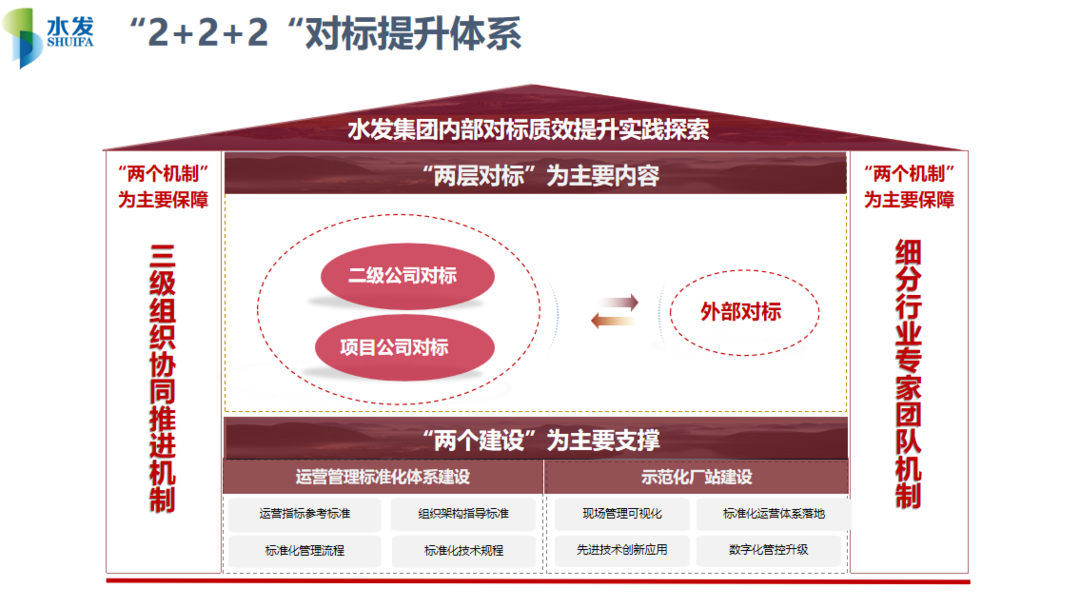
以标准化体系培育内涵式增长新动力,水发集团对标一流靶向发力新路径
Da Zhong Ri Bao· 2025-11-14 03:23
Core Viewpoint - The implementation of benchmarking against world-class enterprises is a crucial measure for advancing state-owned enterprise (SOE) reform and enhancing efficiency and development [1][3] Group 1: Benchmarking Implementation - The benchmarking initiative aims to address the disparity in performance among SOEs, as many exhibit strong asset totals and revenue but lack competitive profitability compared to industry leaders [3][4] - Water Development Group has established a "2+2+2" operational management benchmarking system, focusing on internal and external benchmarking to enhance performance in various sectors such as water supply, wastewater treatment, and renewable energy [2][5] Group 2: Challenges in Benchmarking - A common issue faced by SOEs is the difficulty in finding comparable external benchmarks due to differing development stages and operational contexts, leading to ineffective benchmarking practices [4][5] - Previous benchmarking efforts often focused on external comparisons, which did not yield actionable insights due to the unique circumstances of each enterprise [4][5] Group 3: Benchmarking System Features - The "2+2+2" system includes two levels of benchmarking (secondary companies and project companies), supported by standardized operational management and demonstration facilities [5][8] - The internal benchmarking indicators include return on net assets, income profit margin, gross profit margin, and direct operating costs, evaluated dynamically to encourage continuous improvement [8][9] Group 4: Performance Improvements - Water Development Group reported significant reductions in operational costs across various sectors, with specific decreases in unit costs for water supply, heating, and renewable energy [12][14] - The profitability of Water Development Group's subsidiaries has improved, with notable increases in profit and cash flow, indicating the effectiveness of the benchmarking system [14][15] Group 5: Future Directions - The company plans to maintain a focus on internal benchmarking while enhancing the conversion of external benchmarking experiences into actionable strategies for continuous improvement [16]