
喷雾器

Search documents
AGCO (NYSE:AGCO) FY Conference Transcript
2026-03-02 15:52
AGCO FY Conference Summary Company Overview - AGCO is a 35-year-old company and the largest pure play agricultural company in the industry, generating over $10 billion in agricultural revenue last year [3][4] - The company markets its equipment under three primary brands: Fendt (premium), Valtra, and Massey Ferguson [3] Financial Performance - AGCO achieved an operating margin of approximately 7.7%, which is nearly double the last time it was at a similar point in the cycle [4] - The company aims for a mid-cycle operating margin of 14%-15% by 2029, driven by portfolio changes, cost-saving initiatives, and growth in key segments [6][55] Growth Strategies - **Fendt Brand Expansion**: AGCO is focusing on growing the Fendt brand in North and South America, with significant market share growth in North America last year [5][10] - **Technology Portfolio**: The PTx technology portfolio, including a joint venture with Trimble, generated around $860 million in revenue last year, with expectations to grow to $2 billion by 2029 [5][6] - **Parts Business**: The parts business is projected to grow from $1.9 billion to $2.3 billion by 2029 [6] Regional Insights - **Europe**: Accounts for about 60% of AGCO's business, with a stable market and mid-teens margins. The Fendt brand has a strong presence in Western Europe [9][10] - **North America**: Seen as a significant growth opportunity, with AGCO's market share in large agriculture being the lowest among the three regions. The company experienced its largest market share growth in North America last year [14][15] - **South America**: Currently facing challenges due to low commodity prices and trade uncertainties, but long-term growth potential exists, especially for the Fendt brand in the Cerrado region of Brazil [12][13][41] Competitive Positioning - AGCO's competitive advantage lies in its strong brand presence, particularly in Europe, and its innovative technology offerings, such as the FarmerCore service model, which enhances service delivery and reduces costs for dealers [17][24] - The company is focused on providing better fuel efficiency and warranty offerings, which are appealing to farmers looking to minimize costs [15][19] Market Conditions - The North American agricultural market is expected to be challenging in 2026, with a projected decline of around 15%. However, there are signs of stabilization, with improved dealer inventories and pricing [28][29] - In Brazil, AGCO anticipates a flat market in 2026, contingent on potential government stimulus during the election year [41][42] Cost Management - AGCO is implementing significant cost-saving measures, targeting $175 million-$200 million in savings by the end of 2026, primarily through restructuring and offshoring [62][63] - The company expects to offset inflationary costs and tariffs through a pricing strategy of 2%-3% [69][72] Innovation and Technology - AGCO is focusing on technology advancements, particularly in precision agriculture, to differentiate itself from competitors. The retrofit channel allows farmers to adopt new technologies at a lower cost [81][84] - The introduction of new products, such as targeted spraying applications, is aimed at improving farmer productivity and reducing input costs [82][83] Conclusion - AGCO is positioned for growth through strategic brand expansion, technological innovation, and cost management, despite facing challenges in certain markets. The company remains optimistic about its long-term prospects, particularly in North America and South America.

商贸双城记——义乌的“世界坐标”与临沂的“中国流量”
Qi Lu Wan Bao· 2025-12-02 06:25
Core Insights - The article discusses the similarities and differences between Yiwu and Linyi, two major commodity trading cities in China, highlighting Linyi's recent efforts to internationalize its market by learning from Yiwu's experience [1][2]. Group 1: Market Development - Yiwu and Linyi have both evolved from street vendors to significant commercial hubs over the past 40 years, establishing themselves as key trading landmarks in China [1]. - Linyi has a robust market structure with 136 specialized wholesale markets, 63,700 shops, and 460,000 business entities, employing around 1 million people in trade and logistics [6]. - Yiwu's international trade capabilities are highlighted by its large-scale international market, where a single visit could take over a year to explore all stalls if spending three minutes at each [7]. Group 2: Business Opportunities - The article illustrates individual success stories, such as a young entrepreneur from Linyi who has expanded his business internationally, operating hotels and a mattress factory abroad [2]. - Yiwu attracts a significant number of foreign merchants, with over 20,000 foreign traders residing there, indicating its appeal as a multicultural trading hub [3]. - Linyi's products, particularly in the spray equipment sector, are widely used in Africa, showcasing the potential for international market expansion [10]. Group 3: Learning and Adaptation - Linyi's government is actively seeking to learn from Yiwu's successful internationalization strategies, with recent visits by officials to study Yiwu's market practices [10]. - The city aims to enhance its foreign trade capabilities by improving logistics, international trade services, and fostering a culture of entrepreneurship among local businesses [11]. - Linyi has organized numerous overseas exhibitions to encourage local businesses to explore international markets, with 200 events held in 39 countries in the first nine months of the year [11].
前三季度已破4万亿!浙江外贸,更强在结构
2 1 Shi Ji Jing Ji Bao Dao· 2025-10-17 11:47
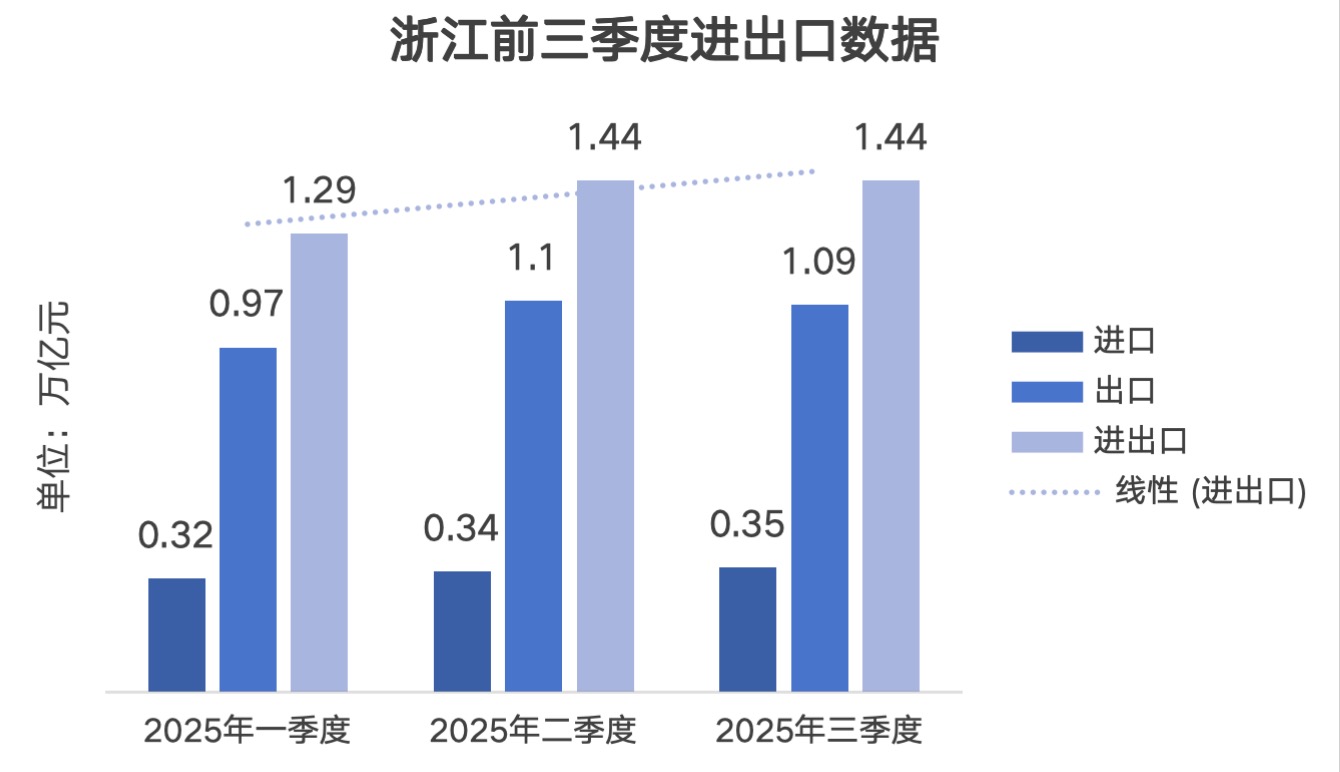
Core Insights - Zhejiang's foreign trade in the first three quarters reached a total value of 4.17 trillion yuan, marking a year-on-year growth of 6.2%, with exports at 3.16 trillion yuan and imports at 1.01 trillion yuan, reflecting historical highs for the same period [4][6] - The growth momentum of Zhejiang's foreign trade is shifting from price-driven to structural optimization and innovation-led, demonstrating resilience amid a complex global economic environment [4][6] Trade Performance - The number of foreign trade enterprises in Zhejiang exceeded 120,000, with private enterprises accounting for 11.2 million, contributing 96.6% to export growth [5][6] - Foreign-funded enterprises also showed stable performance, with a total import and export value of 513.43 billion yuan, growing by 3.5% year-on-year [7] Market Diversification - Zhejiang's export market structure is diversifying, with exports to ASEAN growing by 16.8%, surpassing the U.S. to become the second-largest export market [7] - Exports to the EU reached 559.8 billion yuan, increasing by 10.4%, while exports to countries along the "Belt and Road" totaled 1.75 trillion yuan, up 13.5% [7] Product Structure Optimization - The export structure is continuously optimizing, with mechanical and labor-intensive products exporting 1.48 trillion yuan and 930 billion yuan respectively, showing growth of 9.8% and 4.8% [11] - High-value-added products, including high-tech products, are also on the rise, with exports of high-tech products reaching 199.92 billion yuan, growing by 8.7% [12] Innovation and Technology Adoption - Private enterprises in Zhejiang are accelerating their digital trade transformation, utilizing data platforms and AI for market analysis and product optimization [6] - The export of "new three samples" (electric vehicles, lithium batteries, and solar cells) reached 96.38 billion yuan, growing by 19.7%, contributing 6.6% to the overall export increase [11]

组建超1.4万人专业消杀队伍 江门基孔肯雅热疫情快速上升势头得到遏制
Nan Fang Ri Bao Wang Luo Ban· 2025-09-29 08:00
Core Insights - The epidemic situation of Chikungunya in Jiangmen has shown initial signs of control, with daily new cases decreasing from 574 on September 20 to 455 on September 27 [1] - The local government has implemented a level III public health emergency response, focusing on controlling the increase of cases, clearing existing cases, and preventing further spread [1] Group 1: Healthcare Response - Jiangmen has over 5,000 hospital beds reserved for patient treatment, ensuring proximity to medical services and maximizing patient admissions [1] - A total of 4,029 patients have been discharged as of September 27, with specialized care provided for vulnerable groups such as the elderly and children [1] Group 2: Public Health Initiatives - A patriotic health campaign has been launched, with various government levels and sectors taking responsibility for epidemic prevention [1] - Specific action plans have been developed for 17 key locations, including schools and construction sites, to enhance sanitation and hygiene [1] Group 3: Vector Control Measures - Jiangmen has adopted a dual strategy of "killing adult mosquitoes + eliminating breeding sites," with over 14,000 professionals and 22,000 sprayers deployed for comprehensive training and coverage [2] - The city has established a rapid response mechanism for complaints regarding mosquito breeding sites, ensuring timely action on reported issues [2] Group 4: Community Engagement - Citizens are encouraged to actively participate in mosquito control efforts by cleaning up stagnant water and conducting household sanitation [2] - The campaign emphasizes individual responsibility for personal health and collective efforts to combat the epidemic [2]
国产农机产品卖全球!山东今年前8个月农机出口货值同比增长近四成
Sou Hu Cai Jing· 2025-09-27 08:19
Group 1 - Shandong has seen a significant increase in agricultural machinery production and exports in 2023, with a notable rise in port shipment volume and export value [1] - From January to August, the export value of agricultural machinery from Shandong reached 7.6 billion yuan, marking a 100% year-on-year increase [2] - The total number of agricultural machinery exported from Shandong ports during the same period was 8.46 million units, representing a 129.27% year-on-year growth, with a total value exceeding 7.3 billion yuan, up 39.67% [2] Group 2 - The main products exported include sprayers, poultry farming machinery, and lawn mowers, with exports reaching countries such as the United States, Indonesia, India, and Brazil [4] - Shandong Qingdao Port has expanded its shipping routes, adding 14 new container foreign trade routes, covering emerging markets in Southeast Asia and South America [4] - Currently, the Qingdao Port has over 230 container shipping routes, reaching more than 180 countries and regions, and connecting over 700 ports, facilitating a new model of sea-rail intermodal transport [7]
John Deere(DE) - 2025 Q3 - Earnings Call Transcript
2025-08-14 15:00
Financial Data and Key Metrics Changes - Net sales and revenues decreased by 9% to DKK 12.018 billion, with equipment operations net sales also down by 9% to DKK 10.357 billion [9] - Net income attributable to Deere & Company was €1.289 billion, or $4.75 per diluted share [9] - Operating margin for equipment operations was reported at 12.6% [5] Business Segment Data and Key Metrics Changes - **Production and Precision Ag**: Net sales decreased by 16% year over year to €4.273 billion, primarily due to lower shipment volumes and unfavorable price realization [10] - **Small Ag and Turf**: Net sales were down 1% year over year to €3.025 billion, with a slight decline in shipment volumes offset by positive currency translation [11] - **Construction and Forestry**: Net sales decreased by 5% year over year to DKK 3.059 billion, mainly due to unfavorable price realization [17] Market Data and Key Metrics Changes - In the U.S. and Canada, large ag equipment industry sales are expected to decline by approximately 30% in fiscal year 2025 due to high interest rates and elevated used inventory levels [12] - Small ag and turf industry demand in the U.S. and Canada is projected to be down 10% [13] - European market sentiment is improving, with expectations for industry sales to be flat to down 5% in fiscal year 2025 [14] Company Strategy and Development Direction - The company is focused on disciplined execution amidst challenging market dynamics, managing production costs, and inventory levels effectively [5][6] - There is an emphasis on responding proactively to market downturns and maintaining robust investment levels for future growth [65] - The company aims to build production in line with retail demand as market conditions improve [26][65] Management's Comments on Operating Environment and Future Outlook - Management noted that global uncertainty and high interest rates continue to weigh on customer sentiment, but there are signs of improved demand in certain segments [5][6] - The company remains optimistic about its order books and is well-positioned to respond to demand growth when it returns [7][65] - Management highlighted the importance of managing costs and production efficiency to navigate the current economic environment [30][32] Other Important Information - Tariff costs in the quarter were approximately $200 million, with a forecasted pretax impact of nearly $600 million for fiscal year 2025 [32][33] - The company has seen significant reductions in inventory levels across various segments, positioning itself well for future demand [26][27] Q&A Session Summary Question: Production to retail demand expectations - Management indicated that production levels could align closely with retail sales increases, particularly in large ag, while small ag and turf may see some lift due to underproduction this year [70][73] Question: Early order programs insights - Management noted that planter programs are seeing cautious ordering, while early responses for combines are positive but still early in the cycle [76][79] Question: Pricing and market competition - Management acknowledged competitive pricing pressures but noted positive market responses to recent pricing actions, with expectations for some price moderation in the fourth quarter [97][99] Question: Cash flow guidance variability - Management explained that the cash flow guidance range reflects uncertainties in the market, but they feel confident about inventory levels and retail sales trends [91][94] Question: Tariff impacts and mitigation strategies - Management provided details on the tariff costs and their allocation among business units, emphasizing ongoing efforts to mitigate these impacts [114]
