
国际现货白银

Search documents
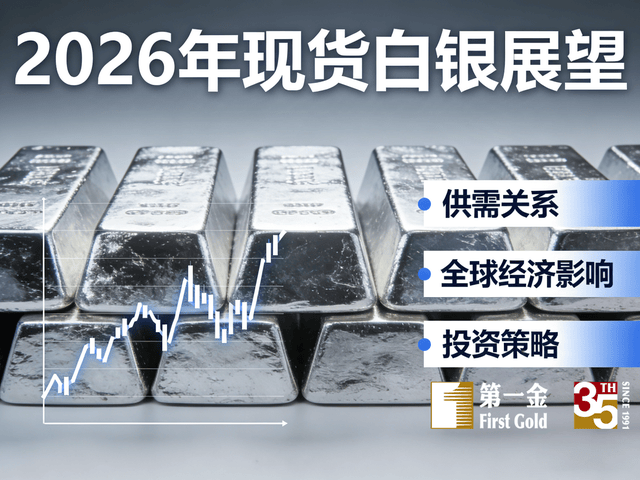
香港第一金:2026年国际现货白银展望 利多利空的年度总结
Sou Hu Cai Jing· 2026-02-23 16:37
Core Viewpoint - The performance of silver and gold in 2026 is uncertain, with silver potentially experiencing significant volatility and price fluctuations, influenced by various market factors [1][3]. Group 1: Factors Influencing Silver Prices - Positive factors include a global silver supply shortage, with the market experiencing five consecutive years of supply deficits, leading to increased demand and potential price surges [3]. - The industrial demand for silver is expanding beyond traditional uses, as it is now essential in sectors like electric vehicles and photovoltaic technology, positioning silver as a strategic material [3]. - Silver's price volatility is expected to be higher than gold's, with predictions suggesting that silver could reach $150 per ounce in 2026, outperforming gold [3]. Group 2: Risks and Concerns - The rapid price increase of silver, which has risen nearly ninefold since 2020, raises concerns about a potential market correction, especially after a significant drop from $120 per ounce [4][5]. - The sustainability of industrial demand is questioned, as high prices may lead manufacturers to seek alternative materials, potentially dampening future demand [5]. - Changes in U.S. Federal Reserve leadership and monetary policy could impact precious metals, with a hawkish stance potentially slowing central bank purchases of gold and affecting silver's market performance [5][6]. Group 3: Market Dynamics and Strategy - The silver futures market has adjusted trading limits and margin requirements, indicating heightened volatility and the need for cautious trading strategies [5]. - Investors are advised to maintain strict stop-loss measures and be prepared for significant price swings, emphasizing the importance of risk management in trading silver [6]. - Key turning points to monitor include the Federal Reserve's policy direction post-leadership change and the gold-silver ratio, which is currently at a historically low level, indicating silver's relative pricing dynamics [6].

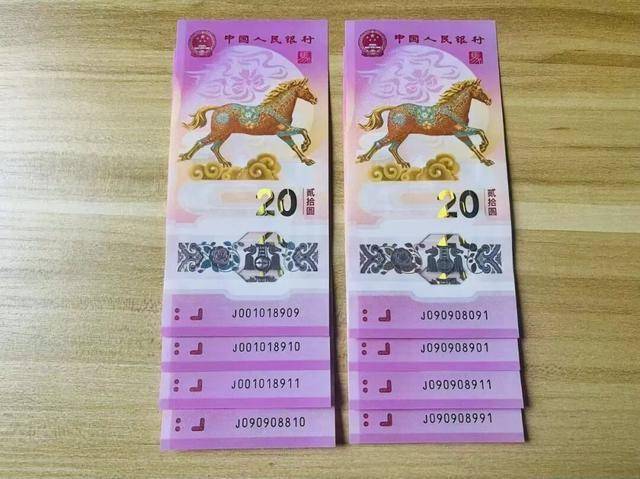
马钞跌、银币飞!春节前最后一次收藏投资机会,到底选哪个?
Sou Hu Cai Jing· 2026-02-10 03:42
Group 1 - The market for commemorative banknotes and coins is experiencing a significant divergence, with the market for the Year of the Horse banknotes and coins showing weakness, while precious metals are witnessing a surge in prices [3][5][11] - The Year of the Horse banknotes have seen a decline in trading activity, with sellers eager to cash out before the Spring Festival, but there are few buyers, indicating a lack of upward momentum in the short term [5][11] - In contrast, the precious metals market, particularly gold and silver, has seen a dramatic increase in prices, which has positively impacted the market for silver commemorative coins, making them the current focus of collectors [7][11] Group 2 - The current purchase price for the Year of the Horse banknote is 30 yuan per piece, while the Year of the Horse coin is priced at 13.5 yuan each, indicating a significant price disparity [8] - The average transaction price for a 150-gram colored silver coin has stabilized above 11,500 yuan, while the 30-gram panda silver coin has seen a price drop to 750 yuan, still reflecting a 70% increase from previous levels [9] - The analysis suggests that the Year of the Horse banknotes remain weak, while precious metals are performing strongly, and collectors should consider purchasing high-quality commemorative coins for long-term investment [11][13]
国际现货黄金、白银再度反弹 机构:市场上短期获利了结者与长期配置者并存
Xin Lang Cai Jing· 2026-02-06 11:20
Core Viewpoint - International spot gold and silver have rebounded, with gold prices recovering above $4900 per ounce and silver prices experiencing significant fluctuations [1][2] Market Performance - On February 6, gold prices rose over 2%, reaching $4857.57 per ounce, an increase of approximately 1.7%, while silver prices peaked with a rise of over 6%, settling at $74.12 per ounce, up about 4.5% [1][2] Investor Behavior - Institutional investors remain the primary force in the gold futures market, likely holding positions at low levels and partially selling for profit as prices rise, while also establishing short positions at high levels to close out when prices fall [1][2] - The market currently features both short-term profit-takers and long-term allocators, with professional investors typically not liquidating all positions even when taking partial profits [1][2] Long-term Trends - Since the fourth quarter of the previous year, there has been a consistent increase in purchases by global central banks and a sustained demand for hedging from professional investors through ETFs, driven by long-term risk-averse strategies [1][2] - Ongoing concerns regarding geopolitical risks, U.S. debt risks, and the sustainability of U.S. equity and government finances have not changed, suggesting that buying interest will persist even if gold prices decline [1][2]
国际现货黄金站上4900美元/盎司关口 现货白银日内涨超6%
Sou Hu Cai Jing· 2026-02-06 06:38
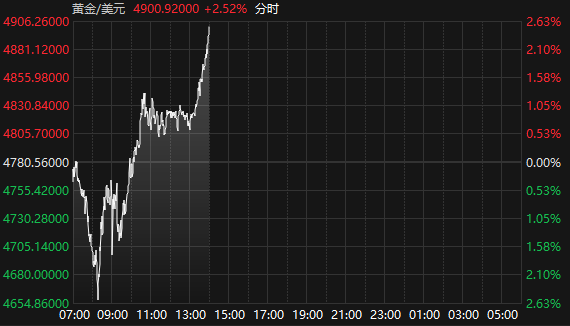
Core Viewpoint - International spot gold and silver experienced a rapid increase on February 6, with gold reaching $4900.92 per ounce, up 2.52% for the day, and silver at $75.25 per ounce, up 6.02% [1][1]. Group 1 - As of 14:00 on February 6, spot gold was reported at $4900.92 per ounce [1]. - Spot silver was reported at $75.25 per ounce [1]. - The daily increase for gold was 2.52% [1]. - The daily increase for silver was 6.02% [1].
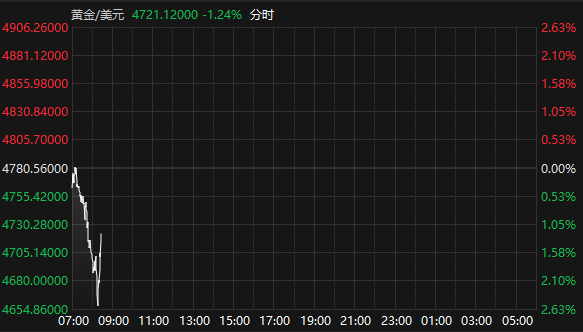
国际现货黄金延续跌势 一度失守4700美元/盎司关口
Sou Hu Cai Jing· 2026-02-06 01:00
Core Viewpoint - International spot gold and silver prices continued to decline on February 6, with gold dropping to $4,721.12 per ounce, a decrease of 1.24%, and silver falling to $67.97 per ounce, down 4.24% [1][1]. Price Movement - As of 8:27 AM, spot gold was reported at $4,721.12 per ounce, having previously dipped below the $4,700 per ounce mark [1][1]. - Spot silver was reported at $67.97 per ounce, reflecting a daily decline of 4.24% [1][1].
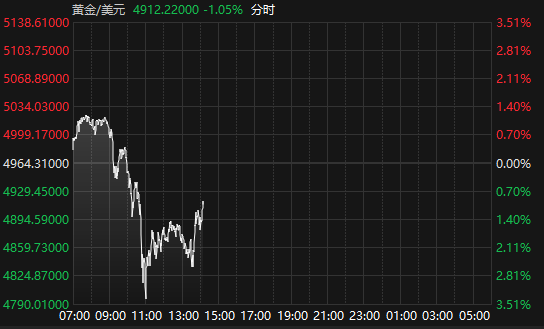
国际现货黄金跌幅收窄 回升至4900美元/盎司上方
Sou Hu Cai Jing· 2026-02-05 06:54
Core Viewpoint - International spot gold and silver prices experienced a decline on February 5, with gold reporting a price of $4912.22 per ounce, down 1.05% for the day, and silver at $78.46 per ounce, down 11.04% [1][1]. Group 1 - As of 14:11 on February 5, spot gold was priced at $4912.22 per ounce [1]. - Spot silver was priced at $78.46 per ounce [1]. - The daily decline for gold was recorded at 1.05% [1]. - The daily decline for silver was significantly higher at 11.04% [1].
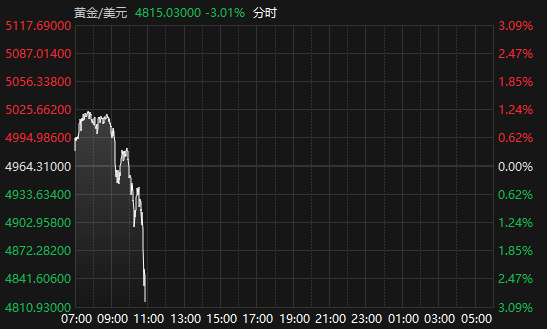
国际现货黄金、白银盘中跳水 白银跌幅扩大至14%
Sou Hu Cai Jing· 2026-02-05 03:13
Core Viewpoint - On February 5, international spot gold and silver experienced significant declines, with gold dropping to $4815.03 per ounce and silver falling to $75.54 per ounce, marking a day-over-day decrease of 3.01% for gold and 14.36% for silver [1][1]. Group 1 - International spot gold reported at $4815.03 per ounce as of 10:52 AM on February 5 [1]. - International spot silver reported at $75.54 per ounce as of 10:52 AM on February 5 [1]. - The day-over-day decline for gold was 3.01% [1]. - The day-over-day decline for silver was 14.36% [1].
银价暴跌,白银LOF“手动”下调31.5%净值引争议!应对极端行情得有“自动”机制
Mei Ri Jing Ji Xin Wen· 2026-02-03 09:21
Core Viewpoint - The recent manual adjustment of the net asset value (NAV) of the silver LOF fund by Guotou Ruijin Fund has sparked widespread controversy and dissatisfaction among investors due to a significant drop in value, highlighting the need for better risk management mechanisms in the fund industry [1][2][3] Group 1: Fund NAV Adjustment - On February 2, Guotou Ruijin Fund announced a manual revaluation of the fund's assets based on international silver futures market price fluctuations, resulting in a NAV drop to 2.2494 yuan, a decrease of 31.5% in one day [1] - The silver LOF continued to hit the trading limit on February 3, with a limit price of 4.25 yuan still reflecting an 88.9% premium over the latest NAV [1] - Investor feedback indicated three main concerns: the excessive NAV adjustment leading to significant losses, the inconsistency in NAV calculation standards, and the misalignment of the fund's NAV with its actual investment target [1] Group 2: Risk Management and Valuation Process - The fund management's decision to adjust the NAV was seen as a necessary response to the extreme market conditions, particularly after international silver prices experienced a dramatic drop of over 30% on January 30 [2] - The adjustment process adhered to regulatory guidelines, as significant changes in the economic environment or major events affecting security prices necessitate valuation adjustments exceeding 0.25% [2] - The incident revealed shortcomings in the fund company's risk management and the absence of mechanisms to handle extreme market conditions effectively [2] Group 3: Recommendations for Future Mechanisms - Historical experiences suggest that establishing automatic response mechanisms for extreme market conditions is more efficient than manual adjustments [3] - The urgency of the NAV adjustment was driven by concerns over potential continued trading limits on silver futures, which could hinder the fund's ability to meet redemption requests [3] - Recommendations include incorporating automatic redemption suspension clauses in fund contracts during extreme market conditions and setting predefined conditions for valuation adjustments to avoid disputes over valuation standards [3]
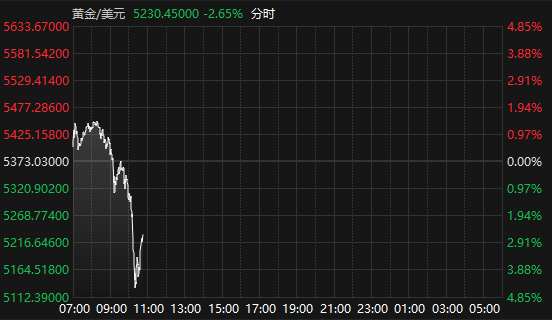
国际现货黄金白银跌幅收窄
Xin Lang Cai Jing· 2026-01-30 04:31
Group 1 - The international spot gold price is reported at $5230.45 per ounce, with a daily decline of 2.65% as of 10:46 AM on January 30 [1][3] - The international spot silver price is reported at $111.37 per ounce, with a daily decline of 3.71% as of the same time [1][3] Group 2 - The price movements for gold show a high of $5633.67, reflecting a 4.85% increase, and a low of $5112.39, indicating a 4.85% decrease [4] - The price movements for silver show a high of $123.30, reflecting a 6.60% increase, and a low of $108.03, indicating a 6.60% decrease [4]
白银价格狂飙突进:2026年首月暴涨58%背后的逻辑与风险
Sou Hu Cai Jing· 2026-01-30 04:12
Core Viewpoint - The silver market is experiencing a historic surge driven by multiple factors, reshaping the global precious metals landscape, with domestic silver futures rising by 57.93% and international spot silver prices exceeding $109 per ounce, marking a 13-year high [1] Group 1: Economic Factors - The expectation of interest rate cuts and a declining dollar are key drivers of the current silver rally, with the U.S. inflation rate dropping to 2.8% and unemployment rising to 4.3%, leading to a 70% probability of a Fed rate cut in June [2] - The dollar index has fallen below 96, a four-year low, enhancing the appeal of silver priced in dollars due to lower holding costs [2] Group 2: Market Dynamics - The gold-silver ratio has reached a historical low of 45.5, prompting speculative investments in silver as it acts as a "shadow asset" to gold, with significant inflows into silver funds [3] - The COMEX silver futures market has seen record high long positions, with a single-day surge of 8.51%, indicating strong speculative interest [6] Group 3: Supply and Demand - Global silver inventories have dropped to 233 tons, sufficient for only 1.2 months of consumption, while China's new export policy has reduced global supply by 4,500-5,000 tons [4] - Industrial demand for silver is surging, particularly in the photovoltaic sector, with an expected installation of 600GW in 2026, leading to a significant increase in silver usage [4][8] Group 4: Geopolitical Influences - Ongoing geopolitical tensions, particularly in the Middle East, and risks of U.S. government shutdown are driving safe-haven investments into precious metals [5] Group 5: Investment Trends - The largest silver ETF, SLV, increased its holdings by 210 tons, surpassing $20 billion in assets, while domestic silver futures funds have had to suspend subscriptions due to high demand [7] - The shift from copper to silver in electronic applications is expected to create an additional demand of 30-50 million tons, altering traditional supply-demand dynamics [8] Group 6: Risks and Signals - The current gold-silver ratio of 45.5 is significantly below the historical average of 60, indicating potential selling pressure on silver if gold prices adjust [9] - Concerns over inventory levels and potential tariff changes could impact silver prices, with COMEX inventories down 70% year-on-year [10] - Technical indicators suggest that silver is in an overbought condition, with RSI levels above 80 and volatility at a historical high [11][12]