
地平线征程家族芯片

Search documents
猜想谁是26年“易中天”系列——地平线机器人
格隆汇APP· 2026-02-02 10:56
Core Viewpoint - The article emphasizes that the smart driving industry is transitioning from a "technology frontier demonstration" phase to a stage characterized by large-scale implementation, where engineering stability and delivery reliability are becoming key competitive factors [4][11]. Industry Stage Assessment - The smart driving industry is currently in a phase of engineering and large-scale competition, shifting focus from technical capabilities to stable and replicable operation in complex environments [11][12]. - Companies that prioritize engineering capabilities are more likely to gain advantages in mass production and scale expansion [12]. Organizational and Governance Structure - The company has maintained a focused strategic path since its inception, emphasizing an "edge AI computing platform" and selecting smart driving as a primary application area [15]. - The organization promotes a production-oriented engineering logic, where chip architecture, algorithm capabilities, and customer delivery systems are developed in a coordinated manner [15]. Business Model Analysis - The company positions itself as a smart driving computing platform provider rather than a traditional chip supplier, offering scalable solutions through self-developed AI chip architecture [17]. - The platform business model allows for continuous iteration and optimization based on engineering experience and data feedback [17]. Production Capacity and Client Relationships - The company has achieved significant milestones, with over 10 million units of its chips produced and deployed in various mainstream vehicle models [21]. - Mass production signifies higher demands for chip stability, algorithm robustness, and system consistency, which can deepen customer relationships [21]. Technical Pathway - The company focuses on system-level efficiency rather than aggressive competition on computing power, balancing power consumption, cost, and computational efficiency [23]. - This strategy is advantageous during mass production, aiding in vehicle energy management and cost control [23]. Ecosystem and Collaboration - The company emphasizes collaborative development with OEMs and Tier 1 suppliers rather than standard supply, fostering a continuous iterative process within the same technical framework [25]. - This approach enhances customer loyalty but may reduce flexibility in customer structure due to reliance on a single platform [25]. Industry Trends - The penetration rate of smart driving technology is still on the rise, supported by policy environments, consumer acceptance, and automotive strategies [28]. - However, the increase in penetration does not guarantee market share growth for any single manufacturer due to industry dynamics and competitive pricing [29]. Financial Characteristics and Valuation Discussion - As a growth-stage technology company, the company exhibits financial characteristics of "high investment with effects released upon scaling" [31]. - Projected revenue for 2026 is estimated between 5.2 billion to 6.2 billion RMB, reflecting a year-on-year growth of approximately 53% to 70% [31]. Conclusion - The company possesses certain platform and engineering capability advantages as the smart driving industry transitions to engineering and large-scale competition [34]. - Long-term value realization is highly dependent on industry development pace, customer structure stability, and the company's execution capabilities [34].


猜想谁是26年“易中天”系列——地平线机器人
Ge Long Hui· 2026-02-02 07:25
Core Viewpoint - The transition of intelligent driving from a "technology frontier display" phase to an industrialization phase characterized by large-scale implementation is highlighted, with a focus on the importance of engineering systems and continuous delivery capabilities for competitive advantage [1][4]. Industry Stage Assessment - Intelligent driving is entering a phase of engineering and large-scale competition, where the focus shifts from technical capabilities to stable and replicable operation in complex environments [3][4]. - The competitive landscape is evolving, emphasizing the need for scalable deployment solutions that meet cost, power consumption, stability, and long-term supply requirements [4]. Organizational and Governance Structure - The company has maintained a focused strategic path since its inception, emphasizing an "edge AI computing platform" and targeting the complex application of intelligent driving [6][7]. - The organization prioritizes production-oriented engineering logic, integrating chip architecture, algorithm capabilities, and customer delivery systems within the same product framework [7]. Business Foundation Analysis - The company is positioned as a provider of intelligent driving computing platforms rather than a traditional chip supplier, utilizing self-developed AI chip architecture (BPU) to offer scalable solutions [8][9]. - The platform business model allows for continuous iteration and optimization based on engineering experience and data feedback, adapting to the shift in automotive demand from high-end to mainstream models [9]. Customer and Production Capability - Achieving mass production deployment is a critical indicator of a company's capabilities in the intelligent driving sector, with the company having established partnerships with several major automakers [12]. - Mass production requires higher standards for chip stability, algorithm robustness, and system consistency, which can deepen customer relationships but also increase quality responsibilities and delivery pressures [12][13]. Ecosystem and Collaboration - The company emphasizes collaborative development with automakers and Tier 1 suppliers rather than standard supply, fostering a continuous iteration within the same technical framework [14][15]. - This collaborative model enhances customer loyalty but may reduce flexibility in customer structure due to higher dependency on a single platform [15]. Industry Trends - The penetration rate of intelligent driving is still on the rise, supported by policy, consumer acceptance, and automaker strategies, with demand for computing platforms expected to expand beyond high-end configurations [16]. - However, uncertainties related to industry rhythm, price competition, and technological differentiation must be monitored, as increased penetration does not guarantee market share growth for any single vendor [16]. Financial Characteristics - As a growing tech company, the company exhibits financial characteristics of "high investment, with effects released after scaling," with revenue predictability expected to improve as the number of mass-produced models increases [17]. - Projected revenue for 2026 is estimated between 5.2 billion to 6.2 billion RMB, reflecting a year-on-year growth of approximately 53% to 70%, with a market valuation range of about 160 billion HKD based on a 30x PS valuation assumption [17]. Conclusion - The company's core asset value lies in its "industrial certainty" as it transitions from technology validation to engineering and large-scale implementation in the intelligent driving sector [21][22]. - Long-term value realization is highly dependent on industry development pace, customer structure stability, and the company's execution capabilities, with stability, replicability, and scalability becoming crucial evaluation metrics [22].

L3级准入破冰 自动驾驶商业化落地驶入快车道
Bei Jing Shang Bao· 2025-12-15 22:56
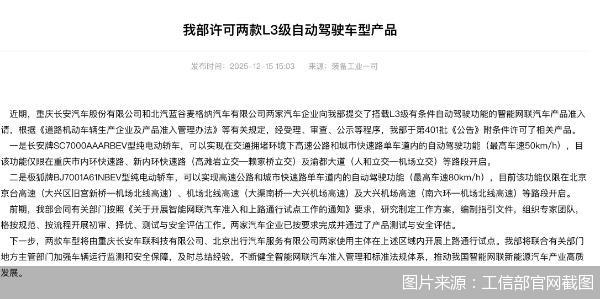
Core Insights - The Ministry of Industry and Information Technology (MIIT) of China has officially announced the first batch of L3 conditional autonomous driving vehicle permits, with Changan Automobile and BAIC Jihe receiving approvals for trial operations in designated areas of Chongqing and Beijing respectively [1][2] Group 1: L3 Autonomous Driving Development - The approval of L3 autonomous driving vehicles is expected to accelerate technological iterations within the industry and drive computing platforms towards automotive-grade standards and scalable applications [1][6] - L3 autonomous driving allows for partial decision-making by the system under specific conditions, enabling drivers to completely disengage from driving tasks [2][6] - Changan's approved model can achieve autonomous driving at speeds up to 50 km/h in congested scenarios on designated highways, while BAIC's Alpha S (L3 version) can reach speeds of 80 km/h on certain routes in Beijing [2] Group 2: Industry Competition and Collaboration - Major automotive companies have entered a competitive mode to commercialize autonomous driving technology, with several firms, including BAIC, GAC, and BYD, being included in the first batch of intelligent connected vehicle trial operations [4][6] - The collaboration between automotive manufacturers and technology companies is crucial for the commercial viability of L3 autonomous driving, with Horizon Robotics and Huawei providing essential technological support [5][6] Group 3: Safety and Regulatory Framework - The shift in driving responsibility due to autonomous driving raises concerns about accident liability, with regulations evolving to clarify responsibilities among users and autonomous systems [3][6] - The MIIT and other departments have emphasized the need for improved regulations and safety standards to support the growth of the autonomous driving sector [5][6] - The market for autonomous driving in China is projected to approach 450 billion yuan by 2025, driven by technological advancements and cost reductions [6]
L3级准入破冰,自动驾驶商业化落地驶入“快车道”
Bei Jing Shang Bao· 2025-12-15 14:07
Core Viewpoint - The Ministry of Industry and Information Technology (MIIT) of China has officially granted the first batch of L3 conditional autonomous driving vehicle permits, allowing Changan Automobile and BAIC's Arcfox models to conduct road trials in designated areas of Chongqing and Beijing, respectively [1][4]. Group 1: Policy and Regulatory Developments - The MIIT has approved L3 autonomous driving vehicles under specific conditions, marking a significant step towards the commercialization of autonomous driving technology in China [4][9]. - The approval process involved thorough assessments and compliance with regulations, ensuring that the vehicles meet safety and operational standards [3][4]. Group 2: Vehicle Specifications and Capabilities - Changan's model can achieve autonomous driving at speeds up to 50 km/h in congested traffic conditions on designated roads in Chongqing [3][4]. - BAIC's Arcfox model can operate at speeds up to 80 km/h on specific highways in Beijing, showcasing the capabilities of L3 autonomous driving technology [3][4]. Group 3: Industry Trends and Competitive Landscape - The autonomous driving industry is entering a competitive phase, with multiple automakers racing to develop and deploy L3 technology [6][9]. - Companies like GAC and BYD are also advancing their L3 capabilities, with GAC's model receiving a license for high-speed testing and BYD integrating L3 systems into urban driving scenarios [7][9]. Group 4: Technological Advancements and Partnerships - The successful deployment of L3 technology relies on advanced sensor systems, with BAIC's Arcfox equipped with 34 high-performance sensors for comprehensive environmental perception [7][8]. - Partnerships with technology firms are crucial, as seen with Horizon Robotics and Huawei, which are providing the necessary technological foundation for L3 commercialization [8][10]. Group 5: Market Outlook and Future Projections - The autonomous driving market in China is projected to approach 450 billion yuan by 2025, driven by technological advancements and increasing adoption rates [9]. - The focus on safety, regulatory compliance, and user experience will shape the competitive landscape, with companies needing to balance innovation with responsible marketing practices [9][10].


高阶智驾下放10万元级车型 智驾平权迈入深水区
Bei Jing Shang Bao· 2025-12-09 15:37
Core Insights - The high-level autonomous driving technology is accelerating its penetration into the mass market, with Horizon Robotics' CEO Yu Kai announcing the upcoming mass production of the city navigation assisted driving (NOA) system based on a single Journey 6M chip, expected to be featured in vehicles priced around 100,000 yuan [1] - The HSD Together algorithm service model aims to significantly reduce the human resource investment, computing power consumption, and time to market by 90% for partners developing products based on Horizon's verified intelligent foundation [2] - The demand for equitable intelligent driving in the Chinese market is increasing, with nearly 50% of the overall market delivery volume coming from vehicles priced below 200,000 yuan, contributing a 70% growth rate [2] Group 1 - Horizon Robotics has partnered with Denso and the joint venture CARIZON to launch urban assisted driving [1] - The Journey family of chips has achieved cumulative shipments of over 10 million units in five years, with a goal of producing 10 million units of the HSD system in the next 3-5 years [1] - The Journey 6 chip family has achieved full market coverage, with the Journey 6E/M chips reaching over one million shipments in their first year [2] Group 2 - Major automakers are continuously pushing high-level autonomous driving technology into lower price segments, with models like GAC Toyota's Platinum Smart 3X and Zeekr 007GT featuring advanced technologies at competitive prices [3] - The competition in the intelligent driving sector is shifting from high-end to mid-range vehicles due to decreasing costs, prompting a need for companies to balance cost and performance [3] - The implementation of L3-level autonomous driving will pose compliance challenges related to responsibility allocation and data security, necessitating the establishment of open collaborative networks to meet diverse scenario demands [3]