
地面系统

Search documents
“天、地、端、火箭、应用” ,五层解构商业航天产业链
Hua Er Jie Jian Wen· 2026-01-21 07:33
Core Viewpoint - The aerospace industry is undergoing a paradigm shift from a cost-agnostic "engineering narrative" to a profit and market-driven "industrial narrative," with a focus on commercial viability rather than just technological milestones [1] Group 1: Industry Transition - China's commercial aerospace is at a "dawn moment," transitioning from an engineering-driven model to an industry-driven one, with low Earth orbit satellite constellations becoming marketable infrastructure [1] - The competition between China and the U.S. is intensifying, with China attempting to catch up to SpaceX's cost barriers through initiatives like the "GW constellation" and "Thousand Sails constellation" [1] Group 2: Satellite Manufacturing - The satellite manufacturing sector is shifting to a mass production model, akin to the automotive industry, with China's market expected to grow from approximately 7.1 billion yuan in 2025 to 39.4 billion yuan by 2030 [2] - The urgency to secure orbital and frequency resources is driving a transition from sporadic research models to continuous, batch engineering deliveries [3] Group 3: Ground Systems - Ground systems are evolving from a supporting role to a core hub in the satellite constellation, with the market projected to grow from 1.2 billion yuan in 2025 to 39.1 billion yuan by 2030 [6] - The complexity of data access, forwarding, and scheduling will increase exponentially with the rise in satellite numbers, making ground systems critical for operational success [6] Group 4: Terminal Market - The terminal segment is expected to see explosive growth, with market size projected to surge from 0.5 billion yuan in 2025 to approximately 141.9 billion yuan by 2030 [7] - The current market is limited to specialized industries, but the potential for consumer markets exists, particularly with advancements in satellite and WiFi integration [7] Group 5: Rocket Launch Costs - The primary constraint in commercial aerospace is launch costs, with current Chinese prices ranging from 50,000 to 100,000 yuan per kilogram, while SpaceX has reduced costs to about 20,000 yuan per kilogram [8] - The market for rocket launch services is expected to grow from 10.7 billion yuan in 2025 to 34.3 billion yuan by 2030, driven by advancements in reusable rocket technology [9] Group 6: Application Market - The application segment is projected to grow from a mere 0.2 billion yuan in 2025 to 525 billion yuan by 2030, with applications expected to account for over 67% of revenue [10] - The strategy involves targeting specialized industries first before expanding into consumer markets, similar to SpaceX's approach with Starlink [10]

中美竞逐万亿美元新赛道,五层解构下的投资蓝图
Tebon Securities· 2026-01-21 04:07
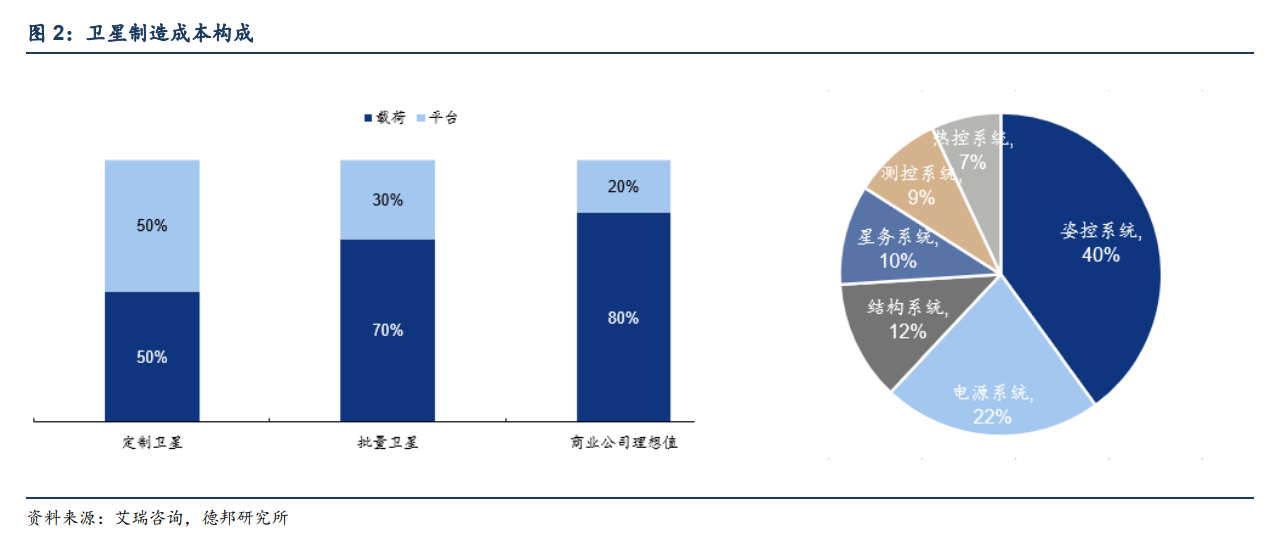
Investment Rating - The report maintains an "Outperform" rating for the commercial aerospace industry [1] Core Insights - The aerospace sector is transitioning from being viewed as a "cost center" driven by national will to a "growth engine" driven by commercial demand, with significant investments and strategic planning from both the US and China [6][9] - The global aerospace economy is projected to reach $613 billion in 2024, with commercial aerospace contributing 78%, and is expected to exceed $1 trillion by 2032 [6][9] - The value chain of commercial aerospace is divided into five core levels: "space, ground, terminal, rocket, and application," each presenting unique market opportunities and technical challenges from 2026 to 2030 [10][29] Summary by Sections 1. Space: Satellite Manufacturing - The satellite manufacturing market in China is expected to grow from approximately 7.1 billion yuan in 2025 to about 39.4 billion yuan by 2030, reflecting a shift from sporadic research models to continuous, batch engineering deliveries [16][18] 2. Ground: Ground Systems - The ground systems market is projected to increase from around 1.2 billion yuan in 2025 to approximately 39.1 billion yuan by 2030, evolving from a supporting role to a core infrastructure essential for stable satellite constellation operations [21][22] 3. Terminal: Key Variable for Commercial Aerospace - The terminal market is anticipated to grow from 500 million yuan in 2025 to about 141.9 billion yuan by 2030, driven by multiple vertical industries and potential consumer scenarios [23][24] 4. Rocket: Core Constraint - The cost of rocket launches is a critical constraint, with reusable technology expected to reduce costs by 80%-90% compared to traditional expendable rockets. The market for rocket launch services is projected to grow from approximately 10.7 billion yuan in 2025 to about 34.3 billion yuan by 2030 [25][26] 5. Application: Final Value Realization - The application market is expected to expand from 200 million yuan in 2025 to 525 billion yuan by 2030, with the revenue share from applications projected to rise from single digits to over 67% by around 2030 [27][28] 6. Investment Opportunities - Investment opportunities in commercial aerospace can be categorized into three main tracks: 1. Launch and manufacturing segments, which are expected to benefit directly from increased orders and visibility 2. Core components and systems, characterized by high technical barriers and critical for long-term competitiveness 3. Downstream applications and operational services, which, while currently limited in scale, hold the greatest long-term potential for value realization [29][30]


四川发布商业航天发展计划:力争到2030年 航天产业规模达千亿元
Zhong Guo Chan Ye Jing Ji Xin Xi Wang· 2025-05-13 22:21
Core Insights - The Sichuan Provincial Government has released the "Sichuan Commercial Aerospace High-Quality Development Action Plan (2025-2030)", aiming to establish a spatial layout led by the Chengdu metropolitan area and Liangshan Prefecture, targeting a commercial aerospace industry scale of over 50 billion yuan by 2025 and 100 billion yuan by 2030 [1][2] Group 1: Strategic Objectives - The plan emphasizes the construction of a collaborative industrial ecosystem to efficiently connect technology, capital, and market demand, featuring a "dual-core leadership and multi-regional collaboration" approach [2] - Liangshan Prefecture will leverage its launch resource advantages to develop a rapid manufacturing and launch capability, while Chengdu will focus on high-standard industrial zones to attract leading enterprises [2][3] Group 2: Development Initiatives - The action plan outlines measures to attract aerospace manufacturing and related enterprises, support in-situ manufacturing, and accelerate the development of industrial support zones to create a symbiotic industrial ecosystem [3] - It encourages both internal cultivation and external attraction of enterprises, promoting investment from large domestic companies and supporting small and medium-sized enterprises in the aerospace sector [3] Group 3: Regional Focus Areas - Different regions will focus on specific areas within the commercial aerospace industry: Chengdu will concentrate on rockets, satellites, and ground systems; Liangshan will focus on rocket satellites and commercial launches; Mianyang will target rocket and engine manufacturing; and other cities will specialize in various aerospace-related sectors [4]
