
垂直起降固定翼无人机

Search documents
纳入“十五五”四大新兴产业,低空经济加速“起飞”还有多远
Di Yi Cai Jing· 2026-01-22 15:13
Core Insights - The article emphasizes the importance of strategic emerging industries in China's economic planning, particularly focusing on four key sectors: new energy, new materials, aerospace, and low-altitude economy [2][3] - The low-altitude economy is transitioning from early-stage applications to deeper penetration, with a focus on transforming blueprints into valuable commercial scenarios and improving related infrastructure [2][3] Group 1: Low-Altitude Economy Development - The Chinese government aims to accelerate the development of strategic emerging industry clusters, including the low-altitude economy, through large-scale application demonstrations of new technologies and products [3] - Nearly 1,000 companies have registered civil unmanned aerial vehicle products, with 3,191 types of products and over 478,000 units [3] - The eVTOL (electric vertical takeoff and landing) sector has received over 1,000 orders from domestic and international clients since 2025, with various application scenarios being explored [3] Group 2: Application Scenarios and Challenges - Most eVTOL applications are still in the testing phase, with commercial operations requiring operational certificates, which currently have many restrictions [4] - The low-altitude economy has three main application scenarios: manned low-altitude transportation, unmanned low-altitude logistics, and low-altitude digital applications [5] - Agricultural applications of the low-altitude economy are showing promising trends, with over 300,000 agricultural drones and an operational area exceeding 46 million acres by 2025 [6] Group 3: Infrastructure and Regulatory Challenges - Infrastructure development for the low-altitude economy is accelerating, with plans to establish 46 low-altitude flight service stations by 2025, covering 23 provinces [7] - Challenges include fragmented airspace management and the need for improved approval efficiency for new aircraft types, which is currently a bottleneck for rapid development [7][8] - The low-altitude airspace is still under strict control, requiring approvals from military and air traffic control, which complicates the establishment of a comprehensive low-altitude traffic network [8] Group 4: Future Outlook - The goal is to have large unmanned aerial vehicles with transfer capabilities operational by 2035, integrating manned and unmanned operations into a complex air route network [8] - The large-scale commercial application of eVTOL and other low-altitude economy aircraft in urban air traffic may take another decade to realize [9]


纳入“十五五”四大新兴产业,低空经济加速“起飞”还有多远
第一财经· 2026-01-22 14:34
Core Viewpoint - The article emphasizes the importance of developing strategic emerging industries, particularly focusing on low-altitude economy, which is transitioning from early-stage applications to deeper penetration, requiring effective infrastructure and commercial scenarios to accelerate growth [3][4]. Group 1: Emerging Industries - The recent guidelines highlight the need to accelerate the development of strategic emerging industries, including new energy, new materials, aerospace, and low-altitude economy [4]. - The low-altitude economy is characterized by a long industrial chain and requires cluster development, with the low-altitude manufacturing sector currently experiencing the fastest growth [4]. Group 2: eVTOL Development - As of 2025, over 1,000 domestic and international orders for eVTOLs have been received, with applications being explored in various scenarios, including logistics in mountainous regions and urban flights in Qatar [4]. - However, most eVTOL applications are still in the testing phase, with commercial operations requiring operational certificates, which currently have significant restrictions [5]. Group 3: Application Scenarios - The low-altitude economy has three main application scenarios: manned low-altitude transportation, unmanned logistics, and low-altitude digital applications [6]. - In agriculture, the low-altitude economy is showing promising results, with over 300,000 agricultural drones and a mechanization rate of 76.7% expected by 2025 [6]. Group 4: Infrastructure Development - The construction of low-altitude infrastructure is accelerating, with plans to establish a network of low-altitude flight service stations and optimize regulatory platforms by 2026 [7]. - The current strict regulation of low-altitude airspace poses challenges for the industry, necessitating a comprehensive air traffic network and operational rules [8]. Group 5: Future Outlook - The roadmap for civil unmanned aerial vehicles aims for the integration of manned and unmanned aircraft by 2035, indicating that large-scale commercial applications of eVTOLs may still be a decade away [8].

纳入“十五五”四大新兴产业,低空经济加速“起飞”还有多远|“十五五”产业前瞻
Di Yi Cai Jing· 2026-01-22 10:18
Core Insights - The key to accelerating the low-altitude economy lies in transforming blueprints into actionable and valuable business scenarios, along with improving the related infrastructure network [1] Group 1: Government Initiatives - The recent guidelines emphasize the need to accelerate the development of strategic emerging industries, including low-altitude economy, with nearly 30 provinces incorporating it into their 14th Five-Year Plan [1] - The focus on low-altitude economy has been reiterated in multiple government reports, highlighting its significance in national economic planning [1] Group 2: Industry Development - The low-altitude economy is transitioning from early-stage applications to a critical phase of deep penetration, necessitating cluster development due to its extensive industrial chain [2] - As of now, nearly 1,000 companies have registered civil unmanned aerial vehicle products, with 3,191 types of products and over 478,000 units [2] - The eVTOL (electric vertical takeoff and landing) sector has received over 1,000 intent orders from domestic and international clients since 2025, showcasing its potential in low-altitude applications [2] Group 3: Application Scenarios - Current eVTOL applications are primarily in the testing phase, with limited commercial operations due to stringent operational certifications [3] - The low-altitude economy is expected to have three main application scenarios: manned low-altitude transportation, unmanned low-altitude logistics, and low-altitude digital applications [3][4] - Agricultural applications of low-altitude technology are showing promising trends, with over 300,000 agricultural drones and an operational area exceeding 46 million acres by 2025 [4] Group 4: Infrastructure Development - The construction of low-altitude infrastructure is accelerating, with plans to issue six types of unmanned aerial vehicle type certificates by 2025 and establish a flight service network covering 23 provinces [6] - The low-altitude economy faces challenges such as fragmented airspace management and the need for improved approval efficiency, which are critical for its commercial viability [6] - The current strict regulation of low-altitude airspace requires approvals from military and air traffic control, indicating a need for a comprehensive low-altitude traffic network [7] Group 5: Future Outlook - The goal is to have hub-type large unmanned aerial vehicle takeoff and landing sites operational by 2035, integrating manned and unmanned operations into a complex route network [7] - The large-scale commercial application of eVTOL and other low-altitude aircraft in urban air mobility may take up to ten years to realize [7]
国泰海通证券走进纵横股份(SH.688070):近距离感受硬核制造 共探低空经济新机遇
Xin Lang Cai Jing· 2025-12-12 14:13
Core Viewpoint - The event "I am a Shareholder" provided investors with an opportunity to gain in-depth insights into the leading industrial drone company, Zongheng Co., through factory visits and discussions, highlighting the growth potential in the low-altitude economy supported by national policies and technological advancements [1][8]. Company Overview - Zongheng Co. was established in 2010, focusing on the research and development of drone flight control navigation systems and complete systems, participating in major national aircraft projects and setting multiple industry standards [3][10]. - The company has developed four main product lines: vertical take-off and landing fixed-wing drones, multi-rotor drones, unattended systems, and sliding fixed-wing drones, with the unattended system allowing remote autonomous flight across the country [3][10]. Financial Performance - In the third quarter, Zongheng Co. reported revenue of 322 million yuan, a year-on-year increase of 57%, and a quarterly profit of 16.52 million yuan, marking a return to profitability [4][11]. - The gross profit margin for the first three quarters reached 48.9%, an increase of 2.2 percentage points compared to the previous year [4][11]. Technological Advancements - The company developed a smart air traffic control system in 2022, which won a special award from the Transportation Association, and the UTMIS system, co-developed with the Civil Aviation Second Institute, has become the national air traffic control baseline version [4][11]. - Zongheng Co. holds nearly 500 intellectual property rights, including over 100 invention patents, and has participated in the formulation of numerous industry standards [4][11]. Future Outlook - Zongheng Co. plans to increase R&D investment, enhance its product portfolio, and expand its applications in smart governance, with expectations for overseas business to gradually account for one-third or more of its operations [6][13]. - The company aims to focus on the low-altitude digital economy and logistics sectors, leveraging unattended systems and AI technology to promote the large-scale development of the low-altitude economy [6][13].


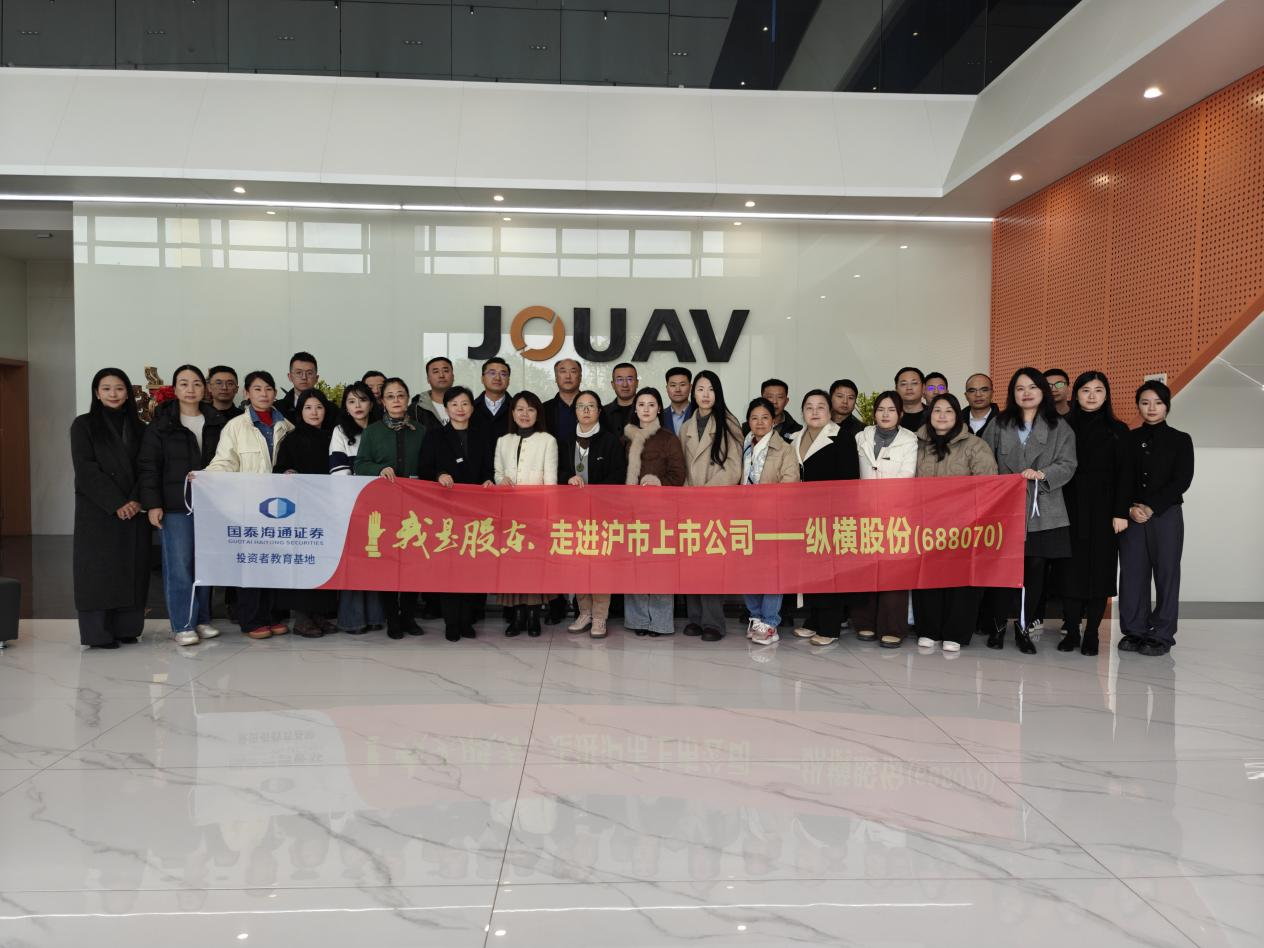
国泰海通证券走进纵横股份:近距离感受硬核制造 共探低空经济新机遇
Quan Jing Wang· 2025-12-12 08:08
Core Insights - The event "I am a Shareholder" provided investors with an opportunity to gain in-depth knowledge about the leading industrial drone company, Zongheng Co., through factory visits and discussions [1][2] Company Overview - Zongheng Co. has focused on the research and development of drone flight control navigation systems and complete systems since its establishment in 2010, participating in major national aircraft projects and setting multiple industry standards [2] - The company has developed four main product lines: vertical take-off fixed-wing drones, multi-rotor drones, unattended systems, and sliding fixed-wing drones, with the unattended system allowing remote autonomous flight across the country [2][3] - As of now, Zongheng Co. holds nearly 500 intellectual property rights, including over 100 invention patents, and has participated in the formulation of dozens of industry standards [2] Financial Performance - In the third quarter, Zongheng Co. reported an operating income of 322 million yuan, a year-on-year increase of 57%, and a quarterly profit of 16.52 million yuan, marking a return to profitability [2] - The gross profit margin for the first three quarters reached 48.9%, an increase of 2.2 percentage points year-on-year [2] Future Outlook - Zongheng Co. plans to increase R&D investment, enhance its product portfolio, and expand its applications in smart governance, while also aiming to grow its overseas market share to one-third or more [3] - The company’s core competitiveness lies in its deep technical accumulation and full industry chain layout, focusing on low-altitude digital economy and logistics [3] - The ongoing support from national policies and continuous technological advancements are expected to provide Zongheng Co. with more development opportunities in the low-altitude economy [3]

四川成都市市场监管系统转理念探索服务发展新路径
Zhong Guo Zhi Liang Xin Wen Wang· 2025-09-26 04:34
Core Insights - Chengdu's market regulation system is implementing a "service-oriented regulation" approach to promote high-quality industrial development, exemplified by the opening of the Jianzhou New City Testing and Inspection Industrial Park [1][2] - The system has established a collaborative mechanism involving government, enterprises, and research institutions to address key issues faced by businesses, resulting in over 400 resolved requests with a problem-solving rate of 96.78% [1][2] Group 1: Service Model Transformation - The service model has evolved from "single-point response" to "systematic solutions," focusing on key concerns of local governments and enterprises [2] - The "Five Ones" development model (one park, one policy, one platform, one fund, one alliance) has been introduced to enhance collaboration among various stakeholders [2] Group 2: Industry-Specific Solutions - The establishment of a joint inspection laboratory for small and micro food enterprises has reduced operational costs by 77%, providing comprehensive testing services [2] - A collaborative effort with China Agricultural University aims to reduce meat product dry loss by 0.3%, potentially increasing annual efficiency by over 2 million yuan [3] Group 3: Cross-Regional Collaboration - A cross-level collaboration mechanism has been set up to address complex issues faced by enterprises, such as patent disputes and financing challenges [4][5] - The "Quality Credit Financing+" model has facilitated nearly 1.2 billion yuan in loans for businesses, demonstrating the effectiveness of quality assurance in securing financing [5] Group 4: Comprehensive Support Framework - The market regulation system is providing full lifecycle support for enterprises through policy, platform, and technical assistance, enhancing operational efficiency [6] - A green food inspection service platform has been created to lower testing costs by approximately 50%, streamlining the inspection process [6] Group 5: Future Directions - The Chengdu market regulation system plans to expand its service scope and institutional innovations to further support industrial development [7] - The "three-dimensional empowerment" model aims to replicate successful experiences across various sectors, contributing to the construction of the Chengdu-Chongqing economic circle [7]
纵横股份: 关于2025 年度“提质增效重回报”行动方案的半年度评估报告
Zheng Quan Zhi Xing· 2025-08-21 16:47
Core Insights - The company is committed to enhancing its investment value and maintaining shareholder interests through the "Quality Improvement and Efficiency Enhancement Return" action plan for 2025 [1] - In the first half of 2025, the company reported a significant increase in operating income and improved overall operational quality despite a net profit loss [1] Group 1: Business Development - The company is actively promoting low-altitude economy infrastructure and applications, achieving a revenue of 134.66 million yuan, a year-on-year increase of 61.72% [1] - The company has secured a 106 million yuan project for the "Smart Bazhong" low-altitude digital economy unmanned system, marking a strategic breakthrough in the low-altitude economy sector [2] - The company is expanding its partnerships with local governments and industry associations to explore low-altitude economy business opportunities [3] Group 2: Product and Technology Innovation - The company is focusing on the development of various unmanned aerial vehicle (UAV) systems, including vertical take-off and landing fixed-wing UAVs and unmanned systems [4] - New products such as the JOS-P200 multi-rotor unmanned system and the Cloud Dragon fixed-wing UAV system have been launched, enhancing the company's product offerings [5] - The company is collaborating with academic institutions to address challenges in civil drone traffic management [5] Group 3: Internal Management and Governance - The company is enhancing its internal control and governance systems, focusing on performance evaluation and incentive mechanisms [6] - A total of 29 training sessions were conducted, with 3,750 participants, aimed at improving employee skills and management capabilities [6] - The company is committed to optimizing cost management and improving overall profitability and competitiveness [6] Group 4: Investor Relations and Transparency - The company has published 80 announcements in the first half of 2025, ensuring compliance with information disclosure regulations [6] - Regular communication with investors is maintained through various channels, enhancing market transparency and trust [6] - The company plans to continue evaluating and implementing the action plan while focusing on core business and international market development [6]
国网北京密云供电公司:险情之上 无人机为光明“探路”
Zhong Guo Neng Yuan Wang· 2025-07-30 01:45
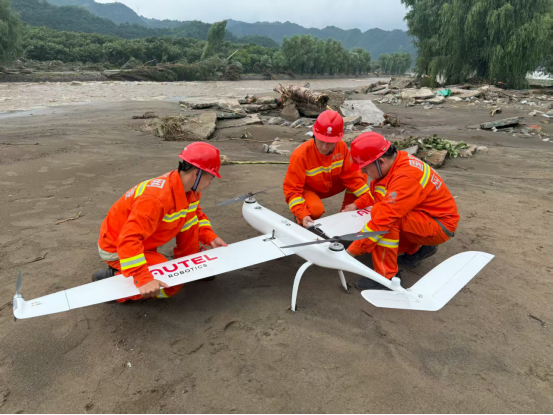
Core Viewpoint - The application of vertical take-off and landing fixed-wing drones by State Grid Beijing Electric Power Company significantly enhances the efficiency and safety of power facility inspections in disaster-stricken areas, particularly during severe weather conditions [5]. Group 1: Emergency Response - On July 26, an emergency task was issued to inspect power facilities in Fengjiayu Town due to road interruptions caused by heavy rainfall [1]. - The emergency response team quickly prepared drones for aerial inspections, highlighting the urgency of the situation [1]. Group 2: Drone Technology Utilization - The drones used have a wingspan of approximately 3 meters and a maximum flight distance of 100 kilometers, capable of operating at 300 meters altitude while capturing detailed images of power infrastructure [5]. - The drones can autonomously fly even in adverse weather conditions without signal, showcasing advanced technology in emergency response [5]. Group 3: Operational Efficiency - The drone inspection covered an area of 80 square kilometers, including one 110 kV substation and four transmission lines, which would take several days to inspect manually [5]. - The deployment of eight drones across multiple towns allowed for rapid assessment of damage and facilitated timely emergency resource allocation [5].
暴雨警报响起,无人机冲上天空
Liao Ning Ri Bao· 2025-07-15 01:21
Core Insights - The article highlights the advanced emergency response capabilities of the Liaoning Electric Power Company, showcasing the integration of high-tech equipment in their operations [1][2] Group 1: Emergency Response Innovations - The emergency drill demonstrated the use of a vertical take-off fixed-wing drone equipped with infrared cameras, capable of completing in 2.5 hours the work that would traditionally take 3 days [1] - The drill simulated severe weather conditions and high-speed rail disruptions, emphasizing the need for rapid response and precision in fault rectification [1] - A new method of grid inspection was introduced, utilizing a "one machine relay, one machine operation" model to enhance efficiency within a 50-kilometer radius [1] Group 2: Technological Integration - The drill featured a 5G communication network established by drones, showcasing the use of advanced technology for emergency communications [1] - A drainage robot was deployed to remove water from substations at a rate of 1,200 cubic meters per hour, illustrating the application of robotics in utility management [1] - The operation involved real-time data reception from over 160 satellites, providing detailed imagery of infrastructure conditions [1] Group 3: Operational Efficiency - The control system demonstrated by the company allowed for simultaneous operation of four drones for comprehensive inspections, highlighting the operational capabilities in maintaining power supply [2] - The emphasis on minimizing disruption to high-speed rail services during emergency repairs reflects the company's commitment to operational excellence [1]
50个重点产品、30个典型应用场景,打造低空产业“山东样板”
Zhong Guo Fa Zhan Wang· 2025-07-11 08:13
Core Viewpoint - Shandong Province is actively promoting the development of the low-altitude industry by selecting 50 key products and 30 typical application scenarios, showcasing innovation and practical applications in various fields [1][2][3] Group 1: Key Products - The selected 50 key products cover the entire industry chain, including 15 types of complete machines, 11 platform systems, and 24 components and supporting products, demonstrating a comprehensive product system [1] - Key products focus on technological breakthroughs, featuring advanced components like optical quantum radar and lightweight aviation engines, highlighting the region's independent innovation capabilities [2] Group 2: Application Scenarios - The 30 typical application scenarios span over 10 fields, including cultural tourism, logistics, medical services, and marine inspection, reflecting real-world needs [2] - Examples include the regular operation of low-altitude logistics between islands, significantly reducing delivery times from 30-40 minutes by water to just 10 minutes by air [2] Group 3: Synergy and Development - The collaboration between key product development and application scenarios creates a virtuous cycle of "product innovation - scenario implementation - industry upgrade," establishing a benchmark for low-altitude economic development [3] - Shandong aims to enhance the low-altitude industry ecosystem by focusing on "hard technology + real demand," promoting high-quality development in the sector [3]