塞外红苹果

Search documents
通辽年沙尘暴次数下降60% 粮食和饲草增产超20%“十四五”绘就绿富同兴新画卷
Nei Meng Gu Ri Bao· 2025-11-17 03:27
Core Viewpoint - Tongliao City has made significant progress in ecological restoration and economic development, demonstrating a successful integration of environmental protection and economic growth during the "14th Five-Year Plan" period [1][5]. Ecological Restoration - The city has completed ecological restoration of 21.648 million acres and managed over 20 million acres of desertified land, resulting in a 60% reduction in sandstorm occurrences [1]. - The forest area has steadily increased to 17.205 million acres, with agricultural and pasture yields rising by over 20% [1]. Economic Development - The "Saibei Red" apple cultivation has reached an area of 350,000 acres, generating an annual output value exceeding 600 million yuan, with products exported to countries like Malaysia and Singapore [2]. - The integration of sand control and wealth generation has transformed the local economy, benefiting farmers significantly [2]. Water Resource Management - Historical breakthroughs in water management have been achieved, with the West Liao River flowing for over 40 days after 27 years of drought, supported by 6.097 billion yuan in water conservancy investments [3]. - The implementation of high-standard farmland has led to an increase in crop yields by over 200 jin per acre, with a total of 4 billion cubic meters of agricultural water saved annually [4]. Environmental Quality Improvement - Air quality in Tongliao has improved, with 342 days of good air quality expected in 2024, a 9-day increase from 2020, and a 17.6% reduction in fine particulate matter concentration [4]. - The water quality of national monitoring sections has improved, with the excellent rate rising from 40% to 60% [4]. Sustainable Development - The city has demonstrated a reduction of 23.16% in carbon dioxide emissions per unit of GDP and an 18.5% decrease in energy intensity, showcasing a positive interaction between ecological protection and economic development [4].
林草经济生机盎然
Jing Ji Ri Bao· 2025-08-28 01:56
Group 1 - The core viewpoint of the articles emphasizes the integration of ecological restoration and economic development in Inner Mongolia, showcasing successful projects that enhance both environmental and economic benefits [1][4][5] - The "Nugusitai Project" in Tongliao City demonstrates the potential of grafting red pine onto larch, which not only improves growth but also increases local income through diverse agricultural practices [1] - The tourism sector in Arxan City is thriving, with the "Oxygen Heart Forest Bathing Trail" attracting around 60,000 to 70,000 visitors annually, generating approximately 1 million yuan in revenue [2] Group 2 - Inner Mongolia has achieved significant progress in ecological restoration, with 148 million mu of afforestation and 367 million mu of grass planting, leading to increased forest coverage and reduced desertification [4] - The total output value of the forestry and grassland industry in Inner Mongolia has surpassed 100 billion yuan, highlighting the region's commitment to high-quality green development [5] - The region's diverse ecological resources, including forests, grasslands, and wetlands, are being leveraged to develop eco-tourism and other sustainable economic activities [3][4]
绿水青山和金山银山的“双向奔赴”
Nei Meng Gu Ri Bao· 2025-07-13 12:45
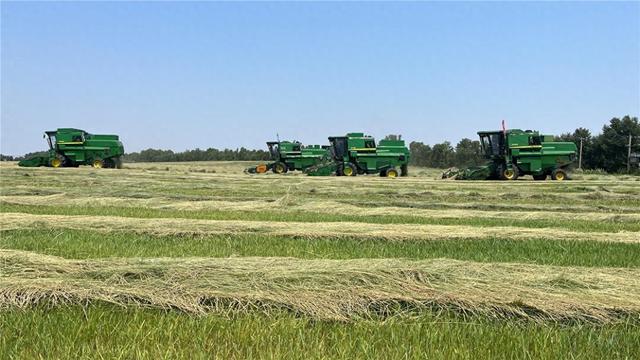
Core Viewpoint - The article highlights the successful transformation of the Kairu County in Tongliao City from desertified land to a thriving ecological and economic region through the cultivation of sheep grass and other sustainable agricultural practices [3][4][10]. Group 1: Ecological Transformation - Kairu County has successfully harvested over 60,000 acres of sheep grass, which serves as a nutritious feed for livestock and contributes to ecological restoration efforts across the country [1][3]. - The area has seen a significant increase in sheep grass cultivation, reaching 200,000 acres with a dry grass yield of 120,000 tons, promoting stable growth in ecological tourism and livestock industries [3][4]. - The region has invested over 40 billion yuan in ecological construction, effectively managing 2.066 million acres of severely desertified land, marking a historic shift from "desert encroachment" to "green recovery" [4]. Group 2: Economic Development - The average benefit from sheep grass cultivation is approximately 1,500 yuan per acre, showcasing the economic viability of ecological restoration efforts [3]. - The "Saiwai Red" apple, developed over 20 years, has become a key economic crop, with a planting area of 320,000 acres and an annual output value of 600 million yuan [6][7]. - The introduction of various ecological industries, including medicinal plants and specialty fruit bases, has led to an annual output value of 800 million yuan from the medicinal plant sector alone [7]. Group 3: Sustainable Practices - The integration of renewable energy projects with desertification control, such as wind and solar power, is being implemented across 164,000 acres, contributing to new economic growth points in the region [9]. - The development of eco-tourism has attracted over 2 million visitors annually, generating an output value of 1.6 billion yuan, emphasizing the dual benefits of ecological and economic growth [10].