增强现实AR眼镜

Search documents
人工智能行至中场,“物理AI”成关键赛点
3 6 Ke· 2025-11-06 23:41
Core Insights - The concept of "Physical AI" is emerging as a focal point in the global technology competition, with major tech companies investing heavily to secure their positions in this next technological era [1][19] - NVIDIA's CEO Jensen Huang has identified Physical AI as a core direction for AI development, emphasizing its potential to enhance physical interaction capabilities [3][19] - The competition spans from Silicon Valley to China, with companies making investments in the hundreds of billions to capture the narrative of the next technological age [1] Group 1: Physical AI Development - Physical AI is defined by the collaborative evolution of mechanics, control, and perception, moving from "digital understanding" to "physical interaction" [3] - The implementation of Physical AI relies on three key components: physical modeling and training in virtual environments, generation and reasoning of high-quality physical data, and the perception and decision-making loop in real-world scenarios [3][6][7] Group 2: Technological Innovations - Virtual modeling serves as the foundation of Physical AI, utilizing a combination of classical physics laws and deep learning to create highly accurate simulation environments [6] - High-quality data generation is crucial for Physical AI, employing a fusion of synthetic and real data to address the scarcity and labeling challenges of real physical data [6][7] - Major tech companies like NVIDIA are showcasing their Physical AI applications, integrating platforms that simulate real-world environments and generate synthetic data for training [8] Group 3: Industry Applications - In the automotive sector, companies like Tesla and Xpeng are leveraging Physical AI for advancements in autonomous vehicles and robotics, with Tesla's Optimus robot utilizing driving data for training [12][19] - Amazon is entering the Physical AI space with new robotic systems aimed at automating warehouse operations, planning to achieve 75% automation in logistics by 2027 [13][19] - Physical AI is expected to revolutionize productivity across various sectors, including manufacturing and transportation, by enabling autonomous decision-making and optimizing operational efficiency [14][16] Group 4: Future Outlook - Gartner predicts that by 2030, all IT work will be deeply integrated with AI, with 25% of IT tasks performed independently by robots [14] - The ultimate value of Physical AI lies in liberating humans from repetitive physical labor, allowing them to focus on higher-value activities [14][19] - The competition for dominance in Physical AI is not just a commercial battle but a critical measure of national technological competitiveness, influencing the future landscape of various trillion-dollar markets [19]



亚马逊推出"三合一"仓库机器人,大摩:到2027年节省40亿美元
Hua Er Jie Jian Wen· 2025-10-22 20:28
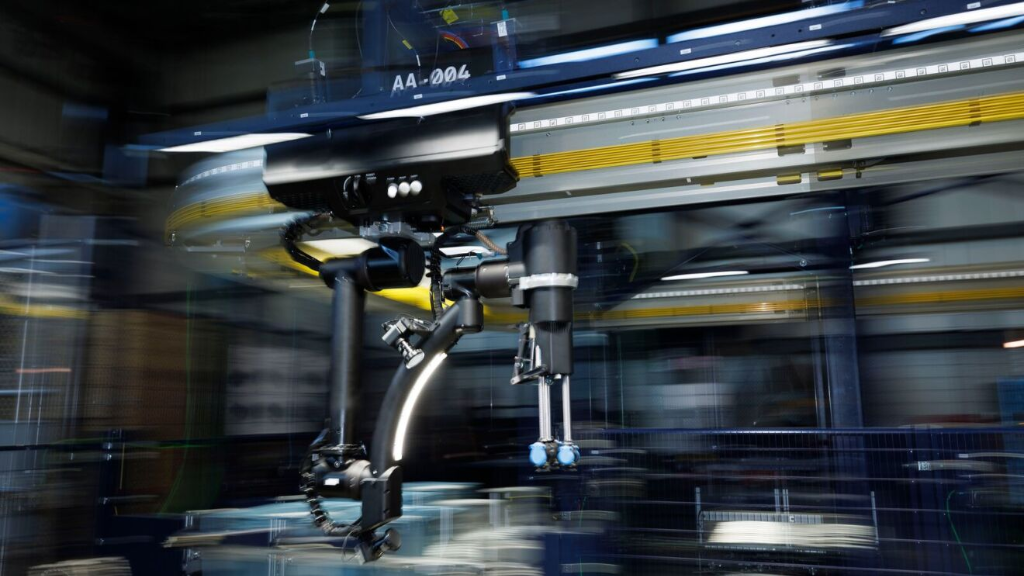
Core Insights - Amazon is deepening its automation strategy with the introduction of a new multifunctional warehouse robot system called "Blue Jay," which is currently being tested in South Carolina [1][2] - The automation team at Amazon anticipates that by 2027, over 160,000 jobs in the U.S. could be eliminated due to automation, although the company disputes the completeness and accuracy of these internal documents [2][6][7] - Morgan Stanley analysts estimate that the promotion of automated warehouses could save Amazon up to $4 billion by 2027 [2] Group 1: Blue Jay System - The Blue Jay system integrates multiple functions such as picking, sorting, and consolidating packages into a single streamlined workstation [2][5] - The system can handle approximately 75% of the product types stored at the testing site in South Carolina [5] - The development of Blue Jay took just over a year, showcasing advancements in technology compared to earlier systems that required three years or more [5] Group 2: Automation and Workforce Impact - Amazon claims that automation aims to improve employee safety and create more valuable positions, but this assertion is met with skepticism [6][8] - The company emphasizes that it is focused on reducing physically demanding tasks and simplifying decision-making for workers [8] - Amazon provides apprenticeship programs in mechatronics and robotics to help employees develop skills for maintaining and monitoring robotic equipment [8] Group 3: Additional Technological Innovations - In addition to Blue Jay, Amazon has introduced "Project Eluna," an AI system designed to support operational managers by predicting bottlenecks and recommending solutions [9] - Amazon has also developed augmented reality (AR) glasses for delivery drivers, which integrate AI, sensors, and cameras to enhance their workflow [9] - These innovations reflect Amazon's ongoing efforts to incorporate more technology into the workflows of its contracted delivery drivers [9]


利亚德以“显示为基、文旅为翼、AI赋能”,开启第二增长曲线新征程
Huan Qiu Wang· 2025-09-22 02:12
Core Viewpoint - The company, Leyard, has transformed from a small LED display manufacturer in 1995 to a multinational technology group with a market value of several hundred billion by 2025, announcing a new strategy focused on "Display + Cultural Tourism + AI and Spatial Computing" during its 30th anniversary celebration [1][8]. Group 1: Business Transformation - Leyard's chairman, Li Jun, emphasized that innovation has been the core driver of the company's growth, successfully capturing the high-end display market globally [3]. - The company's overseas revenue has surpassed domestic revenue for the first time, with its North American brand, PLANAR, achieving historic order performance in 2025 [3]. - Leyard introduced the Hi-Micro technology, a substrate-free Micro LED technology that significantly enhances display performance while reducing costs and improving yield, paving the way for large-scale applications [3]. Group 2: Cultural Tourism as a Growth Driver - Leyard views cultural tourism as its second growth curve, aiming to become a leading global comprehensive service provider in this sector [6]. - The cultural tourism market is substantial, with the night economy reaching 1.9 trillion and the entertainment market around 80 billion, indicating significant growth potential [6]. - The company has adopted a "2+4+1" strategic framework to enhance business models and increase customer retention and engagement [6]. Group 3: AI Integration - Leyard has committed to fully embracing AI to drive its second growth curve, integrating AI into its main business areas, including content creation and holographic generation in the display sector [7]. - The company has made significant advancements in AI technology, with robots now serving as guides and interpreters in cultural tourism settings [7]. - Leyard's acquisition of American company OptiTrack has positioned it to profit from AI-related business ventures [7]. Group 4: Strategic Vision - Leyard's strategy has evolved from being a single display manufacturer to an ecosystem-oriented enterprise focusing on "Display + Cultural Tourism + AI and Spatial Computing" [8]. - The company aims to collaborate with partners to create a new blueprint for audiovisual technology, reflecting a significant shift in its operational mindset [9].