复方丹参滴丸

Search documents
中银证券研究部2026年4月金股
Bank of China Securities· 2026-04-01 07:58
Core Insights - The domestic fundamental and liquidity environment is expected to support the A-share market, with short-term influences from the Middle East situation and control over the Taiwan Strait [2][4] - The A-share market may face a decisive period in April, with potential recovery in earnings as the financial reporting window opens [2][4] - Investment opportunities in the new energy sector are highlighted, particularly in solar and wind power, which are less affected by geopolitical conflicts and fossil fuel prices [2][4] Real Estate Sector: Poly Real Estate Group - Poly Real Estate Group's sales ranking improved to 12th in January 2026, with a sales amount of 3.7 billion yuan, despite a year-on-year decline of 22.9% [8] - The company achieved a sales area of 150,000 square meters in January 2026, down 6.8% year-on-year, with an average sales price of 24,800 yuan per square meter, a decrease of 16.5% [8] - The company has a strong backing from its parent company, Poly Group, which holds 48.09% of its shares, providing stability and growth potential [11] Transportation Sector: COSCO Shipping Specialized Carriers - COSCO Shipping Specialized Carriers reported a revenue of 16.611 billion yuan in the first three quarters of 2025, a year-on-year increase of 37.92% [13] - The company’s net profit reached 1.329 billion yuan, up 10.54% year-on-year, with a significant increase in cash flow from operating activities [13] - The expansion of the fleet and increased shipping business revenue are key drivers of growth, despite rising operational costs [13][14] Transportation Sector: Jitu Express - Jitu Express achieved a total revenue of 5.499 billion USD in the first half of 2025, a year-on-year increase of 13.1%, with significant growth in the Southeast Asian market [15][16] - The company’s Southeast Asian market revenue grew by 29.6%, reaching 1.970 billion USD, with an adjusted EBITDA of 313 million USD [15][16] - The company is focusing on cost optimization and pricing strategies to enhance market share in a competitive environment [17] Chemical Sector: Satellite Chemical - Satellite Chemical reported a gross margin of 22.31% in 2025, with a net margin of 11.52%, despite a slight decline in both metrics [18] - The company’s asset-liability ratio decreased to 51.74%, indicating improved financial stability [18] - The company plans to distribute a cash dividend of 1.678 billion yuan, reflecting a commitment to shareholder returns [18] Chemical Sector: Yake Technology - Yake Technology's revenue grew significantly due to increased sales in LNG and electronic materials, although net profit growth lagged behind revenue growth due to foreign exchange losses [21][22] - The company is focusing on developing advanced semiconductor materials and has established a dual R&D department in China and South Korea [22] - The company’s gross margin was 31.82%, with a net margin of 13.29%, indicating stable profitability despite rising R&D costs [21] New Energy Sector: CATL - CATL reported a revenue of 423.702 billion yuan in 2025, a year-on-year increase of 17.04%, with a net profit growth of 42.28% [25] - The company maintained its leading position in the global battery market, achieving a market share of 39.2% in 2025 [25][26] - CATL's energy storage battery sales grew by 29.13%, with ongoing expansion of production capacity to meet market demand [26] Pharmaceutical Sector: Tasly Pharmaceutical - Tasly Pharmaceutical's revenue was 8.236 billion yuan in 2025, a slight decline of 3.08%, with core products showing stable sales [27][28] - The company is focusing on innovation and has a robust pipeline of new drug projects, with significant R&D investment [29] - The integration with China Resources has strengthened the company's market position and operational efficiency [27] Food and Beverage Sector: Kweichow Moutai - Kweichow Moutai's revenue for Q3 2025 was 39.06 billion yuan, with a slight year-on-year increase of 0.6%, indicating a strategic adjustment in growth [33] - The company is focusing on maintaining quality and long-term value, with plans for internationalization and brand enhancement [32][33] - The company announced a cash dividend of 23.957 yuan per share, reflecting its commitment to shareholder returns [33] Staffing Sector: Core International - Core International expects a steady increase in revenue and net profit in 2025, driven by technological advancements and operational efficiency [35] - The company is leveraging its data and technology capabilities to enhance its service offerings and market presence [35] - The integration of various business lines is expected to drive growth and improve profitability [35] Electronics Sector: Haixing Co., Ltd. - Haixing Co., Ltd. is positioned to benefit from the growing demand for AI server capacitors, with a projected market size increase in the coming years [37][38] - The company is enhancing its production capabilities to meet the rising demand for high-end aluminum electrolytic capacitors [38] - The company holds a leading market share in the aluminum foil sector, with ongoing improvements in technology and production processes [37]





华润三九(000999):“一体两翼”落地显效,创新与并购双轮驱动增长
Guolian Minsheng Securities· 2026-03-26 23:30
Investment Rating - The report maintains a "Buy" rating for China Resources Sanjiu (000999.SZ) [3][7]. Core Views - The company's "one body, two wings" strategy has shown effectiveness, driving growth through innovation and acquisitions [7]. - The revenue for 2025 is projected at 31.603 billion yuan, with a year-on-year growth of 14.43%, while the net profit attributable to shareholders is expected to be 3.421 billion yuan, reflecting a year-on-year increase of 1.58% [7]. - The report anticipates revenue growth for 2026 to 2028 at 10.6%, 9.4%, and 8.8% respectively, with net profit growth rates of 10.8%, 13.3%, and 11.5% [7]. Financial Forecasts and Indicators - **Revenue Forecast**: - 2025: 31,603 million yuan - 2026: 34,937 million yuan - 2027: 38,208 million yuan - 2028: 41,582 million yuan - Growth Rates: 14.4% (2025), 10.6% (2026), 9.4% (2027), 8.8% (2028) [3][8] - **Net Profit Forecast**: - 2025: 3,421 million yuan - 2026: 3,792 million yuan - 2027: 4,296 million yuan - 2028: 4,791 million yuan - Growth Rates: 1.6% (2025), 10.8% (2026), 13.3% (2027), 11.5% (2028) [3][8] - **Earnings Per Share (EPS)**: - 2025: 2.06 yuan - 2026: 2.28 yuan - 2027: 2.58 yuan - 2028: 2.88 yuan [3][8] - **Valuation Ratios**: - Price-to-Earnings (P/E): 14 (2025), 12 (2026), 11 (2027), 10 (2028) - Price-to-Book (P/B): 2.1 (2025), 2.0 (2026), 1.8 (2027), 1.6 (2028) [3][8] Business Segments - **Consumer Health Care (CHC)**: - Revenue: 151.11 billion yuan, accounting for 47.81% of total revenue, with a gross margin of 61.67% [7]. - **Prescription Drugs**: - Revenue: 120.94 billion yuan, accounting for 38.27% of total revenue, with a gross margin of 58.81% [7]. Dividend Policy - The company distributed a total cash dividend of 1.731 billion yuan in 2025, with a payout ratio of 50.59% and a dividend yield of 3.65% [7].

中银晨会聚焦-20260324-20260324
Bank of China Securities· 2026-03-23 23:30
Core Insights - The report highlights the investment opportunities in the pharmaceutical sector, particularly focusing on Tianjin Tianshi Co., Ltd. after the acquisition by China Resources Group, which is expected to drive long-term growth [5][6][9] - The report emphasizes the structural bull market trend in the A-share market, with a focus on the rising opportunities in the new energy sector due to elevated oil prices [11][12][13] - The transportation sector is experiencing shifts due to geopolitical tensions, with shipping routes being adjusted and new business models emerging in low-altitude economy and autonomous driving [21][22] Pharmaceutical Sector - Tianjin Tianshi reported a revenue of 8.236 billion yuan in 2025, a decrease of 3.08% year-on-year, while net profit attributable to shareholders was 1.105 billion yuan, an increase of 15.63% [5][6] - The company is focusing on innovation and has a robust pipeline with 31 projects under development, including 11 in cardiovascular and metabolic diseases [8] - The management has implemented a strategic plan aiming for a doubling of industrial revenue to 15 billion yuan by 2030, leveraging resources from China Resources [6][9] Energy Sector - The report notes that Brent crude oil prices have remained above $100, influenced by geopolitical conflicts, which underscores the importance of energy transition [13] - The new energy sector, including solar and wind power, is expected to perform well as it is less affected by geopolitical tensions compared to fossil fuels [13] - Investment opportunities in the new energy sector are highlighted, with various segments such as batteries and storage systems showing promising growth [13] Transportation Sector - The report discusses the impact of the geopolitical situation on shipping routes, with VLCCs rerouting to avoid disruptions in the Strait of Hormuz [21][22] - Air cargo capacity remains tight due to Middle Eastern tensions, leading to adjustments in flight schedules and routes by carriers [21][22] - The emergence of new business models in the low-altitude economy, including partnerships between tech companies and ride-sharing platforms, is noted as a significant trend [21][22]


【天士力(600535.SH)】首年融合顺利完成,“十五五”规划彰显信心——2025年年报点评(黄素青)
光大证券研究· 2026-03-22 23:05
Core Viewpoint - The company reported its 2025 annual results, showing a slight decline in revenue but a significant increase in net profit, primarily due to the appreciation of financial assets [4][5]. Financial Performance - In 2025, the company achieved operating revenue of 8.236 billion, a year-on-year decrease of 3.08%, while net profit attributable to shareholders rose by 15.63% to 1.105 billion [4]. - The company's cash flow from operating activities was 1.425 billion, down 29.28% year-on-year [4]. - The basic earnings per share (EPS) for 2025 was 0.74 yuan [4]. Industry Analysis - The pharmaceutical industry revenue remained stable, with the company's pharmaceutical manufacturing and commercial revenue at 7.382 billion and 766 million, respectively, reflecting declines of 2.54% and 14.40% [5]. - The decline in revenue was attributed to price reductions from centralized procurement and challenges in the traditional Chinese medicine injection market [5]. Profitability Metrics - The company's gross margin decreased by 0.29 percentage points to 66.85%, with pharmaceutical manufacturing and commercial gross margins at 70.37% and 31.85%, respectively [6]. - The decline in gross margin was linked to price reductions for specific products, such as the compound Danshen dripping pill [6]. - The company maintained a stable expense ratio, with total expenses decreasing by 0.52 percentage points to 48.18% [6]. Innovation and Strategic Planning - The company is committed to innovation in traditional Chinese medicine and advanced therapeutic drugs, focusing on cardiovascular, metabolic, neurological, and digestive fields [7]. - As of now, the company has 31 innovative drugs in development, with 4 in NDA/Pre NDA stages and 17 in clinical phases II and III [7]. - The company aims to double its industrial revenue to 15 billion by the end of 2030, reflecting strong confidence in its development strategy [8].


天士力(600535):华润入主开启新篇章,创新转型效果初显
Bank of China Securities· 2026-03-22 13:27
Investment Rating - The investment rating for the company is "Buy" with a market price of RMB 14.15, and the sector rating is "Outperform" compared to the market [2][4]. Core Views - The report highlights that with the entry of China Resources Group as the controlling shareholder, the company is undergoing a significant transformation, leading to improved governance and strategic upgrades. The approval of innovative traditional Chinese medicine products is expected to drive performance recovery and open long-term growth potential [4][6]. - The company reported a revenue of RMB 8.236 billion for 2025, a decrease of 3.08% year-on-year, while the net profit attributable to shareholders was RMB 1.105 billion, an increase of 15.63% year-on-year. The report anticipates a net profit of RMB 1.277 billion for 2026, reflecting a growth rate of 15.6% [4][6]. Summary by Sections Financial Performance - In 2025, the company achieved a revenue of RMB 82.36 billion, with a decline of 3.08% year-on-year. The net profit attributable to shareholders was RMB 11.05 billion, up 15.63% year-on-year. The fourth quarter of 2025 saw revenues of RMB 19.26 billion, down 5.39% year-on-year, and a net profit of RMB 1.21 billion, up 6.35% year-on-year [4][6]. - The report projects the company's net profit for 2026-2028 to be RMB 12.77 billion, RMB 14.04 billion, and RMB 15.73 billion, respectively, with corresponding EPS of RMB 0.85, RMB 0.94, and RMB 1.05 [6][8]. Market Position and Strategy - The company is focusing on enhancing its core business and expanding its innovative product pipeline, which is expected to contribute to stable growth in performance. The report emphasizes the importance of the collaboration with China Resources in optimizing sales expenses and improving management efficiency [4][6][9]. - The company aims to double its industrial revenue to RMB 15 billion by 2030, positioning itself among the top tier of pharmaceutical companies in China. The integration of resources and strategic planning with China Resources is expected to provide long-term growth momentum [9]. Research and Development - The company has increased its R&D investment to RMB 8.45 billion in 2025, accounting for 11.45% of its pharmaceutical industrial revenue. There are currently 31 innovative drug projects under development, with several in advanced clinical stages [9][10]. - The report notes that the company is focusing on cardiovascular and metabolic diseases, with multiple innovative drugs in various clinical trial phases. The successful approval of new products is anticipated to enhance market share and revenue [9][10].
天士力(600535):2025年年报点评:首年融合顺利完成,十五五规划彰显信心
EBSCN· 2026-03-22 06:32
Investment Rating - The report maintains a "Buy" rating for the company [1] Core Insights - The company achieved operating revenue, net profit attributable to shareholders, and net profit excluding non-recurring items of 8.236 billion, 1.105 billion, and 0.791 billion yuan respectively, with year-on-year changes of -3.08%, +15.63%, and -23.59% [5] - The company’s cash flow from operating activities was 1.425 billion yuan, down 29.28% year-on-year [5] - The company’s gross profit margin decreased by 0.29 percentage points to 66.85%, primarily due to price reductions from centralized procurement [7] - The company has a strong focus on innovation, with 31 innovative drugs in development, including 4 in NDA/Pre NDA stages and 17 in clinical II and III phases [8] - The company aims to double its industrial revenue to 15 billion yuan by the end of 2030 as part of its "14th Five-Year Plan" [8] Financial Performance - The company’s revenue from the pharmaceutical industry and pharmaceutical commerce was 7.382 billion and 766 million yuan respectively, with year-on-year changes of -2.54% and -14.40% [6] - The company’s net profit attributable to shareholders is projected to reach 1.276 billion yuan in 2026, reflecting a growth rate of 15.49% [10] - The company’s total assets are expected to grow from 15.34 billion yuan in 2025 to 17.21 billion yuan in 2028 [12] Profitability and Valuation - The company’s projected P/E ratios for 2026, 2027, and 2028 are 17, 14, and 13 respectively [10] - The company’s return on equity (ROE) is expected to increase from 8.91% in 2025 to 11.06% in 2028 [13] - The company’s gross profit margin is expected to stabilize around 67.1% from 2026 to 2028 [13]
天士力20260319
2026-03-20 02:27
Summary of Tianjin Tasly Pharmaceutical Conference Call Company Overview - **Company**: Tianjin Tasly Pharmaceutical Co., Ltd. - **Industry**: Pharmaceutical Strategic Goals - **2030 Strategic Target**: Achieve industrial revenue and profit of 15 billion RMB, doubling current figures and positioning among the top tier of Chinese pharmaceutical companies [2][5] - **Integration with China Resources Sanjiu**: Expected to enhance marketing, R&D, and management, with a 20% increase in terminal coverage by 2025 [2][3] Core Products and Market Expectations - **Compound Danshen Dripping Pills**: Sales expected to reach 300 million RMB by 2025, with the impact of price reductions from centralized procurement expected to diminish by 2026 [2][3] - **Puyouke for Stroke Indication**: Market potential expected to expand 4-5 times post-approval, with a target to develop it into a product exceeding 1 billion RMB in sales [2][3] - **Sales Growth of Core Products**: Five core products showed stable growth in 2025, with significant contributions from Qi Shen Yi Qi Dripping Pills and Yangxue Qingnao Granules, the latter exceeding 100 million RMB in sales [7][8] R&D and Innovation Focus - **R&D Transformation**: Shift from generic drug investment to focus on innovative traditional Chinese medicine (TCM) and advanced therapies, with 31 innovative drug candidates currently in development [2][5][12] - **Clinical Trials**: Multiple innovative TCM products are in Phase III clinical trials, showcasing strong competitive advantages in fever and gout treatment [2][5] Marketing and Sales Strategies - **"Fifteen" Strategic Plan**: A comprehensive plan focusing on innovation-driven growth, with nine key strategic initiatives including enhancing R&D efficiency, cost control, and marketing system improvements [3][5] - **Academic Promotion**: Emphasis on academic marketing to enhance product competitiveness and market share, particularly for core products [9][13] Financial Performance and Projections - **Revenue and Profit Growth**: Aiming for double-digit growth in revenue and profit by 2026 through a "foundation in hospitals, efficiency outside" business model [6][9] - **Sales and R&D Expenses**: Focus on cost control in sales expenses while increasing R&D investment in innovative drugs, reducing resources allocated to generics [22] Collaboration and Integration - **Synergy with China Resources Sanjiu**: Successful integration efforts have led to improved operational efficiency and enhanced market coverage, particularly in retail and e-commerce channels [6][10] - **Retail Strategy**: Plans to strengthen prescription management and patient education in the outpatient market, leveraging a large sales team for effective terminal activation [10][11] Emerging Therapeutic Areas - **Small Nucleic Acids and CGT**: Early-stage projects in small nucleic acids and cell and gene therapy (CGT) are being developed, with a focus on innovative treatment options [15][16] - **Market Potential for New Indications**: Significant market opportunities identified for new indications of existing products, particularly in stroke and metabolic diseases [17][18] Conclusion - **Overall Outlook**: The company is positioned for substantial growth through strategic integration, innovative product development, and enhanced marketing efforts, aiming to solidify its status as a leading player in the Chinese pharmaceutical market by 2030 [2][5][9]
深市并购重组提质增效:“48%增速+近八成产业并购”
证券时报· 2026-03-16 08:43
Core Viewpoint - The article emphasizes the importance of mergers and acquisitions (M&A) as a strategy for companies to enhance their core competitiveness and achieve sustainable development, particularly in the context of the "Six M&A Guidelines" implemented since 2024 [1][3][5]. Group 1: M&A Market Activity - The Shenzhen Stock Exchange (SZSE) has seen a significant increase in M&A activity, with 1,317 new disclosed M&A transactions in 2025, representing a 48% year-on-year growth, and 114 major restructurings, up 52% [1][3]. - The focus of M&A has shifted back to core industries, with nearly 80% of transactions involving companies within the same industry or related upstream and downstream sectors [3][5]. Group 2: Strategic Restructuring - Companies are increasingly using strategic restructuring to break through traditional growth bottlenecks and transition to new productive forces, supported by a more accommodating regulatory environment [5][6]. - Notable examples include China Resources Sanjiu's acquisition of Tian Shili's controlling stake, enhancing its product portfolio and market position in traditional Chinese medicine [3][6]. Group 3: Cross-Border Integration - Cross-border M&A is becoming a vital strategy for companies to integrate global resources and enhance international competitiveness, moving towards precise supply chain supplementation and global positioning [8][9]. - New Giant Feng's acquisition of Hong Kong-listed Funmei Packaging exemplifies this trend, as it aims to enhance supply chain control and competitiveness [9]. Group 4: Capital Empowerment - The "Six M&A Guidelines" support private equity funds in acquiring listed companies to facilitate industrial integration, leveraging their resources and capabilities to empower these companies [11][12]. - Examples include Qiming Venture Partners' acquisition of a stake in Tianmai Technology, which aims to expand into smart transportation and vehicle networking [12]. Group 5: Regulatory Optimization - The SZSE is actively implementing the "Six M&A Guidelines" by optimizing regulatory standards and enhancing service efficiency to support high-quality M&A activities [13][14]. - In 2025, the SZSE received 45 share restructuring applications, a 309% increase year-on-year, with a 100% approval rate for 16 of these applications, indicating improved efficiency in the review process [14].

天士力国际化遇挫,复方丹参滴丸出海之路再添变数
Xin Lang Cai Jing· 2026-02-13 07:14
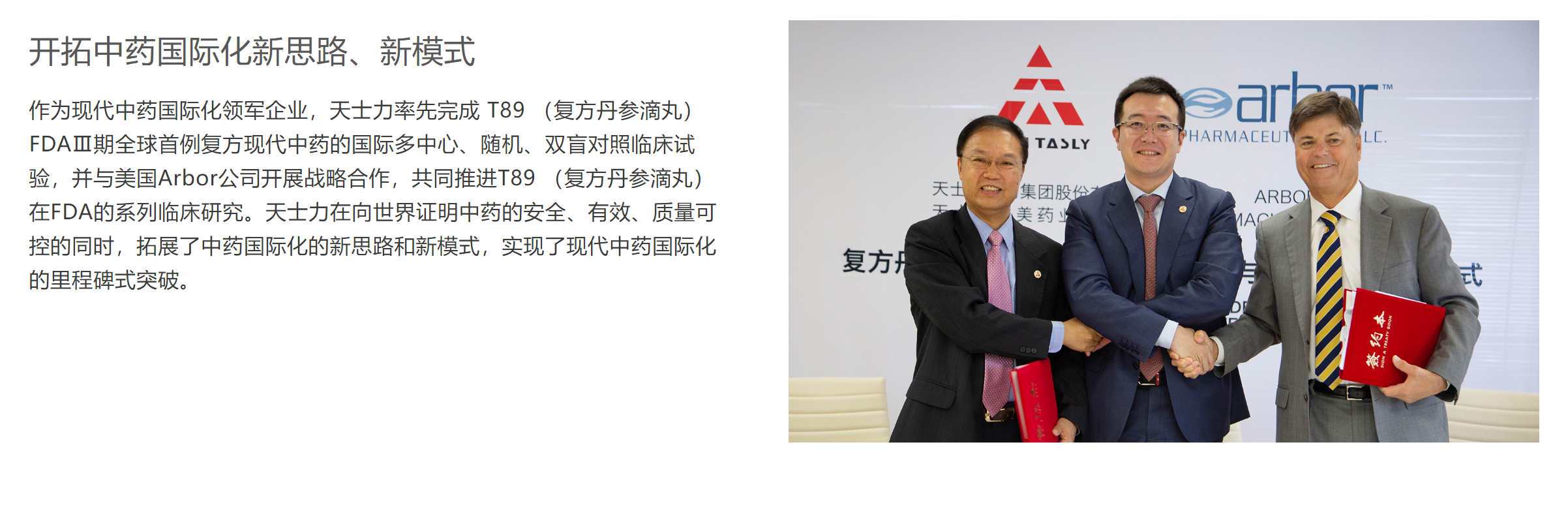
Core Viewpoint - Recently, the company Tian Shi Li announced the termination of its cooperation agreement with the US company Arbor, halting the joint plan for the compound Danshen dripping pill (T89) in the US market. Although the company stated it would recover related rights and receive $7.5 million, and that this would not have a significant impact on its production and operations, the event reflects the multifaceted risks and challenges faced by Tian Shi Li in the internationalization of traditional Chinese medicine, research and development progress, and corporate operations [1][4]. Group 1: Internationalization Strategy Challenges - The compound Danshen dripping pill has been under FDA clinical application in the US since 1998, making it a landmark project for the internationalization of traditional Chinese medicine. However, the termination of the partnership with Arbor signifies a setback in the strategy of leveraging local partners for market entry [5][6]. - Despite the company emphasizing its accumulated international clinical experience and that the application process is not entirely dependent on Arbor, the exit of the partner undoubtedly increases the uncertainty of its independent advancement. Currently, the two indications for the drug—chronic stable angina and acute altitude sickness—are still in phase III clinical trials, with no clear timeline for final approval [6]. Group 2: Research and Development Progress and Regulatory Risks - The approval process for the compound Danshen dripping pill in the US has been fraught with difficulties. In 2017, the FDA required the company to complete a second confirmatory clinical trial in addition to an already completed phase III trial, with both trials needing to achieve statistical significance (p<0.05). The first trial took about four years, and the second trial, which started in 2018, has exceeded four years without results [2][6]. - This prolonged and high-investment clinical process not only brings financial pressure but also reflects the stringent challenges faced by traditional Chinese medicine formulations under Western regulatory systems. If the results of the second clinical trial do not meet the standards, years of effort may be wasted. The company's "lone battle" in the internationalization of traditional Chinese medicine—where only a few traditional Chinese medicine products have attempted to navigate the FDA—also makes it difficult to learn from peers, leading to high trial-and-error costs [2][6]. Group 3: Operational Difficulties and Transformation Challenges - The journey of the compound Danshen dripping pill abroad mirrors the development trajectory of Tian Shi Li in recent years. The company's revenue approached 19 billion yuan between 2016 and 2019, but has since been under pressure due to the sale of its marketing subsidiary and the impact of medical insurance cost control and centralized procurement policies. In 2025, the company's revenue was 8.236 billion yuan, a year-on-year decline of 3.08%, while the net profit excluding non-recurring items was 786 million yuan, down 24.06% year-on-year, indicating a continued lack of growth momentum [2][7]. - Additionally, the company officially integrated into the China Resources Sanjiu system in 2025, which may provide resource support but also means that its original development strategy will face adjustments. In the context of weak growth in its main business and slow internationalization progress, how Tian Shi Li repositions its core competitive path will be a key question for its future development [7]. Conclusion - The "American dream" of the compound Danshen dripping pill remains unfulfilled, while Tian Shi Li has entered a new development cycle. From self-research challenges to setbacks in cooperation, and from peak performance to integration and transformation, the case of this leading traditional Chinese medicine enterprise illustrates that the internationalization of traditional Chinese medicine involves not only technical compliance and clinical data but also a multifaceted test of corporate strategic determination, financial endurance, and market adaptability. The company still needs to find a feasible path to bridge traditional Chinese medicine and modern pharmaceutical systems [3][8].
天士力复方丹参滴丸出海美国再受挫
Xin Lang Cai Jing· 2026-02-09 13:03
Core Viewpoint - Tianshili has terminated its collaboration with Arbor Pharmaceuticals, impacting the U.S. market expansion plan for its compound Danshen dripping pill (T89), which was a key project for the internationalization of traditional Chinese medicine [1][4]. Group 1: Collaboration Termination - The termination of the partnership with Arbor was due to Arbor's acquisition by Azurity and subsequent business adjustments, leading to the end of the U.S. market cooperation plan for T89 [1][4]. - Tianshili will receive a payment of $7.5 million as part of the termination agreement and will regain exclusive sales rights for T89 in the U.S. [1][4]. - The company stated that this termination will not significantly impact its project advancement, production operations, or financial status [1][4]. Group 2: Historical Context of T89 - The internationalization of T89 began in 1998 when it was officially approved for clinical research by the U.S. FDA [3]. - T89 received FDA approval for indications related to chronic stable angina and acute altitude sickness in 2006 and 2018, respectively [4]. - Tianshili and Arbor signed a licensing agreement in September 2018, with Arbor committing up to $23 million for research and obtaining exclusive sales rights for T89 in the U.S. [4]. Group 3: Clinical Trials and Regulatory Challenges - Tianshili has accumulated significant overseas clinical trial experience prior to the collaboration with Arbor, having completed a large-scale Phase III clinical trial [4][5]. - The success of T89's U.S. market entry hinges on obtaining regulatory approval based on clinical data, with the product still awaiting approval [5][6]. - Tianshili is currently conducting two Phase III clinical trials for T89, with the results of the second trial being crucial for U.S. approval [6][9]. Group 4: Company Performance and Market Position - Tianshili is a leading company in the modern Chinese medicine sector, listed on the Shanghai Stock Exchange since 2002 [7]. - T89 is Tianshili's most recognized product, achieving sales of over 3.3 billion yuan in 2015 and maintaining its position as the top-selling traditional Chinese medicine product for 13 consecutive years [8]. - The company has faced declining revenues since 2020, with total revenue of 8.236 billion yuan in 2025, a decrease of 3.08% year-on-year, and a net profit decline of 24.06% [11].