天工Skywork

Search documents
未知机构:昆仑万维稀缺大模型标的重视价值重估机会催化智谱Mini-20260224
未知机构· 2026-02-24 02:30
Summary of Company and Industry Insights Company: Kunlun Wanwei Key Points 1. **Model Development**: Kunlun Wanwei has a comprehensive layout in large models, applications, and computing infrastructure. The company’s large models cover multiple fields, with the music model Mureka ranked among the global top tier. The release of version V8 in January has enhanced music creation capabilities, and the company plans to launch AI Studio, aiming for an AI version of Spotify [1][1][1]. 2. **Revenue Generation**: The company has started generating revenue from its AI software technology, reporting an income of 65.27 million yuan in the first half of 2025, which represents a year-on-year growth of over 10 times. Key products contributing to AI revenue include Skywork, Linky (AI social), and Mureka (AI music) [1][1][1]. 3. **Growth in AI Applications**: The desktop version of Skywork and the new version of Mureka are expected to contribute additional revenue. The company is actively expanding its AI applications into short dramas and comics, with its paid platform DramaWave and free platform FreeReels establishing a strong position in the overseas short drama market [1][1][1]. 4. **User Metrics**: The Monthly Active Users (MAU) have surpassed 80 million, with monthly revenue exceeding 40 million USD, indicating a continued upward trend [2][2][2]. 5. **Investment in Computing Power**: Kunlun Wanwei has invested in AI chip development through its 58% stake in Aijiekexin, focusing on enhancing its computing power capabilities [2][2][2]. Additional Insights - The significant growth in AI software revenue and user engagement metrics suggests a robust market position and potential for further expansion in the AI sector. - The strategic investments in AI chip development may enhance the company's competitive edge in the rapidly evolving technology landscape.

腾讯研究院AI速递 20251127
腾讯研究院· 2025-11-26 16:11
Group 1 - OpenAI integrates the "Voice Mode" into the main chat interface, allowing seamless voice and text interaction without mode switching [1] - The new version provides natural voice responses, real-time visual content generation, and automatic voice-to-text transcription [1] - Users can switch back to the old independent voice mode if they prefer an immersive audio experience [1] Group 2 - OpenAI is testing a new App Directory on the ChatGPT web platform, allowing developers to showcase third-party applications systematically [2] - The directory presents AI applications in a card format across various scenarios, enabling users to browse, search, and add applications easily [2] - With 400 million weekly active users and a processing capacity of 6 billion tokens per minute, the App Directory is set to transform AI application distribution [2] Group 3 - The FLUX.2 image generation model family has been released, capable of referencing up to 10 images for consistency in character, product, and style [3] - The open-source FLUX.2 [dev] model features 32 billion parameters and has gained popularity on Hugging Face [3] - The model excels in hyper-realistic image generation but currently does not support Chinese rendering [3] Group 4 - Character.AI introduces a new "Stories" feature for users under 18, shifting from open chat to structured interactions [4] - The CEO expressed concerns about the psychological risks of open chat for users under 18, leading to this decision [4] - California has become the first state to regulate AI companions, with federal proposals aiming to ban their use by minors [4] Group 5 - TRAE's domestic version launches the SOLO mode, introducing features like SOLO Coder, Plan mode, and multi-tasking capabilities [6] - The SOLO mode is designed as a "responsive programming agent," supporting retrieval of 100,000 code files for extensive context [6] - The core design philosophy is "All in One," allowing developers to focus on guiding AI rather than real-time pairing with AI programming assistants [6] Group 6 - Tencent's Hunyuan 3D creation engine launches an international site, with a model API now available for global users [7] - The latest Hunyuan3D 3.0 version introduces a 3D-DiT hierarchical sculpting model, improving modeling precision by three times [7] - Over 150 companies have integrated Tencent Cloud, significantly reducing traditional 3D production times from days to minutes [7] Group 7 - Skywork launches a "Professional Data" mode, connecting to 430 authoritative data sources across various fields [8] - The platform integrates data from key sources like the World Bank and NASA, enabling unified responses and data aggregation [8] - It ensures transparency and reliability in decision-making by providing traceable data sources for all answers [8] Group 8 - Ilya Sutskever discusses the transition from the "Scaling era" to the "Research era," emphasizing the limitations of current technology in achieving AGI [9] - He identifies model generalization as a core bottleneck, stating that even extensive training does not yield true problem-solving intuition [9] - Sutskever predicts the emergence of AI systems that can learn and surpass human capabilities within 5 to 20 years [9] Group 9 - NVIDIA acknowledges Google's successful development of TPU but asserts that its GPUs remain a generation ahead [10] - Google is promoting TPU solutions to major institutions like Meta, which plans to invest billions in TPU by 2027 [10] - NVIDIA emphasizes its unique position as the only hardware platform compatible with all AI models and scenarios [11]



中厂样本:昆仑万维5.6亿元现金流“失血” AI全栈自研的激进与代价
Xi Niu Cai Jing· 2025-09-11 01:53
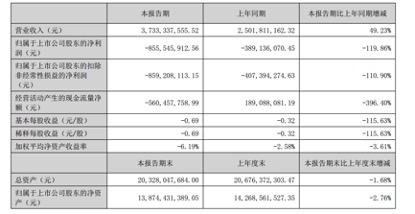
Core Viewpoint - Kunlun Wanwei is facing significant financial challenges despite a notable increase in revenue, highlighting the difficulties of mid-sized companies in the competitive AI landscape [1][4][10]. Financial Performance - In the first half of 2025, Kunlun Wanwei reported revenue of 3.733 billion yuan, a year-on-year increase of 49.23% [2][11]. - The company experienced a net loss of 8.56 billion yuan, which is an increase of nearly 120% compared to the previous year [1][4]. - Operating cash flow showed a net outflow of 560 million yuan, a dramatic decline of 396% year-on-year [1][12]. Cost Structure - Operating costs surged by 106.21% to 1.125 billion yuan, primarily due to increased business activities [3][11]. - Sales expenses rose by 95.57% to 1.828 billion yuan, reflecting higher marketing and channel costs [3][11]. - Management expenses increased by 33.04% to 620 million yuan, largely due to rising equity incentive costs [3][11]. Revenue Sources - The revenue growth was significantly supported by overseas short drama and advertising businesses, which contributed 14.33 billion yuan and 5.83 billion yuan respectively [4][9]. - Overseas revenue accounted for 92% of total revenue, with a 56% year-on-year increase [9][12]. AI Business Challenges - Despite heavy investments in AI, the commercialization of AI products remains in its early stages, with the AI model "Skywork" showing declining download numbers [12][13]. - The company’s strategy of extensive investment in AI has not yet translated into profitability, raising concerns about its sustainability [10][15]. Strategic Positioning - Kunlun Wanwei's identity as a mid-sized player limits its competitive edge against larger firms with more resources [10][14]. - The company is pursuing a "full-stack self-research" approach in AI, which may be overly aggressive given the current financial pressures [10][14]. Future Outlook - The chairman has expressed confidence in achieving profitability by 2026, driven by the expansion of overseas markets and AI product collaborations [13][15]. - However, the uncertainty surrounding whether AI revenue growth can outpace rising costs remains a critical concern [13][15].