太乙

Search documents
北京新年人工智能第一会 释放了什么信号?
Xin Jing Bao· 2026-01-05 23:48
Core Insights - Beijing is positioning itself as a global hub for artificial intelligence (AI) innovation, with a projected core industry scale of 4.5 trillion yuan by 2025, reflecting a year-on-year growth of 25.3% [3][5] - The city has over 2,500 AI companies and has registered 209 large models, accounting for nearly 30% of the national total [3][5] - The "Nine Major Actions" plan aims to enhance AI foundational theories and core technology capabilities significantly within two years, targeting the emergence of more original achievements and a competitive industry landscape [7][9] Industry Development - AI technology is deeply integrated into urban development in Beijing, transitioning from laboratory concepts to practical applications in various sectors such as healthcare, education, and transportation [4][9] - Major companies like Xiaomi and Altair are leveraging AI for industrial applications, enhancing efficiency and innovation in product design and quality control [2][4] - The city is home to nearly 60 listed AI companies and about 40 unicorns, showcasing its strong industrial cluster development [5][6] Talent and Ecosystem - Beijing boasts a significant talent pool, with 148 influential AI scholars and a total of 15,000 AI researchers, representing over 30% of the national total [4][5] - The city has established a robust ecosystem that includes two national laboratories, four new research institutions, and numerous educational programs in AI [4][5] - The favorable business environment and diverse application scenarios in Beijing provide a solid foundation for AI technology deployment and iteration [4][5] Future Directions - The focus on "scientific intelligence" aims to enhance AI's role in scientific discovery, with an emphasis on integrating AI with the physical world [9] - The goal is for embodied intelligence to serve as a partner to humans rather than a replacement, indicating a shift towards collaborative AI applications [9] - The city aims to surpass a core AI industry scale of 1 trillion yuan and establish a new form of intelligent economy within the next two years [9]

北京新年人工智能第一会,释放了什么信号?
Bei Ke Cai Jing· 2026-01-05 15:00
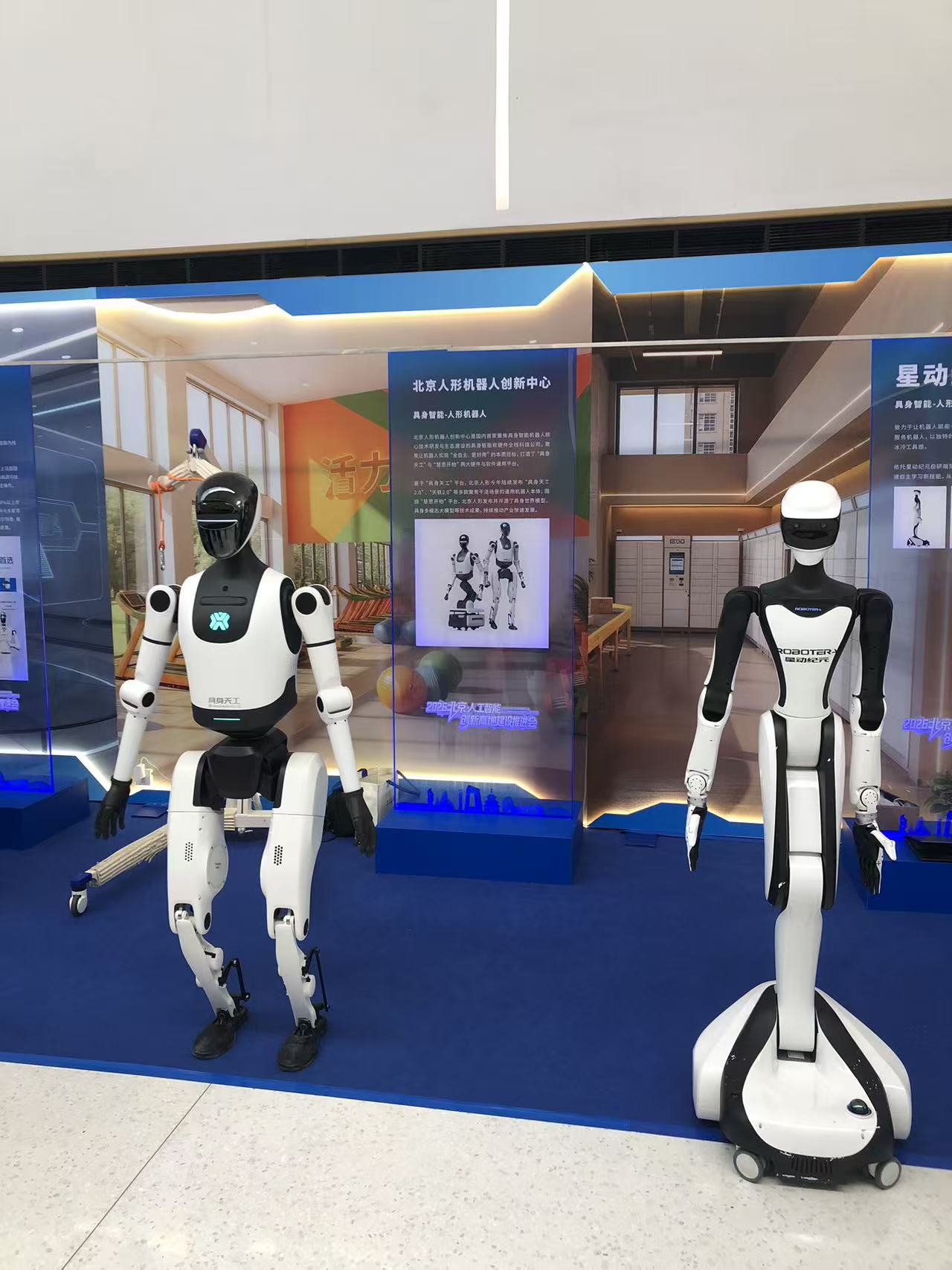
Core Insights - Beijing is positioning itself as a global hub for artificial intelligence (AI), with a projected core industry scale of 450 billion yuan by 2025, reflecting a year-on-year growth of 25.3% [2][6] - The city has over 2,500 AI companies and has registered 209 large models, accounting for nearly 30% of the national total [2][3] - The "Nine Major Actions" plan was introduced to enhance AI innovation, focusing on technology, ecosystem, and application scenarios [2][6] Group 1: AI Integration and Applications - AI technologies are deeply integrated into various sectors, including healthcare, education, and transportation, with innovations like the Galaxy General G1 robot for smart medical retail and AI tools for creative industries [1][3] - Xiaomi's AI vision technology has significantly improved industrial efficiency, achieving detection rates that are dozens of times faster than manual inspections [1] - The introduction of AR smart glasses by Liangliang Vision aims to enhance communication and navigation for users with accessibility needs [1] Group 2: Talent and Ecosystem Advantages - Beijing boasts a strong talent pool, with 148 influential AI scholars and a total of 15,000 AI researchers, representing over 40% and 30% of the national figures, respectively [3][4] - The city has a favorable business environment and diverse application scenarios, which facilitate the implementation and iteration of AI technologies [4][5] - The presence of major AI companies and a robust industrial cluster underscores Beijing's competitive edge in the AI sector, with nearly 60 listed companies and around 40 unicorns [4][5] Group 3: Future Development Plans - The "Nine Major Actions" aim to significantly enhance AI foundational theories and core technologies within two years, targeting the emergence of more original achievements and leading global standards in scientific and embodied intelligence [6][7] - The goal is to establish a self-sufficient computing power system and create over 100 benchmark AI applications, alongside attracting 200 billion yuan in investment [6] - The vision includes a breakthrough in the AI core industry scale to over 1 trillion yuan, forming a new intelligent economic model [8]
百度伐谋发布同舟生态伙伴计划 加速AI进产业
Zheng Quan Shi Bao Wang· 2025-12-25 11:01
Core Insights - Baidu has launched its self-evolving super intelligent system, Baidu Famu, which has seen over 2,000 enterprises apply for trials within a month, covering sectors such as logistics, manufacturing, and AI4S [1][2] - The system aims to enhance efficiency in various industrial applications by utilizing advanced technology to significantly improve operational processes, as highlighted by Baidu's founder, Robin Li [1] Group 1: Product Development and Upgrades - Baidu Famu has undergone product upgrades focusing on generality, production-level capabilities, and sustainability, facilitating innovation in enterprise R&D and academic research [2] - New front-end agents have been introduced, including Web, CLI, and IDE plugins, to simplify the integration of Baidu Famu into various scenarios, addressing challenges in demand description and evaluation [2] - A local evaluation solution has been launched, allowing algorithms generated in the cloud to be evaluated locally, thus streamlining the business validation process [2] Group 2: Collaborative Initiatives - The "Tongzhou Ecological Partner Program" has been introduced to share high-quality industry scenarios and research topics with academic labs and software companies, providing comprehensive free support for innovative projects [3] - A partnership with A-share company Alter (300825) has been established, focusing on intelligent wind resistance prediction, which has significantly reduced validation time from 10 hours to 1 minute through the use of Baidu Famu's self-evolution capabilities [3]

飞行汽车联合实验室成立,江淮汽车携手合作伙伴解锁低空经济新未来
Zhong Zheng Wang· 2025-12-10 02:53
Core Viewpoint - The establishment of a joint laboratory for flying cars by Jianghuai Automobile, Beijing Institute of Technology Hefei Institute of Intelligent Equipment, and Alter Automotive marks a significant step in the development of the low-altitude economy in China, driven by national policies and industry demand [1][2]. Group 1: Joint Laboratory Establishment - The joint laboratory aims to enhance the development of flying cars, which are seen as a key component of the low-altitude economy, with applications in emergency rescue, tourism, and urban commuting [1]. - The collaboration involves three parties with complementary strengths: Jianghuai Automobile's extensive experience in vehicle development, Beijing Institute of Technology's expertise in unmanned systems, and Alter Automotive's capabilities in complete vehicle development and innovation [2]. Group 2: Research Focus and Goals - The laboratory will focus on nine core areas, including aerodynamic optimization, efficient energy drive, precise flight control, integrated decision-making, smart cockpit technology, and testing methodologies [3]. - The next steps include exploring demonstration applications in tourism, emergency rescue, and low-altitude logistics, while also seeking major national and provincial technology projects [3]. Group 3: Industry Impact - The establishment of the joint laboratory is expected to accelerate breakthroughs in key technologies for flying cars, leading to the development of core results with independent intellectual property rights [3]. - It is anticipated that the laboratory will attract related upstream and downstream enterprises and innovation resources to the Baohe District, providing new growth opportunities for the local new energy vehicle and intelligent connected industries [3].