百度伐谋

Search documents
百度发布最新财报:2025年营收1291亿元 四季度AI业务收入占比43%
Zhong Guo Jing Ji Wang· 2026-02-27 07:44
Core Insights - In 2025, Baidu's total revenue reached 129.1 billion yuan, with AI business revenue at 40 billion yuan, exceeding market expectations [1] - The year 2025 is highlighted as a pivotal year for AI to become Baidu's new core, with strong momentum in AI cloud services [1] - Baidu's AI-native marketing services saw a significant revenue increase of 301% in 2025 [2] Group 1: Financial Performance - Baidu's total revenue for Q4 was 32.7 billion yuan, with AI business revenue accounting for 43% of general business revenue [1] - AI cloud revenue for the full year 2025 grew by 34% year-on-year, with Q4 AI high-performance computing subscription revenue increasing by 143% [1] - The number and amount of winning bids for large models in Baidu's intelligent cloud reached first place for two consecutive years [1] Group 2: User Engagement and AI Applications - Monthly active users of the Baidu App reached 679 million, while Wenxin Assistant had 202 million monthly active users, with a fourfold increase since the launch of the Spring Festival red envelope activity [2] - AI applications surpassed 10 billion yuan in revenue for the year 2025, with the no-code generation platform outperforming in functionality and application quality [2] - The "Luo Bo Kua Pao" service recorded 3.4 million global autonomous driving service instances in Q4, with a year-on-year growth of over 200% [2] Group 3: Technological Advancements - The official version of Wenxin 5.0 was launched, featuring 2.4 trillion parameters and supporting multiple information types [3] - Baidu's ESG performance has shown further improvement, as noted in the S&P Global Sustainability Yearbook 2026 [3]

向市场亮剑,百度2025年Q4 AI业务增长为行业注入信心
Sou Hu Cai Jing· 2026-02-26 22:33
Core Insights - The AI industry experienced significant growth in 2025, with Baidu emerging as a leading player and a benchmark for the sector [1][3] - Baidu's total revenue for 2025 reached 129.1 billion RMB, with AI business revenue accounting for 40 billion RMB, representing 43% of its general business revenue [1][4] Financial Performance - In Q4 2025, Baidu's total revenue was 32.7 billion RMB, showing a year-on-year growth of 5% [2] - AI-related business segments demonstrated robust growth, with AI cloud revenue increasing by 34% year-on-year, and AI high-performance computing subscription revenue soaring by 143% in Q4 [4][5] Strategic Positioning - Baidu's AI business is transitioning from a cost center to a profit center, indicating a shift towards quantifiable revenue streams [4][8] - The company has positioned itself as a leading AI firm with a strong internet foundation, as evidenced by its strategic focus on AI commercialization [5][8] Market Impact - Baidu's AI applications have shown significant commercial value, with AI application revenue surpassing 10 billion RMB in 2025 [4][9] - The launch of "Robotaxi" services has expanded Baidu's market presence, with over 3.4 million rides in Q4 2025, marking a growth of over 200% [16][18] Future Outlook - Baidu announced a new stock buyback plan of $5 billion and introduced a dividend policy for 2026, signaling confidence in its AI profitability and market valuation [19][21] - The potential spin-off of Baidu's Kunlun chip business is expected to unlock further value and enhance the company's growth trajectory [21][22]

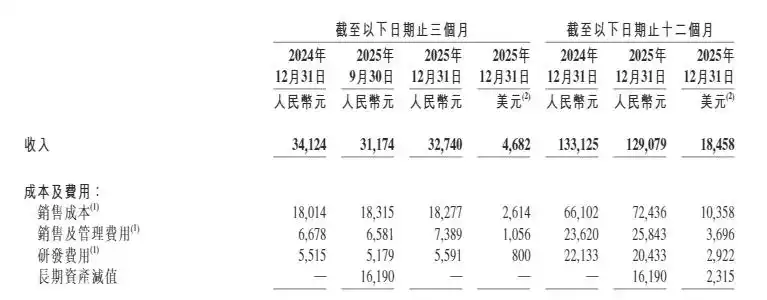
百度2025年营收达1291亿元 第四季度AI业务收入占比43%
Zheng Quan Ri Bao Wang· 2026-02-26 13:05
Core Insights - Baidu's total revenue for 2025 reached 129.1 billion yuan, with AI business revenue accounting for 40 billion yuan, indicating a significant shift towards AI as a core business driver [1] - The company reported that AI-related services are expanding rapidly, with AI cloud revenue growing by 34% year-on-year and AI native marketing services increasing by 301% in 2025 [2][3] Group 1: Financial Performance - In Q4 2025, Baidu's total revenue was 32.7 billion yuan, with AI business revenue constituting 43% of general business income [1] - AI cloud's subscription revenue surged by 143% year-on-year in Q4, reflecting strong demand for high-performance computing [1] - AI native marketing services revenue reached 2.7 billion yuan in Q4, marking a 110% year-on-year increase [2] Group 2: User Engagement and Application Growth - Baidu App's monthly active users reached 679 million, while Wenxin Assistant's monthly active users hit 202 million, showcasing strong user engagement [2] - The launch of the Wenxin Assistant during the Spring Festival led to a fourfold increase in active users [2] - Baidu's AI applications generated over 10 billion yuan in revenue for the year, with significant growth in various sectors [2] Group 3: Autonomous Driving and Market Expansion - In Q4 2025, Baidu's autonomous driving service, "Luobo Kuaipao," recorded over 3.4 million rides, a year-on-year increase of over 200% [3] - The service has expanded to 26 cities globally, with a total of over 20 million rides provided [3] - Baidu's autonomous driving technology has accumulated over 300 million kilometers of total driving distance, with over 190 million kilometers being fully autonomous [3] Group 4: Capitalization and Strategic Moves - Baidu's subsidiary Kunlun Chip has submitted a listing application to the Hong Kong Stock Exchange, indicating a strategic move to capitalize on its AI chip business [4] - The company announced a share buyback plan of up to 5 billion USD and plans to declare its first dividend in 2026, enhancing shareholder returns [4] - These initiatives are expected to optimize Baidu's valuation structure and open financing channels for long-term technological investments [5]
百度发布最新财报!
Zhong Guo Ji Jin Bao· 2026-02-26 11:37
Core Insights - Baidu's total revenue for 2025 reached 129.1 billion yuan, with AI business revenue accounting for 40 billion yuan, indicating a strong performance in AI-related sectors [1] - In Q4 2025, total revenue was 32.7 billion yuan, with AI business revenue making up 43% of general business income, surpassing market expectations [1] - The company emphasizes that 2025 is a pivotal year for AI to become the new core of Baidu's operations, with a focus on expanding AI applications to meet diverse needs [1] AI Business Performance - AI revenue grew by 34% year-on-year, with Q4 subscription revenue from high-performance computing facilities increasing by 143%, accelerating from 128% in Q3 [1] - AI-native marketing services saw a remarkable 301% year-on-year revenue growth, with AI applications generating over 10 billion yuan in total revenue for the year [2] - Monthly active users for Baidu App reached 679 million, while Wenxin Assistant's monthly active users hit 202 million, with a fourfold increase since the launch of the Spring Festival red envelope activity [2] Autonomous Driving Expansion - The autonomous driving service "Luobo Kuaipao" recorded over 3.4 million service instances in Q4, marking a year-on-year growth of over 200% [3] - As of February 2026, Luobo Kuaipao has provided over 20 million service instances globally, covering 26 cities [3] - The total mileage for autonomous driving has exceeded 300 million kilometers, with fully autonomous driving mileage surpassing 190 million kilometers [3] Technological Advancements - The official version of Wenxin 5.0 was launched, featuring 2.4 trillion parameters and supporting multi-modal input and output [3] - Wenxin 5.0 has achieved top rankings in domestic text and visual understanding benchmarks, outperforming several mainstream models [3] - Kunlun Chip has submitted an application for a mainboard listing on the Hong Kong Stock Exchange [3]
百度最新财报:2025年营收1291亿元 四季度AI业务收入占比43%
市值风云· 2026-02-26 10:12
Core Insights - Baidu's total revenue for 2025 reached 129.1 billion yuan, with AI business revenue accounting for 40 billion yuan, exceeding market expectations [1] - The year 2025 is identified as a pivotal year for AI to become Baidu's new core, with strong momentum in AI cloud services and a growing portfolio of AI applications [1] - AI cloud revenue grew by 34% year-on-year in 2025, with high-performance computing subscription revenue increasing by 143% in Q4 [1] Group 1: AI Business Performance - AI native marketing services revenue increased by 301% year-on-year in 2025 [2] - Monthly active users of Baidu App reached 679 million, while Wenxin Assistant's monthly active users reached 202 million, with a fourfold increase since the launch of the Spring Festival red envelope activity [2] - The revenue from AI applications surpassed 10 billion yuan in 2025, indicating significant growth in this segment [2] Group 2: Autonomous Driving and AI Model Developments - The autonomous driving service "Luobo Kuaipao" recorded 3.4 million service instances in Q4, with a year-on-year growth of over 200% [2] - The total mileage for autonomous driving exceeded 300 million kilometers, with fully autonomous driving mileage surpassing 190 million kilometers [3] - The official version of Wenxin 5.0 was launched, featuring 2.4 trillion parameters and achieving top rankings in various AI model benchmarks [3] Group 3: Market Expansion and ESG Performance - Luobo Kuaipao is accelerating its expansion into global markets, having provided over 20 million service instances across 26 cities by February 2026 [2] - Baidu has made further improvements in ESG performance, as noted in the S&P Global Sustainability Yearbook 2026 [3]
百度最新财报:2025年营收1291亿元 四季度AI业务收入占比43%
Qi Lu Wan Bao· 2026-02-26 09:23
Core Insights - Baidu's total revenue for 2025 reached 129.1 billion yuan, with AI business revenue accounting for 40 billion yuan, exceeding market expectations [1] - The company emphasizes that 2025 is a pivotal year for AI to become its new core, with strong momentum in AI cloud services and a growing portfolio of AI applications [1] - AI cloud revenue grew by 34% year-on-year, with high-performance computing subscription revenue increasing by 143% in Q4 [1] Group 1: Financial Performance - In Q4, Baidu's total revenue was 32.7 billion yuan, with AI business revenue constituting 43% of its general business revenue [1] - AI-native marketing services saw a revenue increase of 301% for the entire year of 2025 [2] - The total revenue from AI applications surpassed 10 billion yuan in 2025 [2] Group 2: User Engagement and Market Expansion - As of December 2025, Baidu App had 679 million monthly active users, while Wenxin Assistant reached 202 million monthly active users, with a fourfold increase since the launch of the Spring Festival red envelope activity [2] - The autonomous driving service, "Luobo Kuaipao," recorded 3.4 million service instances in Q4, marking a year-on-year growth of over 200% [2] - Luobo Kuaipao has expanded its global reach, providing over 20 million service instances across 26 cities by February 2026 [2] Group 3: Technological Advancements - The official version of Wenxin 5.0 was launched, featuring 2.4 trillion parameters and supporting multiple forms of input and output [3] - Wenxin 5.0 has achieved top rankings in various domestic benchmarks, surpassing several mainstream models [3] - Baidu's ESG performance has improved, as noted in the 2026 Global Edition of the S&P Global Sustainability Yearbook [3]
李彦宏:2025年是AI成为百度新核心的关键一年
Xin Lang Cai Jing· 2026-02-26 09:18
Core Insights - Baidu's total revenue for 2025 reached 129.1 billion yuan, with AI business revenue at 40 billion yuan, indicating a strong performance in AI sectors [1][4] - In Q4 2025, Baidu's total revenue was 32.7 billion yuan, a 5% year-over-year increase, with AI business revenue accounting for 43% of general business income, exceeding market expectations [1][4] AI Business Growth - The AI cloud segment saw a revenue increase of 34% year-over-year for 2025, with Q4 subscription revenue from high-performance computing facilities growing by 143%, accelerating from 128% in Q3 [1][4] - Baidu's AI-native marketing services experienced a remarkable 301% year-over-year revenue growth in 2025 [5] - The AI application revenue surpassed 10 billion yuan in 2025, showcasing the company's expanding capabilities in AI solutions [5] User Engagement and Expansion - By December 2025, Baidu App had 679 million monthly active users, while Wenxin Assistant reached 202 million monthly active users, with a fourfold increase in active users since the launch of the Spring Festival red envelope activity [5] - The "Luobo Kuaipao" autonomous driving service recorded 3.4 million global rides in Q4, more than doubling year-over-year, with a peak of over 300,000 rides per week [6] - As of February 2026, "Luobo Kuaipao" had provided over 20 million global rides, covering 26 cities worldwide [6] Technological Advancements - The total mileage for "Luobo Kuaipao" autonomous driving exceeded 300 million kilometers, with fully autonomous driving mileage surpassing 190 million kilometers [3][6] - The self-evolving super-intelligent agent "Baidu Famou" received applications for trials from over 2,000 enterprises, indicating strong interest in innovative AI solutions [5]
新京报2025“智慧生活”年度案例揭晓,20家企业和产品入选
Xin Jing Bao· 2026-01-30 08:09
Core Insights - The 2025 "Smart Life" annual case event revealed 20 companies and products, highlighting the deep integration of technology and daily life, with a focus on AI products that enhance empathy and user experience [1] - The event emphasizes the importance of practical applications of smart technology in addressing real-life issues and improving user convenience, showcasing a shift from tool-based to ecosystem-based technology [1] Group 1: Key Trends in Smart Technology - The integration of AI products is becoming more pronounced, with a focus on empathy and user-centric solutions [1][3] - Future products are expected to deeply incorporate large model capabilities from the design phase, leading to a new generation of AI-native applications that transform user habits [2] Group 2: Notable Award Winners - Taobao Flash Purchase was recognized as the annual instant retail innovation platform [5] - Ant Financial's "Afu" was awarded as the annual family health guardian AI butler [5] - Kuaishou's "wow" intelligent agent was named the annual commercial AI assistant [6] - Hisense's AI Life Butler received recognition as the annual smart appliance innovation case [12] - DJI's Osmo Action 6 was awarded for its contribution to smart imaging accessibility [13]

让AI沉下来:北京锻造人工智能第一城
Bei Jing Ri Bao Ke Hu Duan· 2026-01-26 16:49
Core Viewpoint - Beijing is positioning itself as the "Artificial Intelligence Capital" by leveraging its unique advantages in talent density, full-stack ecosystem, and industrial clusters, aiming for a core AI industry scale exceeding 1 trillion yuan within two years [2][11]. Group 1: AI Industry Development - The AI core industry in Beijing is projected to grow from approximately 450 billion yuan in 2025 to over 1 trillion yuan by 2027, indicating a doubling of the industry size [12]. - The city has established itself as a global AI innovation hub, with 1.5 million AI scholars, accounting for 30% of the national total, and 148 individuals listed among the world's most influential AI scholars [4][10]. - Beijing's AI ecosystem includes 209 registered large models, representing nearly 30% of the national total, with significant contributions from various local companies and institutions [10]. Group 2: Technological Innovations - The launch of the AI video generation model Vidu by Shengshu Technology marks a significant advancement, enabling the generation of high-quality videos in just 8 seconds, a drastic reduction from the previous 900 seconds [6][7]. - The collaboration between domestic GPU companies and research institutions has led to the successful training of advanced AI models, showcasing the capabilities of local technology [8][10]. - The FlagOS system software stack developed by Zhiyuan Research Institute serves as a universal language connecting domestic AI chips and large models, enhancing efficiency and reducing costs in the AI industry [5][10]. Group 3: Market Opportunities - The consumer market for AI applications is expanding, with companies like Kuaishou's Keling AI achieving significant revenue growth, indicating a robust demand for AI-driven solutions [13]. - The integration of AI in sectors such as automotive design is streamlining processes, reducing time for tasks like wind resistance validation from 10 hours to just 1 minute [12]. - The development of innovative AI models and applications is creating new market opportunities, positioning Beijing as a leader in AI technology and application [13].


产业级 Agent 如何破局?百度吴健民:通用模型难“通吃”,垂直场景才是出路
AI前线· 2026-01-16 06:28
Core Insights - The article discusses the challenges and advancements in the development of Agentic models, emphasizing that the main bottleneck is not the models themselves but the replication of real-world environments and stable access to external interfaces and databases [2][4][5] - It highlights the current limitations of general-purpose models in achieving industrial-level performance across various vertical agent scenarios, suggesting that tailored models for specific applications are more effective [5][12] - The article also explores the evolution of multi-modal models, indicating that while there have been significant advancements, a unified modeling approach for understanding and generating across modalities remains a key goal for the future [17][20] Group 1: Agentic Models - The primary focus is on enhancing models to perform effectively in various vertical agent scenarios, particularly in coding applications [4] - Current general-purpose models lack the capability to achieve stable generalization across diverse environments, necessitating the customization of models for specific applications [5] - The complexity of real-world environments, including external dependencies and interfaces, poses significant challenges for training agentic models [5][6] Group 2: Multi-Modal Models - The transition from single-modal to multi-modal models has introduced visual capabilities into language models, with a focus on aligning text and visual tokens [17][18] - Despite advancements, the industry faces challenges in scaling multi-modal models due to the difficulty in obtaining high-quality, aligned data [18] - Future directions include the pursuit of unified modeling that integrates generation and understanding capabilities, although current results indicate that separate optimization yields better performance [20][21][22] Group 3: Reinforcement Learning and Training Efficiency - The article emphasizes the importance of reinforcement learning systems for continuous model iteration in specific scenarios, with a focus on high efficiency and throughput [6][9] - The scaling of reinforcement learning has not yet reached a consensus in the industry, but there is recognition of its potential to enhance model capabilities significantly [10][11] - Efficient training processes, particularly in generating diverse paths for evaluation, are critical for the success of reinforcement learning in agentic models [9] Group 4: Future Trends and Directions - The article predicts that the development of agentic models with stable and accurate tool-calling capabilities will expand beyond coding applications to a broader range of real-world APIs [28] - The concept of "world models" is discussed, highlighting the evolution from language models to dynamic models that understand physical world operations [26] - The integration of tools into agent development is seen as a crucial pathway for enhancing model capabilities, reflecting the importance of tool usage in human intelligence evolution [25]