
寡核苷酸药物

Search documents
生物医药企业赴港上市热潮持续升温
Xin Lang Cai Jing· 2026-02-12 00:41
Group 1 - The core viewpoint of the articles highlights a surge in local biopharmaceutical companies applying for listings on the Hong Kong Stock Exchange, driven by favorable market conditions and the need for funding to support research and development [1][5][8] - A significant portion of the companies applying for listings are early-stage, unprofitable biotech firms, with many utilizing the special listing channel for unprofitable companies established under Chapter 18A of the Hong Kong Stock Exchange [2][3] - The current wave of IPOs is characterized by a mix of newly established biotech firms and more mature companies with established business models, indicating a diverse range of funding needs and market strategies [3][4] Group 2 - The capital market's cyclical recovery has provided a crucial external window for these listings, with the Hang Seng Innovation Drug Index showing a rebound of over 200% in the past two years, reflecting a renewed focus on quality assets [5][6] - The internal dynamics of the biopharmaceutical industry, combined with the improved liquidity and sentiment in the Hong Kong market, have created a conducive environment for these companies to seek public funding [7][8] - However, there is a growing concern about market congestion, with over a hundred biopharmaceutical companies in the IPO preparation queue, leading to potential differentiation challenges among these firms [8][9] Group 3 - The market is expected to experience significant polarization, with a clear divide between high-value companies and those with weaker clinical data or less innovative pipelines, which may struggle to attract investment [9][10] - Companies that can withstand market fluctuations are those with unique pipelines and a focus on addressing real clinical needs, as opposed to those merely following trends [10][11] - The long-term success in the biopharmaceutical sector will depend on the ability to build competitive advantages through innovative solutions that meet clinical demands, rather than relying on speculative concepts [11]
睿智医药加码小核酸药物研发领域
Zheng Quan Ri Bao Wang· 2026-01-13 12:49
Core Insights - Ruizhi Pharmaceutical Technology Co., Ltd. has developed two automated integrated micro-flow synthesis systems based on its "Super Limit Intelligent Manufacturing" platform, which are currently applied internally to enhance R&D in ADC and small nucleic acid drug fields [1][2] Group 1: Technology and Innovation - The internal application of the Super Limit Intelligent Manufacturing platform focuses on two main areas: enhancing the coupling process for antibody-drug conjugates (ADCs) and synthesizing nucleoside monomers for oligonucleotide drugs, significantly improving development efficiency and overall yield [1] - The ADC drug process development time can be reduced by 70%, while the cost of synthesizing nucleoside monomers can be lowered by over 40% [2] Group 2: Strategic Partnerships and Market Positioning - The drug manufacturing system was jointly released by Ruizhi Pharmaceutical and East China Normal University, emphasizing the establishment of a joint laboratory to improve the transition from laboratory R&D to industrial production [2] - The company is positioning its business around "new modalities (including small nucleic acids)" and "ecological investment," aiming to create more opportunities in the small nucleic acid sector through strategic partnerships with multiple companies [2]

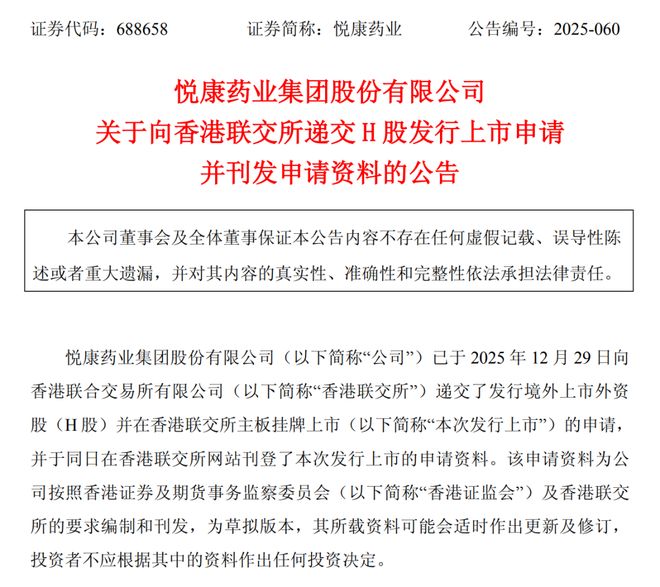
悦康药业营收净利三连降 于伟仕家族为何还分红超4亿?
Zhi Tong Cai Jing· 2026-01-08 09:13
Core Viewpoint - The Hong Kong stock market's biopharmaceutical sector is experiencing a long-awaited uptrend, prompting YK Pharmaceutical to accelerate its plans for a dual primary listing in Hong Kong despite facing significant operational challenges and declining financial performance [1][3]. Financial Performance - YK Pharmaceutical's revenue has been on a downward trend, decreasing from 45.21 billion in 2022 to 37.67 billion in 2024, with a significant drop of 39.4% to 13.04 billion in the first seven months of 2025 [9]. - The company's net profit has also declined sharply from 3.39 billion in 2022 to 1.21 billion in 2024, with a net loss of 1.46 billion reported in the first seven months of 2025 [9]. - Gross margin has decreased from 63.5% in 2022 to 45.7% in 2025, indicating a continuous weakening of profitability [9]. Business Transformation - YK Pharmaceutical is transitioning from a leader in generic drugs to focusing on innovative drug development, with a pipeline that includes 11 oligonucleotide drugs, 2 mRNA vaccines, and 3 innovative traditional Chinese medicines [5][6]. - The company aims to avoid traditional competition in the innovative drug space by leveraging a dual-track approach of self-research and authorized introduction [5]. Cash Flow and Dividend Controversy - The company's cash and cash equivalents fell to 875 million by the end of July 2025, a 30% decrease from the end of 2024, with negative net cash flow from operating activities recorded at -27.32 million [11]. - Despite declining performance, YK Pharmaceutical distributed over 8.9 billion in dividends from 2022 to 2024, including a substantial 4.95 billion in 2023, raising concerns about the sustainability of such payouts during a critical transformation phase [12]. IPO and Market Conditions - The upcoming IPO in Hong Kong is primarily aimed at raising funds for innovative drug research, production facility construction, and operational capital, addressing the company's current financial pressures [13]. - The favorable market conditions in 2025, including the recovery of the Hong Kong biopharmaceutical sector and improved investor sentiment towards quality biopharmaceutical companies, provide a strategic window for the listing [13][14]. Risks and Challenges - The company faces significant risks, including stringent valuation expectations from Hong Kong investors, the early-stage nature of its innovative pipeline, and potential challenges in achieving commercial success [15]. - The dual listing may also lead to valuation discrepancies between the A-share and Hong Kong markets, posing additional risks to the company's financial stability [15]. Industry Perspective - YK Pharmaceutical's journey reflects the broader trend of Chinese generic drug companies needing to innovate and invest in R&D to remain competitive amid industry shifts towards centralized procurement and innovation-driven growth [16].


药石科技:公司高度重视寡核苷酸药物领域的发展机遇
Zheng Quan Ri Bao Wang· 2025-09-29 10:41
Core Viewpoint - The company is focusing on the development opportunities in the oligonucleotide drug field and has established a specialized team to enhance its capabilities in this area [1] Group 1 - The company has designed a diverse range of molecular building blocks, including nucleotides, phosphoramidites, and delivery technologies, with over 500 product types currently available [1] - In the first half of this year, the company integrated internal resources to establish a professional peptide and oligonucleotide team (PTCoE) [1] - The company is accelerating its capabilities in oligonucleotide synthesis, chemical modification, conjugation, process development, and analysis [1] Group 2 - The company will continue to closely monitor industry technology development trends and will timely advance relevant layouts [1]
诺泰生物:被实施其他风险警示暨停牌,公司生产经营正常有序开展
Zheng Quan Shi Bao Wang· 2025-07-18 13:42
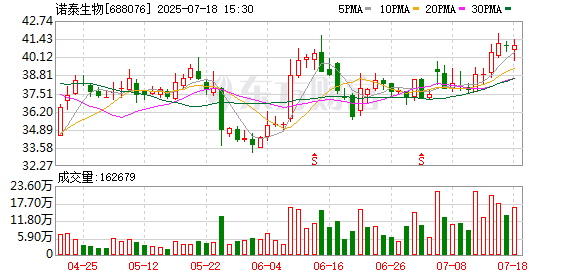
Group 1 - Company received an administrative penalty notice and announced a risk warning, leading to a one-day suspension of its stock on July 21, with resumption on July 22 [2] - The penalty relates to matters from 2021, affecting the annual report and subsequent convertible bond issuance, but does not trigger mandatory delisting [2] - The board is committed to addressing regulatory requirements and aims to mitigate the impact of the penalty, with plans to apply for the removal of the risk warning after fulfilling certain conditions [2] Group 2 - In early July, the company voluntarily disclosed a half-year performance forecast for 2025, expecting a net profit of 300 million to 330 million yuan, representing a year-on-year growth of 32.06% to 45.27% [3] - The growth is driven by the increasing demand for GLP-1 targeted drugs, which supports the company's performance, alongside new production capacity coming online [3] - The company is exploring advanced fields such as oligonucleotide drugs and synthetic biology, including a strategic partnership with a leading biomanufacturing firm to enhance technological progress [3]

★"第五套上市标准"蓄新能 科创板制度包容性不断提升
Shang Hai Zheng Quan Bao· 2025-07-03 01:56
Core Insights - The establishment of the Sci-Tech Innovation Board (STAR Market) has enabled 20 innovative biopharmaceutical companies to list under the fifth set of listing standards, reshaping China's biopharmaceutical landscape [1] - The China Securities Regulatory Commission (CSRC) has introduced measures to enhance the STAR Market's support for high-growth, unprofitable tech companies, emphasizing the importance of "hard technology" [1][3] - The fifth set of listing standards allows unprofitable innovative companies to raise funds, breaking traditional capital market constraints and facilitating financing for R&D-focused firms [1][2] Industry Developments - Since its inception, the STAR Market has seen 20 innovative biopharmaceutical companies adopt the fifth set of listing standards, with significant fundraising efforts directed towards advanced technologies such as antibody drugs and ADCs [1] - In 2024, these 20 companies collectively achieved revenue of 14.21 billion yuan, a year-on-year increase of 44.17%, with several companies projected to exceed 1 billion yuan in revenue soon [1] - Companies like Dizhe Pharmaceutical have reported substantial revenue growth, with a 294.24% increase to 360 million yuan, driven by innovative drug development [2] Company Performance - Companies such as Junshi Biosciences have successfully raised over 8 billion yuan through the STAR Market, significantly advancing their clinical projects and R&D initiatives [2][3] - Ailis, which listed under the fifth set of standards, achieved commercialization of its core product within 2 years and 5 months, demonstrating the effectiveness of the STAR Market in supporting innovative firms [3] - ShenZhou Cell has transitioned from having no products or revenue at the time of listing to achieving 2.51 billion yuan in revenue, marking a successful turnaround [5] Innovation Ecosystem - The STAR Market has fostered an innovation-driven ecosystem, enhancing the flow of resources and increasing recognition of innovative technologies within the capital market [3][4] - Companies are increasingly focusing their resources on R&D, maintaining high levels of investment intensity, and establishing a virtuous cycle of research and development [6] - The introduction of the STAR Market has led to a fundamental shift in the development logic of listed companies, prioritizing quality over scale and fostering collaborative ecosystems [6]


A股或迎创新药企上市潮
21世纪经济报道· 2025-06-18 15:26
Core Viewpoint - The China Securities Regulatory Commission (CSRC) announced the implementation of the "1+6" policy measures to enhance the role of the Sci-Tech Innovation Board (STAR Market) as a "testing ground" for reforms, aiming to better support innovative companies and improve the capital market ecosystem [1]. Group 1: Policy Measures - The "1" in the "1+6" policy refers to the establishment of a Sci-Tech Growth Tier on the STAR Market, which will allow unprofitable companies to list under the fifth set of standards, targeting high-potential tech firms with significant breakthroughs and ongoing R&D investments [1]. - The "6" includes six reform measures such as introducing a professional investor system, expanding the applicability of the fifth set of standards, and improving refinancing systems for STAR Market companies [1]. Group 2: Market Environment - The STAR Market's fifth set of listing standards previously faced a "zero acceptance" situation, but the recent policy shift signals a positive change for unprofitable biotech companies, indicating a more favorable financing environment [1][4]. - Data shows that in 2024, the number of biotech companies listed on A-shares decreased significantly, with only five companies raising a total of 2.561 billion yuan, reflecting a year-on-year decline of 77.27% in the number of listings and 87.91% in total fundraising [4][6]. Group 3: Company Performance - Among the 20 companies that listed under the fifth set of standards, 19 have successfully developed 45 drugs that have been approved or are under review, showcasing strong growth potential despite market challenges [5][8]. - In 2024, these companies collectively generated revenues of 14.339 billion yuan, a staggering increase of 445% year-on-year, with several companies exceeding 1.5 billion yuan in revenue [6][7]. Group 4: International Trends - The Hong Kong Stock Exchange's "18A" listing rules have opened doors for unprofitable biotech companies, leading to a surge in mainland companies seeking IPOs in Hong Kong, with nine biotech firms raising a total of 2.525 billion yuan in 2024 [10]. - The trend of "going out" is becoming a common strategy among innovative drug companies, as they seek to navigate the current capital market challenges and explore more favorable listing environments [10][11].

翰宇药业一季度业绩爆发 携手华为共探“AI智药”新机遇
Zheng Quan Shi Bao Wang· 2025-04-28 01:27
Group 1 - The core viewpoint of the articles highlights the impressive financial performance of Hanyu Pharmaceutical, with a significant revenue increase and successful turnaround in profitability [1][2] - In 2024, the company achieved a revenue of 590 million yuan, a year-on-year growth of 36.82%, and reduced losses by over 60%. In Q1 2025, revenue reached 310 million yuan, with a remarkable year-on-year increase of 106.29% and a net profit of approximately 69.87 million yuan [1] - The growth is attributed to the company's strong foundation in peptide raw materials and formulations, as well as the steady advancement of its GLP-1 drug export strategy [1] Group 2 - Hanyu Pharmaceutical's overseas business has been a significant driver of growth, with overseas revenue increasing by 189.79% to 325 million yuan in 2024 [1] - The company is one of the few globally with large-scale peptide raw materials, offering 32 peptide raw materials and 17 formulation products, reaching over 20 countries for raw materials and over 90 countries for formulations [1] - The partnership with Huawei Cloud aims to explore AI applications in drug development, enhancing efficiency and quality in drug research and production management [2] Group 3 - The company has established a diversified pipeline for short, medium, and long-term development, focusing on several key products such as Teriparatide injection and other promising candidates [3] - Hanyu Pharmaceutical is also advancing its small nucleic acid drugs and CDMO/CMO business, capitalizing on the advantages of oligonucleotide drugs in treating various diseases [3][4] - The integration of resources from its core bases in Wuhan and Shenzhen has created a comprehensive development platform for peptide drugs, enhancing global competitiveness [4] Group 4 - The company plans to continue its strategic focus on talent, innovation, and internationalization, increasing R&D investment and leveraging partnerships to integrate AI into drug development processes [4] - As the strategic layout progresses, Hanyu Pharmaceutical aims to solidify its market position as a leader in the peptide sector, enhancing its global influence and competitiveness [4]
