对话式AI

Search documents
Alight, Inc. Q4 2025 Earnings Call Summary
Yahoo Finance· 2026-02-19 17:31
Core Insights - The company attributes its 2025 financial underperformance to internal execution failures rather than market dynamics, specifically citing misses in new bookings and renewal rates [1] - The new CEO emphasizes the need for a change in execution, focusing on 'leadership rhythm' and disciplined operational excellence while maintaining the company's strategic direction [1] - Client feedback indicates a demand for reduced complexity and more 'flawless' service delivery across health, wealth, and leave administration portfolios [1] Financial Performance - Adjusted EBITDA in Q4 was significantly impacted by a $45 million increase in compensation expense, which is viewed as a necessary investment to enhance service quality and sales coverage [1] Market Dynamics - The outsourced benefits administration market is considered resilient to economic cycles due to increasing regulatory complexity and rising employer costs [1] Technological Advancements - The company is utilizing its proprietary data lake to implement conversational AI, which has successfully reduced 'channel jumping' from digital to call centers during pilot phases [1]
对话式AI,我们斩获“亚太领导者”!
Xin Lang Cai Jing· 2025-12-18 14:26
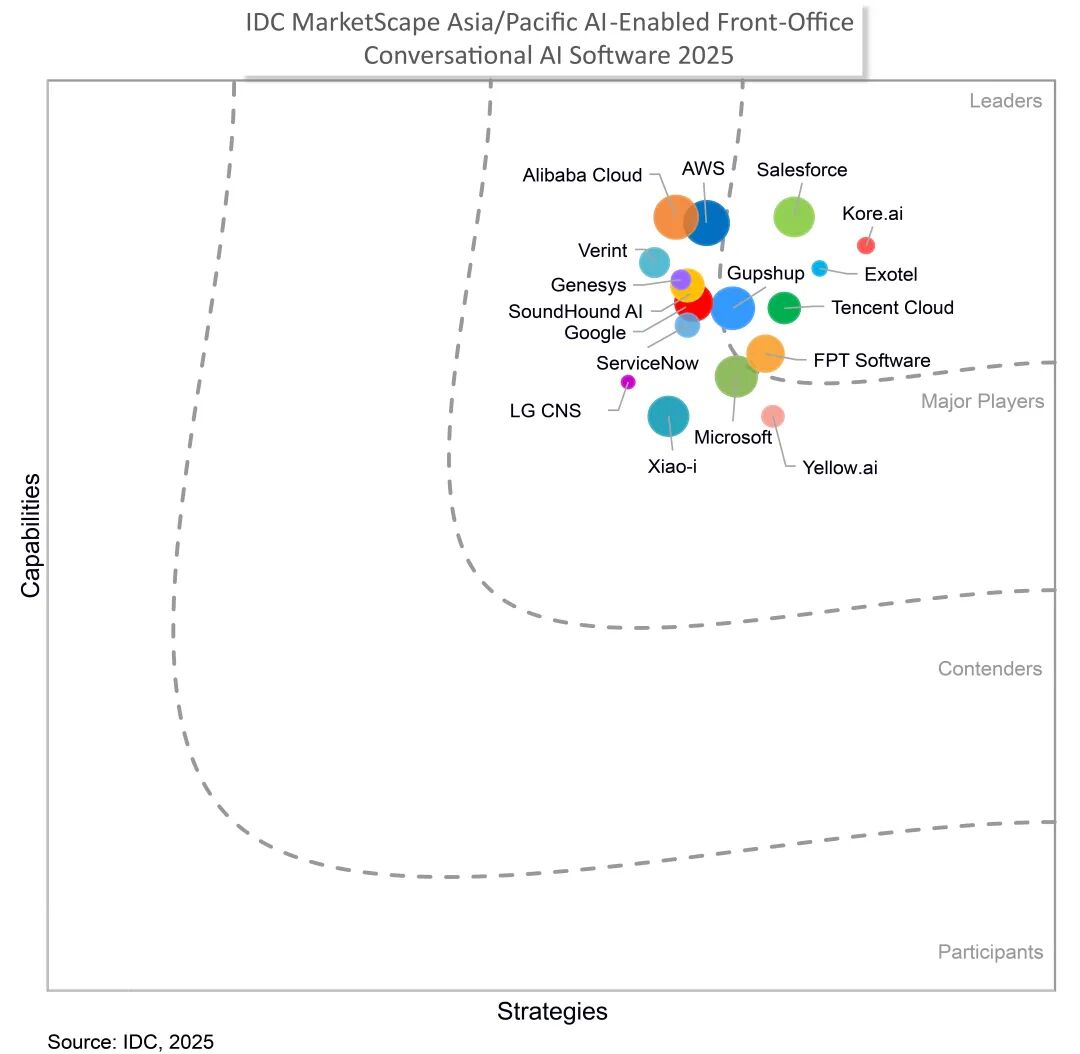
Core Insights - Tencent Cloud has been recognized as a "Leader in the First Quadrant" by IDC, making it the only Chinese company in this category, surpassing many global competitors [1][17]. Group 1: Conversational AI Applications - Conversational AI is highlighted as a key application of generative AI, enhancing customer service externally and improving employee efficiency internally [4][19]. - The Asia-Pacific region presents significant challenges for the deployment of conversational AI due to its linguistic diversity, cultural variety, and complex regulations [4][19]. - Tencent Cloud's conversational AI products have demonstrated improved efficiency, such as a 5% increase in the resolution rate of customer service queries for DHL, reducing the need for human agents by 200 per day [4][19]. Group 2: Industry Collaborations - Tencent Cloud has partnered with Huazhu Group to create a "24-hour digital concierge" app, enhancing customer service across various hotel operations [9][22]. - An intelligent investment assistant developed in collaboration with a leading brokerage firm has processed nearly 2 million user inquiries, tripling user penetration rates [9][23]. - A specialized automotive agent created with FAW Toyota provides detailed maintenance guidance, significantly improving service interaction and problem resolution rates [9][24]. - Collaboration with Yili Group has led to a smart shopping assistant that increased click-through rates by 15.7% and order numbers by 26%, with a 39% rise in conversion rates for direct orders [9][27]. Group 3: Regional Expansion and Impact - Tencent Cloud's conversational AI applications have expanded across regions including Hong Kong, Macau, Singapore, and Indonesia, impacting various industries such as automotive manufacturing, cross-border logistics, pharmaceutical retail, and financial insurance [4][15][29].


AI如何重塑品牌获客逻辑?营销范式转移大揭秘
Sou Hu Cai Jing· 2025-10-15 06:58
Core Transformation: AI Reshaping Brand Customer Acquisition Logic - Traditional marketing relied on the AIDA model and a "traffic thinking" approach, focusing on broad coverage and high exposure, but AI enables a shift to "value-driven, precise reach, and deep interaction" [2] - The transition involves four dimensions: from "traffic thinking" to "user value thinking," from "mass communication" to "hyper-personalized communication," from "post-analysis" to "predictive analysis," and from "labor-intensive" to "technology-driven" [2][3][4][5] Five Core Trends Driven by AI in Brand Customer Acquisition - Trend One: Intelligent orchestration of the customer journey through data integration and automation tools, creating a seamless user experience [6][8] - Trend Two: Generative AI enhances content marketing efficiency by enabling scalable production and dynamic optimization of marketing materials [9][10] - Trend Three: Conversational AI upgrades interactive customer acquisition by transforming passive inquiries into proactive need identification [11] - Trend Four: Predictive analytics allows brands to transition from blind outreach to precise targeting by identifying high-value users and conversion opportunities [12] - Trend Five: AI-driven search engine customer acquisition requires brands to adapt SEO strategies to leverage AI tools for capturing search traffic [13] Practical Framework: Building an AI-Driven Intelligent Customer Acquisition System - Step One: Establish a solid data foundation by integrating diverse data sources into a Customer Data Platform (CDP) to ensure high-quality data [14] - Step Two: Select and integrate technology that matches business needs, ensuring compatibility among tools to prevent data silos [15] - Step Three: Focus on strategy and creativity by defining the division of labor between AI execution and human strategic input [16] - Step Four: Create a testing and iteration loop to continuously optimize strategies based on user data and feedback [17][18][19] - Step Five: Evolve measurement metrics to focus on long-term value indicators, such as customer lifetime value (LTV) and marketing contribution revenue [20][21] Current Challenges and Future Outlook - Brands face challenges in data privacy compliance, algorithm bias, and the need for skill transformation within teams to effectively utilize AI tools [22][24] - Future developments may see AI evolve from a tool to an autonomous decision-making entity, capable of setting acquisition goals and executing strategies in real-time [25]