市民贷

Search documents
国补贴息“普惠”升级 农商行加码消费金融
Xin Lang Cai Jing· 2026-01-30 19:46
Core Viewpoint - The recent optimization of personal consumption loan subsidy policies aims to boost consumer spending and reduce the cost of personal consumption credit for residents, expanding the range of institutions eligible for subsidies and including credit card installment loans [1][2]. Group 1: Policy Changes - The new subsidy policy will take effect from January 1, 2026, and includes a wider range of eligible institutions, such as city commercial banks and rural cooperative financial institutions with a regulatory rating of 3A or above [1][2]. - Local financial institutions, including several rural commercial banks, have begun announcing their participation in the consumption loan subsidy program, indicating a commitment to implement the policy [2]. - The policy aims to simplify the application process and enhance monitoring of loan usage and fund flow, promoting quicker implementation [2]. Group 2: Competitive Landscape - The expansion of the subsidy program is expected to enhance competition among banks, particularly benefiting rural commercial banks that previously faced customer attrition due to limited access to subsidy programs [4][7]. - The competitive environment for personal consumption loans is intensifying, with rural banks now able to offer similar interest rates as larger banks, thus leveling the playing field [5][6]. - Differentiation strategies for rural banks may include targeting specific demographics, such as middle-aged and rural customers, and leveraging local service advantages [5][6]. Group 3: Market Trends - As of the third quarter of 2025, the balance of consumer loans (excluding personal housing loans) reached 21.29 trillion yuan, with a year-on-year growth of 4.2%, indicating a slowdown in growth compared to previous periods [7]. - The trend of increasing loan terms has been observed, with medium to long-term loans accounting for 53.9% of the total by the end of the third quarter of 2025 [7]. - The issuance of personal consumption loan asset-backed securities (ABS) reached 31.34 billion yuan in 2025, representing 10.75% of the total ABS issuance, with rural banks participating but at a lower scale compared to larger institutions [8].
金融精准发力 激活南粤消费 访中国人民银行广东省分行副行长张双长
Jin Rong Shi Bao· 2025-11-21 00:37
Core Insights - Guangdong Province is a leading region in China for consumer activity, with a retail sales total of approximately 3.43 trillion yuan in the first three quarters of 2025, reflecting a year-on-year growth of 2.8% [1] - The financial sector plays a crucial role in supporting consumption, as outlined in the "Guangdong Financial Support for Consumption Expansion Action Plan" [1] - The People's Bank of China Guangdong Branch has implemented a "Four Ones" mechanism to enhance financial services in the consumption sector [1][2] Financial Support Mechanisms - A comprehensive work plan has been established to strengthen policy guidance, targeting four consumer groups and launching six special actions to improve financial services [2] - The introduction of structural monetary policy tools has increased credit supply, with nearly 30 billion yuan in loans allocated to various consumer sectors since the establishment of specific loan programs [2][4] - A project subject database has been created to facilitate precise matching between financial institutions and market entities, enhancing the efficiency of financing [2][3] Innovative Financial Products - A credit product library has been compiled to promote financial products related to service consumption and the elderly care industry, with extensive outreach efforts to break down information barriers [3] - Financial institutions are encouraged to innovate products tailored to local industry characteristics, such as "潮玩版权贷" and "民宿贷," addressing financing challenges for creative and tourism sectors [3][6] Cost Reduction and Accessibility - Structural monetary policy tools have been effectively utilized to increase loan volumes while reducing financing costs, benefiting various consumer sectors [4][5] - Financial services have been extended to small and micro enterprises, with innovative products like "市民贷" designed to meet the needs of new citizens and rural residents [5] Support for Emerging Consumption Trends - Financial institutions are guided to develop flexible credit products and payment solutions that align with the rapid growth of service-oriented consumption, such as cultural tourism and health care [6][7] - The integration of financial services with smart home and green consumption initiatives has led to the introduction of products like "绿能家装贷" and "新能源汽车消费贷," stimulating demand in these sectors [7] Future Directions - The focus will be on nurturing new consumption growth points, optimizing the use of structural monetary policy tools, and enhancing cross-departmental collaboration to amplify policy effects [8][9] - Financial institutions will be encouraged to extend services to frontline consumption areas, creating engaging financial promotional activities to stimulate offline consumption [9]
“金融为民”守初心 “数智赋能”结硕果 ——南海农商银行盛装亮相2025中国国际金融展
Zheng Quan Shi Bao Wang· 2025-06-20 00:30
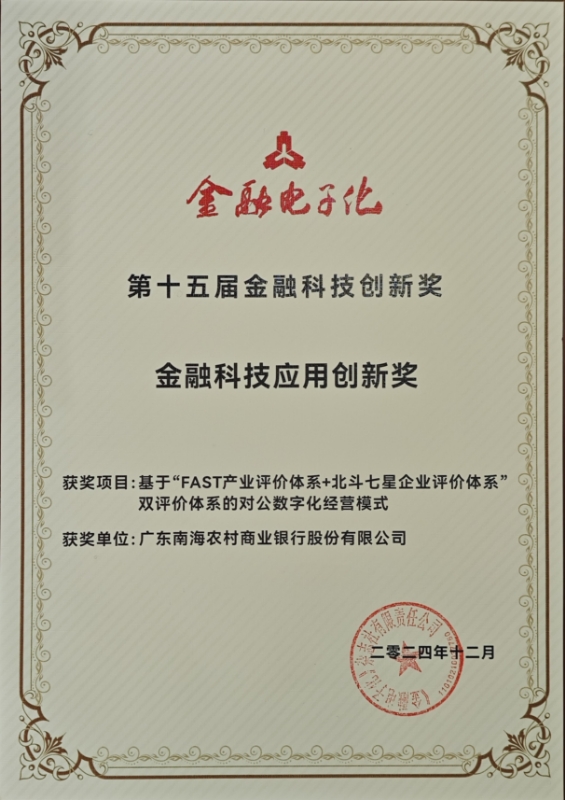
Core Insights - The 2025 China International Financial Expo commenced in Shanghai, showcasing top financial institutions and innovative technologies, with a focus on the digital transformation of regional financial institutions like Nanhai Rural Commercial Bank [1] - Nanhai Rural Commercial Bank highlighted its achievements in five key areas of financial innovation: technology finance, green finance, inclusive finance, pension finance, and digital finance, emphasizing its commitment to serving the real economy and contributing to the construction of a financial powerhouse [1][2] Group 1: Financial Innovation and Recognition - The "Citizen Loan" project by Nanhai Rural Commercial Bank was selected as a national-level case study for inclusive finance, recognized for its digital and intelligent service experience, making it the only financial institution in Guangdong to achieve this [2][3] - The bank's focus on financial technology research and development has been pivotal in its success, showcasing its innovative approach to meet the needs of the community [3] Group 2: Digital Transformation Strategy - Nanhai Rural Commercial Bank has established a high-quality development strategy that integrates digital and practical elements, aiming to create a smart financial system that enhances service efficiency and risk management [4][11] - The bank developed the "FAST + Beidou Seven Stars" dual evaluation system to address financing challenges faced by local enterprises, enabling precise identification of target clients and customized financial solutions [5][6] Group 3: Product Development and Market Impact - The bank has launched various tailored financial products, including "Citizen Loan," "Universal Loan," and "Digital Smart Loan," which have gained market recognition and significantly improved financing efficiency for local businesses [6][7] - The "FAST + Beidou Seven Stars" system has received multiple awards for its innovative application in financial technology, further establishing the bank's reputation in the industry [7] Group 4: Future Outlook and Commitment - Nanhai Rural Commercial Bank aims to continue its commitment to the "finance for the people" philosophy, leveraging technology to enhance financial services and support local economic development [12]

苏商银行2024年报:稳稳的“江苏样本”
Sou Hu Cai Jing· 2025-05-06 08:28
Core Viewpoint - SuShang Bank has achieved high-quality development in 2024 despite a narrowing net interest margin and homogeneous competition, with a focus on stability reflected in its financial performance [1][3]. Financial Performance - The bank reported revenue of 5.006 billion yuan and net profit after tax of 1.158 billion yuan, both growing over 10% year-on-year [1]. - Asset scale reached 137.5 billion yuan by the end of 2024, with a compound annual growth rate of 10.76% over the past three years [1]. Support for Private Enterprises - SuShang Bank has embedded support for private enterprises into its core operations, achieving a 219% increase in private loans by implementing a "Inclusive Micro Loan Combat Manual" [3][4]. - By the end of 2024, the bank's private enterprise loan balance reached 24.141 billion yuan, accounting for over 76% of corporate and operational loans, with nearly 60% being credit loans [7]. Digital Transformation - The bank has leveraged digital technology to maintain a cost-to-income ratio of around 22%, which is approximately 10 percentage points lower than the industry average in Jiangsu [13]. - SuShang Bank's total asset return on assets (ROA) was 0.91% and return on equity (ROE) was 15.71%, placing it among the top banks in Jiangsu [13]. Innovative Financial Products - The bank has developed chain products like "Procurement Loans" and "Supply Loans," supporting over 1,600 core enterprises and focusing on key industries such as digital 3C and biomedicine [6]. - By the end of 2024, the bank's inclusive micro-loan balance was 21.832 billion yuan, with a year-on-year growth of 13.01%, covering 31.23% of total loans [11]. Risk Management and Technology - The bank has transformed its risk management system using advanced technology, processing over 300,000 loan applications daily with millisecond-level decision outputs [17]. - The non-performing loan rate was 1.18% in 2024, with a provision coverage ratio of 214.02%, exceeding regulatory requirements [17].