常青基金

Search documents
2025年度全球另类投资基金调查报告安永2026
EY· 2026-02-24 02:10
Investment Rating - The report does not explicitly state an investment rating for the industry Core Insights - The private equity market is entering a new development phase characterized by a dual focus on innovation and efficiency [5] - There is a significant shift in strategic priorities among institutional investors, with a growing emphasis on operational modernization and transparency [4][10] - The retail market is becoming a new frontier for growth, with a notable increase in focus on high-net-worth and ultra-high-net-worth clients [4][50] - Cost pressures are persistent, with a majority of investors demanding lower management fees and performance fees, driving operational efficiency improvements [4][22] Summary by Sections Survey Methodology - The 2024 report involved interviews with 424 executives from institutional investors and alternative investment fund managers, while the 2025 report utilized AI simulations with a sample size of 60,000 [3] Key Findings - **Finding 1**: Operational modernization is becoming a strategic necessity, with only 2% of institutional investors focusing on this in 2024, rising to 16% in 2025 [4] - **Finding 2**: The expansion into retail business is accelerating, with 31% of fund managers prioritizing private wealth strategies in 2024, increasing to 58% in 2025 [4] - **Finding 3**: Cost pressures are increasing, with 76% of investors demanding lower management fees in 2024 and 59% seeking reduced performance fees in 2025 [4] Growth Opportunities - The market is witnessing a shift towards scalable operations, with fund managers leveraging digital transformation and AI-driven automation to enhance client service [6] - Retail market expansion is being driven by product innovation and new channels targeting affluent clients [6] - The regional fundraising landscape is evolving, with North America and Europe gaining traction while the Asia-Pacific market cools down [6][60] Strategic Focus - Fund managers are increasingly focusing on AI and automation to enhance operational efficiency and meet rising service expectations [10][70] - There is a need for fund managers to adapt to the changing fundraising dynamics and investor expectations, particularly in the context of cost control and transparency [66][70] Product Innovation - Fund managers are rapidly advancing product innovation, particularly in evergreen fund structures and private equity secondary market funds, to provide liquidity and operational flexibility [33][40] - The focus on product design is shifting towards enhancing flexibility and lowering entry barriers for retail clients [40] Client Segmentation - The emphasis on private wealth clients is growing, with 31% of fund managers prioritizing this segment, while only 12% are focusing on the broader retail market [50][56] - Fund managers are re-evaluating their distribution and service models to better cater to high-net-worth clients [56] Regional Dynamics - The fundraising landscape is being reshaped, with increased activity in North America and Europe, while the Middle East is emerging as a significant capital source [60][61] - Fund managers are adjusting their strategies to align with the new fundraising trends and regional shifts [66]
Partners Group (OTCPK:PGPH.F) Update / briefing Transcript
2026-01-14 18:17
Summary of Partners Group Conference Call (January 14, 2026) Company Overview - **Company**: Partners Group (OTCPK: PGPH.F) - **Date**: January 14, 2026 - **Context**: Announcement of Assets Under Management (AUM) as of December 31, 2025 Key Points Industry and Market Environment - The investment environment in 2025 was characterized by macroeconomic uncertainty and geopolitical instability, yet Partners Group managed to grow its AUM by 21% overall [2][4] - The industry remains below peak levels, with a bifurcation between successful firms and those struggling [4] Financial Performance - **AUM Growth**: Increased by 21%, adding $30.2 billion in total new assets, exceeding the guidance of $26-$31 billion [2][26] - **Fundraising**: Achieved $26 billion in fundraising, marking the highest year for new client demand in the company's history, a 22% increase from the previous year [2][15] - **Investment Deployment**: Deployed $27 billion in 2025, a 26% increase year-over-year [3][11] - **Realizations**: Realizations were up 47%, primarily from pre-2022 vintages, with an average premium at exit [3][5] Investment Strategy - Partners Group positions itself as a leading provider of portfolio solutions in private markets, with bespoke solutions contributing 72% of inflows [3][4] - The company has a strong thematic pipeline, particularly in infrastructure, digitization, and energy transition platforms [11][12] - Notable investments include: - **Infinity Fincorp Solutions**: Customized secured loans in India, benefiting from economic growth and digitization [12] - **Life Cycle Power**: Mobile power generation solutions in the US, capitalizing on increased data center power demand [13] - **Royalties Business**: Investment in a royalty spec note for The Weeknd, diversifying cash flows across sectors [13] Performance Fees and Guidance - Performance fees for 2025 are expected to exceed 30% of revenue, with a pull-forward effect from transactions like PCI Pharma Services [8][9] - For 2026, performance fee expectations are set between 25%-40% of revenues, with a cautious outlook due to the pull-forward effect [9][29] - The company anticipates $26 billion to $32 billion in new assets for 2026, reflecting strong fundraising momentum [29] Evergreen Platform and Private Wealth - The Evergreen platform saw inflows of $9.4 billion, a 12% year-on-year increase, with 59% of total inflows coming from new funds [18][19] - Redemption levels increased to 11% in 2025, consistent with a maturing market, but are expected to be offset by NAV growth [20][21] Strategic Partnerships - The company is focused on building strategic relationships with large institutions and expanding its mandate offerings, particularly in Asia and the Middle East [29] - A partnership with Deutsche Bank aims to create a flagship private markets offering for over 20 million clients [24][25] Future Outlook - The company is well-positioned to navigate a complex environment in 2026, with a focus on expanding its diversified Evergreen platform and capturing new client segments [29][30] - Anticipated tail-downs for 2026 are estimated at $10-$13 billion, driven by close-ended traditional funds [30] Additional Insights - The company emphasizes the importance of customization in its offerings, particularly in response to the evolving needs of private wealth clients [19][20] - The performance of Evergreen funds is influenced by vintage share exposure, with newer funds showing strong returns [22][23] This summary encapsulates the key points discussed during the Partners Group conference call, highlighting the company's performance, strategic initiatives, and outlook for the future.
【环球财经】星展银行:黄金长期牛市趋势未改 2026年下半年目标价看高至5100美元
Xin Hua Cai Jing· 2025-12-23 08:57
Group 1: Gold Market Outlook - The long-term bullish trend for gold remains intact despite recent price corrections, with a target price of $5,100 per ounce expected in the second half of 2026 due to currency devaluation risks, geopolitical uncertainties, and central bank gold purchases [1][2] - The report highlights a significant rebound in gold prices, which rose by 32.4% from August to October 2025, followed by a nearly 10% correction, viewed as a healthy profit-taking phase rather than a shift in the long-term upward trend [2] - Central banks are projected to purchase between 750 to 900 tons of gold in 2025, continuing a trend of over 1,000 tons annually from 2022 to 2024, with the total value of gold reserves held by central banks surpassing that of U.S. Treasury bonds [2] Group 2: Alternative Assets and Private Equity - The report emphasizes the end of the "Easy Alpha" era, suggesting that investors should focus on alternative assets, particularly private equity, which currently shows a valuation gap of 4.1 times compared to public markets, the most attractive level in a decade [3] - The anticipated decline in financing costs due to the Federal Reserve's interest rate cuts is expected to boost IPO and merger activities, with a revival in exit activities projected for 2026 [3] Group 3: Investment Strategies - To address the liquidity challenges associated with alternative assets, the report recommends using "Evergreen Funds" as a tool for allocation, which can provide early returns and redemption flexibility while achieving comparable long-term returns to traditional closed-end funds [4] - A mixed investment portfolio that includes both public and alternative assets is advised, utilizing private assets to smooth market volatility and employing statistical techniques for more accurate risk assessment to enhance risk-adjusted returns [4]
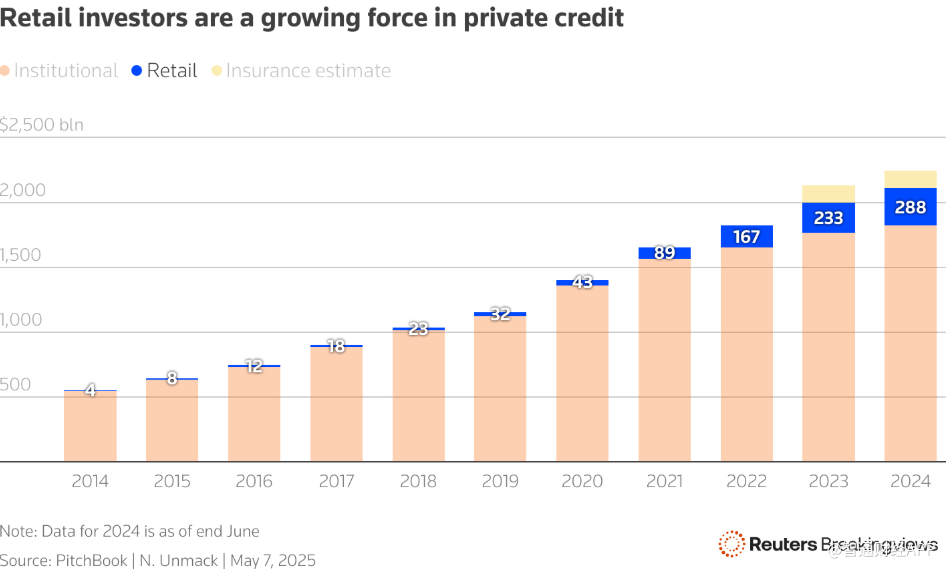
常青基金成散户“新宠” 私人信贷市场风险悄然积聚
智通财经网· 2025-05-12 09:17
Core Viewpoint - The private credit industry, valued at $2.2 trillion, is experiencing a buildup of risks despite its perceived stability compared to traditional banking financing [1] Group 1: Growth of Evergreen Investment Tools - Evergreen investment tools are gaining popularity, particularly in the debt sector, with Blackstone's private credit fund (BCRED) managing $81 billion as of March 31, up from $45 billion three years ago [2] - Private debt management companies raised $67 billion through evergreen tools last year, accounting for about one-third of their total fundraising from major institutional supporters [2] Group 2: Characteristics of Evergreen Funds - Evergreen funds have three key differences from traditional private credit: they are perpetual, allow investors to withdraw funds as needed (with a quarterly limit of 5% of net asset value), and attract a broader audience, including retail investors [5] - The private credit industry has achieved positive returns annually since 2010, with an average return rate of 9.4% [5] Group 3: Concerns and Risks - There are concerns that during a crisis, redemption requests could impact the entire private credit market, as funds may struggle to sell illiquid assets at favorable prices [6] - The rapid growth of the industry may attract less experienced investors, increasing the risk profile of loans and potentially leading to unexpected losses [8]