平湖芯片

Search documents
摩尔线程上市炸锅,千亿市值撑不起巨亏,寒武纪老路要重走
Sou Hu Cai Jing· 2025-12-10 14:03
Core Viewpoint - The listing of Moore Threads has generated significant market excitement, but the company is facing substantial losses, raising concerns about the sustainability of its high valuation [1][10]. Group 1: Company Overview - Moore Threads, known as "China's first general-purpose GPU stock," debuted on the Sci-Tech Innovation Board on December 5, 2025, with an opening price that surged to 650 CNY, leading to a market capitalization exceeding 305.5 billion CNY [4][6]. - The stock closed at 600.5 CNY, reflecting a 425.46% increase, with a market cap of approximately 282.25 billion CNY, despite the company reporting cumulative losses of nearly 6 billion CNY over three years [6][7]. Group 2: Market Dynamics - The capital frenzy surrounding Moore Threads is driven not just by the company itself but by the broader trend of domestic computing power replacement, particularly in the context of the ongoing AI wave [9]. - The scarcity of domestic general-purpose GPUs has heightened investor interest, positioning Moore Threads as a potential leader in this space [9]. Group 3: Competitive Landscape - Moore Threads is compared to Cambricon, which faced challenges after its IPO due to a disconnect between valuation and fundamentals, highlighting the risks of overvaluation in the current market [17][19]. - The competitive environment has intensified since 2020, with major players like NVIDIA and AMD, as well as domestic competitors such as Huawei and Cambricon, increasing pressure on Moore Threads [20][22]. Group 4: Future Outlook - Analysts predict that the AI chip market in China could reach 1.33 trillion CNY by 2029, with GPUs accounting for 77.3% of this market, suggesting significant growth potential for domestic suppliers [14]. - However, the current valuation of Moore Threads, estimated at 3 trillion CNY, far exceeds reasonable projections based on expected revenues of 1 to 1.2 billion CNY in 2025, indicating a potential overvaluation [19].



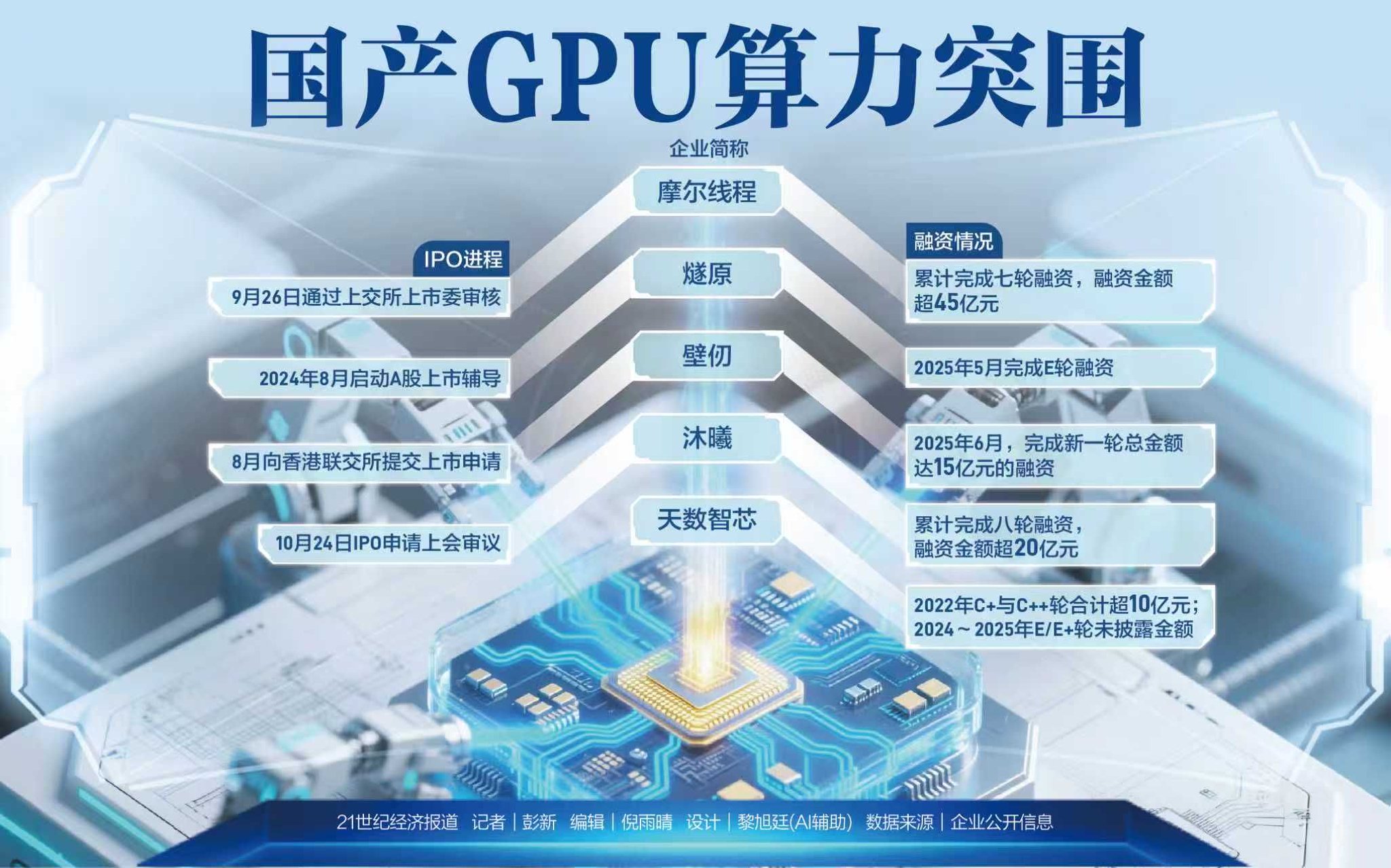
国产GPU算力突围
21世纪经济报道· 2025-10-24 00:44
Core Viewpoint - The article discusses the rapid progress of Chinese GPU companies, particularly Muxi and Moer Thread, in their IPO processes amidst a changing market landscape, highlighting the opportunities and challenges they face in competing with established players like NVIDIA [1][3][6]. Group 1: Company Overview - Muxi Integrated Circuit (Shanghai) Co., Ltd. was established in 2020 and focuses on developing and selling full-stack GPU products for AI training, inference, general computing, and graphics rendering [5]. - Moer Thread, also founded in 2020, has successfully passed the IPO review process and aims to become a leading GPU company, directly competing with NVIDIA [3][6]. - Both companies have attracted significant investments and talent, positioning themselves to challenge NVIDIA's dominance in the Chinese market [1][6]. Group 2: Product Development - Muxi has launched the "Xisi N" series GPUs for intelligent computing inference and the "Xiyun C" series for integrated training and general computing, with the latest C600 model aligning with mainstream architectures [5]. - Moer Thread has introduced four generations of chips from 2021 to 2024, with the latest "Pinghu" chip supporting advanced model training and achieving significant revenue from AI cluster products [4][6]. - Both companies are developing products that aim to match or exceed the performance of NVIDIA's offerings, with Muxi's C500 reportedly achieving performance comparable to NVIDIA's A100 in certain scenarios [5][8]. Group 3: Market Dynamics - The market for AI GPUs in China is rapidly expanding, with projections indicating a growth from 142.86 billion yuan in 2020 to 996.72 billion yuan by 2024, reflecting a compound annual growth rate of 62.5% [14]. - The changing geopolitical landscape, particularly U.S. export controls, has created a unique opportunity for domestic GPU companies as NVIDIA's market share in China has plummeted from 95% to nearly 0% [14]. - The shift towards domestic AI chips is being supported by both policy changes and market demand, providing unprecedented opportunities for companies like Muxi and Moer Thread [14]. Group 4: Competitive Landscape - The article highlights the significant gap in software ecosystems between domestic GPU companies and NVIDIA, with the latter having a well-established developer ecosystem based on its CUDA platform [8][9]. - Despite advancements in hardware, domestic companies face challenges in competing with NVIDIA's rapid product iterations and established market presence [9][11]. - The inference market is seen as a more attainable target for domestic companies, with lower computational requirements compared to training tasks, which are expected to grow significantly in the coming years [9].

沐曦股份IPO今日上会审议 GPU算力竞速:国产芯片的历史性机遇
2 1 Shi Ji Jing Ji Bao Dao· 2025-10-24 00:16
Core Viewpoint - The IPO applications of Chinese GPU companies, including MuXi Integrated Circuit and MoEr Thread, are progressing rapidly, marking a significant moment for the domestic GPU industry as they aim to challenge NVIDIA's dominance in the market [1][4][11]. Group 1: Company Developments - MuXi Integrated Circuit, established in 2020, has developed the "XiSi N" series GPUs for intelligent computing inference and the "XiYun C" series for training and general computing, targeting AI training and inference scenarios [1][5]. - MoEr Thread, also founded in 2020, has successfully passed the IPO review process in a record 88 days, potentially becoming the largest IPO on the STAR Market this year [3][4]. - Both companies have seen accelerated IPO processes amid a changing market environment, with significant investments and talent acquisition aimed at capturing the lucrative GPU market [1][5]. Group 2: Market Environment - The market for AI GPUs in China is experiencing rapid growth, with the market size projected to increase from 142.86 billion yuan in 2020 to 996.72 billion yuan by 2024, reflecting a compound annual growth rate of 62.5% [12]. - The exit of NVIDIA from the Chinese market due to U.S. export restrictions has created a unique opportunity for domestic GPU companies to fill the void [11]. - The competitive landscape is shifting, with domestic companies like MoEr Thread and MuXi aiming to establish themselves as viable alternatives to NVIDIA, which has seen its market share in China plummet from 95% to nearly 0% [11]. Group 3: Technological Challenges - Despite advancements, domestic GPU companies still face significant technological gaps compared to NVIDIA, particularly in software ecosystems and manufacturing processes [8][9]. - The transition costs for developers to switch from NVIDIA's CUDA to domestic alternatives remain a major hurdle for the adoption of domestic GPUs [8]. - The manufacturing capabilities of domestic companies are limited to 7nm or 14nm processes, while NVIDIA has moved to 4nm, posing challenges for future competitiveness [9]. Group 4: Future Outlook - The success of domestic GPU companies will depend not only on technological advancements but also on the maturation of the entire industry ecosystem [9]. - The push for domestic AI chip independence is gaining momentum, with increasing support from policies and market dynamics favoring local manufacturers [7][11]. - The rapid adaptation of domestic GPUs to emerging AI applications, such as DeepSeek, indicates a growing recognition of their capabilities in the market [12].
摩尔线程科创板IPO不到三个月顺利过会:今日距“1+6”新政推出100天整
3 6 Ke· 2025-09-26 11:43
Core Viewpoint - The successful IPO of Moore Threads on the Sci-Tech Innovation Board highlights the strong support from the Shanghai Stock Exchange for hard technology enterprises and the emphasis on artificial intelligence and new productivity by policy makers [1][2]. Company Overview - Moore Threads, established in 2020, focuses on the research, design, and sales of full-function GPUs and related products, aiming to provide computing acceleration platforms for high-performance computing fields such as AI, digital twins, and scientific computing [1][2]. - The company is one of the few domestic GPU manufacturers that integrates both graphics rendering and AI computing, offering a comprehensive product layout from cloud to edge [1]. Financial Performance - In the first half of 2025, Moore Threads is projected to achieve a revenue of 702 million yuan, surpassing the total revenue of 608 million yuan from 2022 to 2024, which reflects a compound annual growth rate of over 200% [2]. - The revenue growth is attributed to the continuous expansion of the product matrix and sustained market demand, with the company launching a new generation of GPU architecture chips annually from 2021 to 2024 [2]. Product Development - Moore Threads has introduced four generations of chips, including "Sudi," "Chunxiao," "Quyuan," and "Pinghu," with the upcoming "Changjiang" smart SoC chip set to launch in 2024 [2]. - The performance of Moore Threads' products is approaching or has reached international advanced levels, with specific products like the MTT S80 graphics card showing single-precision floating-point performance comparable to NVIDIA's RTX 3060 [2]. Market Position and Trends - Moore Threads is currently the only domestic manufacturer capable of mass-producing full-function GPUs, with products adaptable to various application scenarios, including large model training, digital twins, consumer electronics, and cloud computing [3]. - The demand for computing power driven by AI and large model training is surging, positioning GPUs as a core computing engine and emphasizing the importance of achieving self-sufficiency in GPU technology [3]. Industry Outlook - According to Frost & Sullivan, the global GPU market is expected to reach 3.6 trillion yuan by 2029, with China's GPU market projected to grow to 1.36 trillion yuan, increasing its market share from 30.8% in 2024 to 37.8% [3]. - The AI chip market in China is forecasted to grow from 142.54 billion yuan in 2024 to 1.34 trillion yuan by 2029, with a compound annual growth rate exceeding 50%, making GPUs one of the fastest-growing segments [3][4]. Technological Advancements - As the digital economy advances, the application scenarios for GPUs are expanding beyond traditional graphics processing to include AI computing, digital twins, intelligent driving, and the metaverse, necessitating higher requirements for versatility, computing performance, and ecosystem compatibility [4]. - Companies adhering to a full-function GPU technology route are likely to achieve broader industrial application, with Moore Threads positioned as a leading player in this domain [4].
摩尔线程科创板IPO不到三个月顺利过会:今日距“1+6”新政推出100天整
IPO早知道· 2025-09-26 10:28
Core Viewpoint - The article highlights the rapid progress of Moer Technology's IPO process, reflecting strong policy support for AI and advanced productivity in China [2][3]. Company Overview - Moer Technology, established in 2020, focuses on the research, design, and sales of full-function GPUs and related products, aiming to provide computing acceleration platforms for high-performance computing fields such as AI and digital twins [2][3]. - The company has a diverse product layout covering cloud to edge, supporting digital transformation across various industries [3]. Financial Performance - Moer Technology is projected to achieve a revenue of 702 million yuan in the first half of 2025, surpassing the total revenue from 2022 to 2024, which was approximately 608 million yuan [3]. - The company has experienced a compound annual growth rate (CAGR) of over 200% from 2022 to 2024, with revenues of 46 million yuan, 124 million yuan, and 438 million yuan in those respective years [3]. Product Development - Moer Technology has launched four generations of GPU architecture chips from 2021 to 2024, with the latest being the intelligent SoC chip "Changjiang" [3][4]. - The products have achieved performance metrics close to or at international advanced levels, with the MTT S80 graphics card's single-precision floating-point performance nearing that of NVIDIA's RTX 3060 [4]. Market Position and Trends - Moer Technology is currently the only domestic company capable of mass-producing full-function GPUs, with products applicable in various fields such as large model training, digital twins, and cloud computing [4]. - The global GPU market is expected to reach 3.6 trillion yuan by 2029, with China's GPU market projected to grow to 1.36 trillion yuan, increasing its market share from 30.8% in 2024 to 37.8% [4][5]. - The AI chip market in China is anticipated to grow from 142.54 billion yuan in 2024 to 1.34 trillion yuan by 2029, with GPUs being one of the fastest-growing segments [5]. Strategic Importance - The demand for computing power driven by AI and large model training is surging, positioning GPUs as critical components in this landscape [4][5]. - Companies adhering to a full-function GPU technology route are expected to achieve broader industrial applications, with Moer Technology being a leading player in this domain [5].