
手机卡

Search documents
端掉10个短信诈骗窝点 抓21人
Xin Lang Cai Jing· 2026-02-10 23:14
Group 1 - The core issue involves a significant increase in mobile phone number registrations followed by rapid number portability and mass SMS sending, indicating potential telecom fraud activities [2][4]. - A criminal gang was identified, which was involved in sending over 100,000 fraudulent SMS messages within a short span of 10 days, using newly registered mobile numbers [4][6]. - Law enforcement agencies, specifically the Shenyang Public Security Bureau, successfully dismantled multiple criminal networks involved in SMS fraud, leading to the arrest of 21 suspects and the seizure of various illegal equipment [1][3][6]. Group 2 - The investigation revealed that the gang operated by opening multiple mobile accounts and sending deceptive collection messages, impersonating online lending companies to trick victims into transferring money [3][5]. - Following the initial arrests, further investigations led to the identification and dismantling of 9 additional criminal sites, resulting in the capture of 11 more suspects and the confiscation of equipment used for mass SMS sending [6]. - The police established a closed-loop operational model in collaboration with telecommunications departments to effectively analyze and combat such fraudulent activities [6].
反诈最前沿|专向学生下手 不偷手机只偷卡 背后套路大
Yang Shi Wang· 2026-01-05 05:31
Group 1 - The core issue involves multiple middle school students in Heze, Shandong, who have experienced a peculiar incident where their mobile phone SIM cards were stolen while the phones remained intact [1] - The motive behind stealing only the SIM cards, rather than the phones themselves, raises questions about the underlying reasons for this targeted theft [1] - The incident highlights potential security concerns related to mobile phone usage and the value of personal data associated with SIM cards [1]
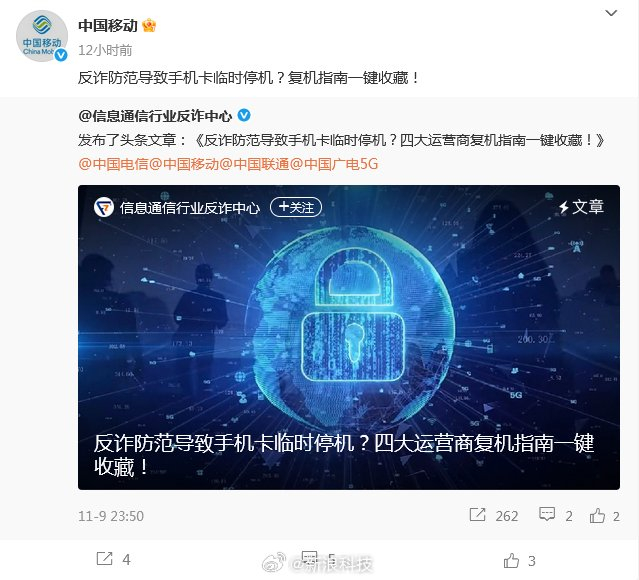
四大运营商发布反诈停机复机指南,线上线下均可办理
Xin Lang Ke Ji· 2025-11-11 02:22
Core Viewpoint - The article discusses the temporary suspension of mobile phone cards due to anti-fraud measures and provides recovery guidelines from the four major telecom operators in China. Group 1: China Telecom - Online channels: Users can process recovery through public accounts, mini-programs, and online service halls (specific methods can be found in the verification notification SMS) [1][17] - Offline channels: Users can bring their ID and phone card to any China Telecom service hall nationwide (specific locations can be queried via local 10000 service) [1][17] Group 2: China Mobile - Online channels: Users can click the link in the notification SMS or call the 10086 customer service hotline for self-service recovery (specific methods can be found in the verification notification SMS) [2][18] - Offline channels: Users can bring their ID and phone card to any China Mobile service hall nationwide (specific locations can be queried via local 10086 service) [2][18] Group 3: China Unicom - Online channels: Users can apply for recovery by searching for the "self-service recovery" interface on the China Unicom app homepage or through public accounts and mini-programs (specific methods can be found in the verification notification SMS) [3][19] - Offline channels: Users can bring their ID and phone card to any China Unicom service hall nationwide to complete real-person authentication [4][19] Group 4: China Broadcasting Network - Online channels: Users can download the China Broadcasting Network app via the link in the notification SMS and complete recovery after passing the identity verification. The app usage does not incur data charges [5][20] - Offline channels: Users can visit any China Broadcasting Network service hall, providing their ID and the phone card for real-person authentication to complete recovery [5][20]




医生做手术时手机突然因“涉诈”被停机,二十多天未能复机,“无法与病人取得联系”!其妻子也因“打电话频繁”被停机,最新进展来了
Mei Ri Jing Ji Xin Wen· 2025-11-09 01:27
Core Viewpoint - The article highlights the issues faced by users of China Mobile due to unexpected service suspensions related to fraud prevention measures, raising concerns about the lack of clarity and consistency in the company's policies and customer service responses [1][5][10]. Group 1: User Experience and Complaints - A doctor in Hunan reported that her and her husband's mobile numbers were suspended for over 20 days due to alleged fraud involvement, causing significant disruption to their work and communication with patients [1][6]. - The couple faced difficulties in restoring service as they were required to travel to the number's registered location in Changsha, despite having no criminal record or abnormal communication behavior [6][8]. - Customer service representatives provided inconsistent information regarding the requirements for restoring service, leading to confusion and frustration for users [7][9]. Group 2: Company Policies and Procedures - China Mobile's fraud prevention measures involve automatic suspensions of numbers flagged for unusual activity, which can include frequent calls or changes in usage patterns [11][12]. - The company has been criticized for the lack of transparency in its fraud detection criteria and the process for restoring service, with users expressing dissatisfaction over the burdensome requirements [10][15]. - Regulatory frameworks, such as the Anti-Telecom Network Fraud Law, mandate that telecom operators conduct real-name verification for flagged users, but the implementation and communication of these policies remain unclear [8][11].

医生做手术时手机突然因“涉诈”被停机,二十多天未能复机,“无法与病人取得联系”!最新进展来了
Mei Ri Jing Ji Xin Wen· 2025-11-09 01:23
Core Points - A doctor in Hunan reported that her and her husband's mobile numbers were inexplicably suspended due to "fraud suspicion," causing significant disruption to their work and life [1][4] - The couple faced difficulties in restoring their service, as the local service center could not handle requests for numbers registered in other cities, requiring them to travel to the original registration location [5][6] - The customer service responses varied, with some representatives stating that a police clearance was necessary for reinstatement, while others indicated that it was not required [6][8] Group 1 - The incident highlights the challenges faced by users when their mobile services are suspended due to automated fraud detection systems [1][7] - The "protective suspension" policy is implemented when unusual communication patterns are detected, which can lead to significant inconvenience for users [8][10] - There is a lack of clarity regarding the criteria used for determining suspicious activity, leading to frustration among affected users [9][12] Group 2 - The case is not isolated, as other users have reported similar experiences of unexpected service suspensions, indicating a broader issue within the telecom industry [7][9] - Experts suggest that while telecom operators have a responsibility to ensure user safety, the standards for triggering these suspensions need to be more transparent to avoid arbitrary decisions [10][12] - Legislative representatives have raised concerns about the excessive power of telecom operators and the need for better protection of user rights [12][14]
大连警方公布4起电信网络诈骗典型案例
Zhong Guo Xin Wen Wang· 2025-10-22 11:26
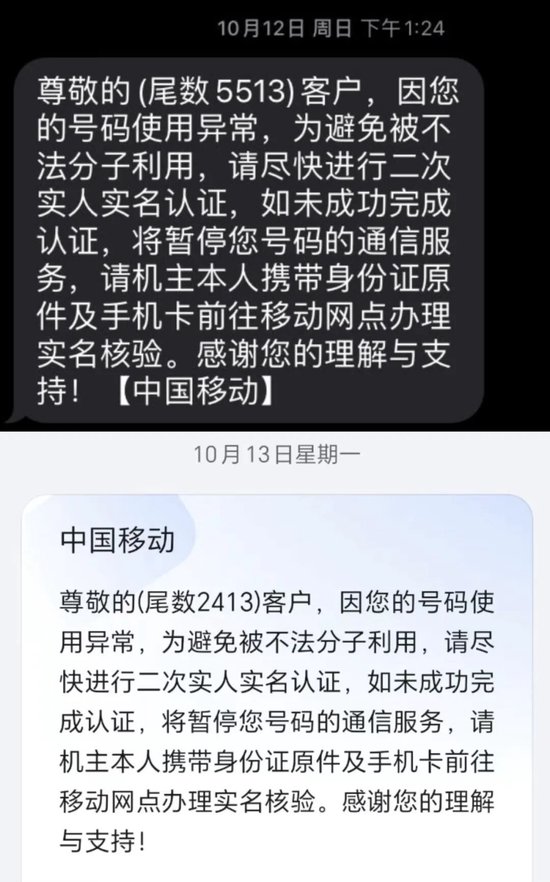
Group 1 - Dalian police announced four typical cases of telecom network fraud, highlighting that these cases, while seemingly unrelated to fraud itself, play a crucial role in facilitating telecom fraud as part of a larger criminal chain [1][2] - In one case, five suspects illegally bought and sold 50,000 pieces of personal information, using this data for telecom fraud and earning over 50,000 RMB. They were apprehended in Ganjinzi District [1] - Another case involved a group that lured individuals into obtaining phone cards under the pretext of "gifts for card applications," later selling the information to fraudsters for illegal gains exceeding 100,000 RMB [1] Group 2 - A suspect named Chen rented out his bank cards for telecom fraud, leading to over 1 million RMB in fraudulent activities. He was detained by police for his involvement [2] - Another individual, Zhang, sold a newly activated phone card for 300 RMB, which was subsequently used in a telecom fraud scheme that defrauded victims of over 30,000 RMB. He faced administrative detention and a fine [2] - Dalian police emphasized the importance of not falling for the temptation of easy money and maintaining a zero-tolerance policy towards such illegal activities, aiming to dismantle the fraud-related black and gray industry chains [2]
在中国电信靠营销提成月入过万?我劝你别想太多!
Sou Hu Cai Jing· 2025-10-04 03:46
Group 1 - The core argument is that relying on commission-based earnings in the saturated telecom market is unrealistic due to intense competition and limited new customer acquisition opportunities [1][3] - The telecom market is saturated, making it difficult to generate new business from standard services like mobile plans and broadband, except for large enterprises or significant recruitment events [1] - The commission structure has a clawback mechanism, meaning if a customer cancels a service, the commission earned is retracted, creating a risk for sales personnel [3] Group 2 - There is a psychological barrier for sales personnel, as they may feel inferior when approaching clients, knowing that clients are not dependent on them for services [3] - The conclusion suggests that employees should focus on meeting monthly performance targets rather than expecting substantial commission earnings, which may not be feasible for the average person [3]


盲人办手机卡得睁眼刷脸?办事不能如此瞎要求
Nan Fang Du Shi Bao· 2025-05-14 14:44
Core Viewpoint - The reliance on facial recognition technology for identity verification is creating barriers for disabled individuals, highlighting a disconnect between technological advancement and accessibility for vulnerable groups [1][2][3] Group 1: Issues Faced by Disabled Individuals - Disabled individuals, such as the blind, are facing challenges in accessing services that require facial recognition, which often does not accommodate their conditions [1] - Examples include a blind man struggling to obtain a business license due to facial recognition requirements, and elderly patients being denied banking services due to their inability to perform required actions [1][2] Group 2: Alternatives and Solutions - There are feasible alternatives to facial recognition, such as allowing disabled individuals to present their identification and disability certificates for verification [2] - Technological solutions like "silent live detection" and "accessible facial recognition" are being developed, but immediate practical solutions like fingerprint verification and manual review should be prioritized [2] Group 3: Regulatory Changes - A new regulation, effective June 1, 2025, will prohibit the use of facial recognition as the sole verification method for disabled and elderly individuals, emphasizing the need for alternative verification methods [3] - There is a call for accountability mechanisms to ensure that service providers do not discriminate against individuals requiring alternative verification methods [3]