手机软件

Search documents
冰雪经济系列报道之二 产业体系更健全 冰雪经济释放新活力
Ren Min Wang· 2025-12-12 07:38
Core Insights - The ice and snow industry in China is experiencing significant growth, with a projected consumer spending of over 187.5 billion yuan during the 2024-2025 season, marking a year-on-year increase of over 25% [1] - The demand for ice and snow equipment is surging, with production orders in some manufacturing companies reaching three times the volume of the previous year [3] - The integration of digital technology into the ice and snow industry is creating new business models and enhancing consumer experiences [1][3] Industry Growth - The ice and snow economy is expanding rapidly, with various new business formats emerging, driven by increased participation in ice and snow sports [1] - Ski resorts are enhancing their offerings by increasing the number of ski trails, providing professional coaching teams, and creating family-friendly skiing environments [1][2] - The report indicates that ski resort consumption reached 78.61 billion yuan, with a 27.97% increase in spending within a two-kilometer radius of ski resorts [1] Technological Integration - Ski resorts are adopting smart technologies, such as high-definition cameras and satellite positioning, to enhance visitor experiences [2][3] - A mobile application for skiing services has gained over 10 million registered users, indicating a growing interest among younger consumers [3] Recommendations for Development - The industry should focus on strengthening technological empowerment for smart management, utilizing 5G, IoT, and big data to improve operational efficiency and visitor experience [3][4] - Establishing a talent cultivation and standardization system is crucial for providing specialized and versatile professionals to the industry [3][4] - Enhancing statistical monitoring and regional collaboration can help create a unified national strategy for the ice and snow economy [4] - Strengthening policy and resource support is essential for optimizing the policy framework and improving infrastructure accessibility to boost the ice and snow tourism sector [4]
手机流量劫持,不能让用户忍气吞声
Bei Jing Shang Bao· 2025-11-30 16:13
Core Viewpoint - The article highlights the issue of mobile software hijacking user traffic through deceptive practices, prompting regulatory intervention from the market supervision authority to address these behaviors [1][2][3]. Group 1: Regulatory Actions - The market supervision authority has identified three main issues with mobile software: traffic interception, forced redirection, and malicious incompatibility settings, urging companies to adhere to regulations [1]. - New amendments to the Anti-Unfair Competition Law have further clarified the standards for identifying irrational and unfair competition behaviors, specifically listing forms of traffic hijacking and malicious interference [3]. Group 2: Industry Practices - Certain mobile manufacturers are reportedly treating non-native apps unfairly, leading to delayed reviews and limited exposure, which can degrade the performance of competing apps through system updates [2]. - The article describes these practices as a form of hidden digital kidnapping, where user attention is covertly stolen, diverting traffic from an open internet to a closed ecosystem [3]. Group 3: Market Implications - The article argues that short-term profit motives driving these deceptive practices could ultimately harm the market by reducing competition and user choice, potentially leading to a smaller market for all players involved [3]. - It emphasizes that a lack of open ecosystems and free competition will hinder product longevity and market growth, suggesting that companies should focus on compliance, respect for competitors, and consumer interests to expand their market [4].
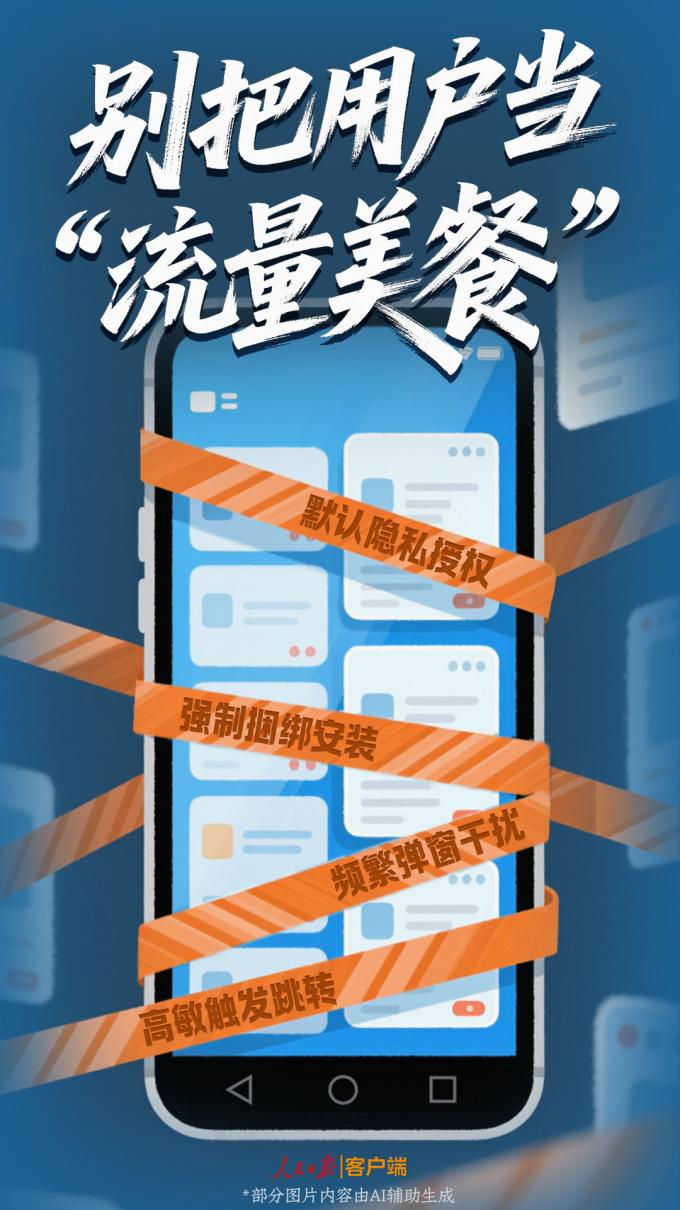
把用户当“流量美餐”,这种手机软件走不远
Ren Min Ri Bao· 2025-11-27 05:00
Core Viewpoint - The article highlights the increasing prevalence of "gray traffic" tactics used by mobile software companies to hijack user attention and data, raising concerns about user privacy and the ethical implications of such practices [1][4][5] Group 1: Gray Traffic Tactics - Mobile software companies are employing various deceptive methods, such as default selections for privacy permissions and intrusive pop-up ads, to capture user data and attention [1][4] - The competition for user traffic has led to the emergence of "gray traffic" strategies, which are designed to manipulate users into granting access to personal information without their full awareness [1][4] Group 2: User Rights and Regulations - The article notes that while the pursuit of traffic is understandable, it must not come at the expense of user rights, as highlighted by regulations aimed at ensuring transparency and user consent in app usage [4][5] - Regulatory bodies have recognized the issues surrounding "gray traffic" and have established guidelines to prevent misleading practices, such as forced installations and deceptive pop-up ads [4][5] Group 3: Industry Implications - The ongoing use of manipulative tactics by some mobile software companies could lead to a loss of user trust, ultimately resulting in users abandoning these applications [4][5] - The article emphasizes the need for stricter enforcement against non-compliant practices and encourages companies to focus on providing genuine value to retain users rather than exploiting them [5]