
投资研究报告

Search documents
超预期的1月非农,背后有哪些疑点?
Hua Er Jie Jian Wen· 2026-02-12 10:03
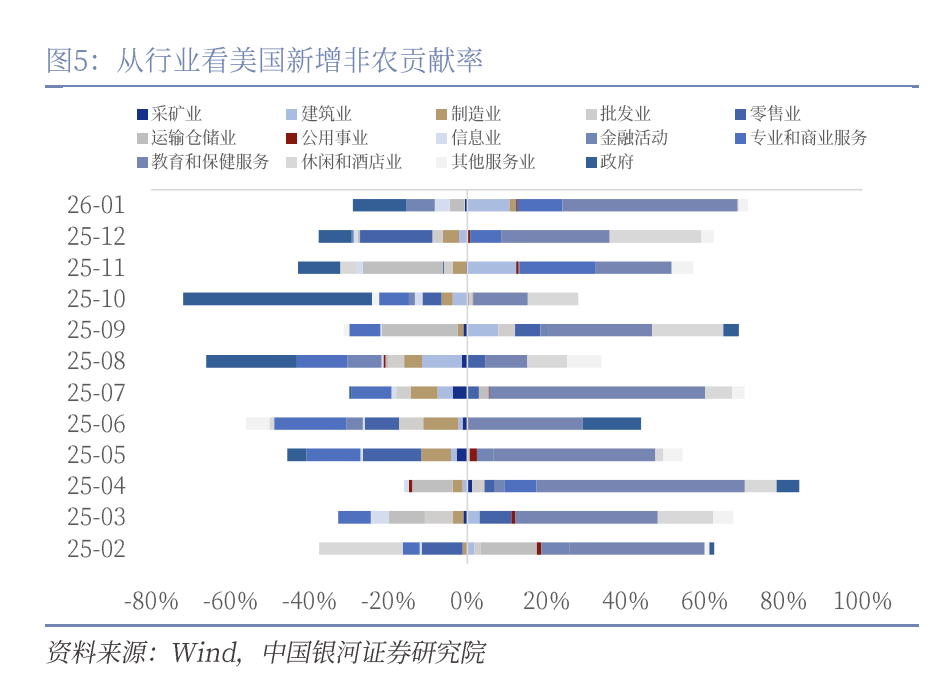
Group 1 - The core viewpoint of the article indicates that while January's non-farm employment data exceeded expectations, the labor market recovery remains fragile due to last year's employment overestimation and concentrated industry growth [1][14] - Employment growth in January was heavily concentrated in a few sectors, particularly healthcare, with structural characteristics showing no improvement, raising concerns about the sustainability of economic conditions [2][14] - The market's pricing for interest rate cuts in 2026 narrowed by 8 basis points to 52 basis points following the data release, with 2-year and 10-year U.S. Treasury yields rising by 7 and 5 basis points respectively [1] Group 2 - In January, the private sector added 172,000 non-farm jobs, marking the highest monthly increase since 2025, but the distribution across industries was highly uneven [2] - The healthcare sector contributed significantly with 124,000 new jobs, a substantial increase from the average of 52,000 in the last quarter of the previous year [2] - The unemployment rate fell by 0.1 percentage points to 4.3%, better than market expectations, with the labor force participation rate rising to 62.5% [9] Group 3 - Several institutions expressed skepticism regarding the reliability of January's non-farm data, noting significant downward revisions in previous employment levels [4] - The introduction of a new "business birth-death model" by the Bureau of Labor Statistics (BLS) may enhance data accuracy but could also introduce short-term volatility in January's figures [4] - The BLS's annual population control benchmark update was delayed due to a government shutdown, potentially affecting the comparability of January's employment data with future reports [6] Group 4 - Despite the positive January employment data, institutions maintain a cautious outlook on its sustainability, with expectations that the Federal Reserve will pause interest rate cuts until at least June [14] - The necessity for the Fed to hold off on rate cuts is emphasized, considering the dual factors of economic data recovery and policy independence [14] - The overall moderate inflation and uncertainty regarding the sustainability of employment data suggest that the Fed is likely to remain observant before making any policy changes [14]

已成AI"关键瓶颈",高盛:欧美电网远远落后于中国,铜将变成新的石油
Hua Er Jie Jian Wen· 2025-09-28 03:33
Group 1 - Goldman Sachs warns that aging power grids in Western countries have become a "vulnerable link" in energy security due to increasing AI demand and geopolitical tensions, predicting copper prices will rise to $10,750 per ton by 2027 [1][4] - The average operational lifespan of power grids is nearing its end, with Europe at 50 years and North America at 40 years, while China is advancing its ultra-high voltage transmission network [1][2] - The report emphasizes the interdependence of the power grid, AI, and national defense, making investment in grid infrastructure a pressing national security priority [3][4] Group 2 - The rapid development of AI is intensifying pressure on already strained power grid systems, as data centers require significant electricity [3] - Goldman Sachs predicts that by the end of 2030, power grid and infrastructure upgrades will account for approximately 60% of global copper demand growth, equivalent to adding another U.S. consumption level to global demand [4] - The strategic importance of copper is increasing as it becomes essential for power grid construction, leading to its characterization as the "new oil" [4]
