抖音放心借

Search documents
起底宁波银行征信查询“罗生门”:账户注销≠额度注销?
Yang Shi Wang· 2026-01-26 09:32
Core Viewpoint - The dispute between a consumer and Ningbo Bank highlights issues of financial privacy, authorization boundaries, and institutional power in credit reporting practices [1][2][4] Group 1: Consumer Complaints and Bank Responses - A consumer reported that Ningbo Bank continued to query their credit report despite having canceled their "Douyin Fangxin Loan" account over a year ago, leading to claims of unauthorized credit checks [1][2] - Ningbo Bank stated that the consumer's loan limit remains valid until August 2026, and they have not received any request to cancel the credit limit, thus justifying their ongoing credit checks [2][3] Group 2: Regulatory and Compliance Issues - The incident reveals a significant gap between the bank's internal risk management logic and the consumer's understanding of account termination, indicating potential compliance issues within the credit reporting system [2][4] - Experts argue that continued credit checks after account cancellation do not align with the "legitimate and necessary" principles outlined in the Credit Reporting Management Regulations [3][11] Group 3: Broader Industry Implications - The case reflects a broader trend of disputes between financial institutions and consumers regarding credit reporting practices, with several banks facing penalties for similar violations [3][7] - Ningbo Bank's rapid growth and expansion have led to challenges in compliance and risk management, raising concerns about the protection of consumer privacy amid aggressive business strategies [8][9] Group 4: Recommendations for Improvement - Experts suggest that improvements in technology and credit reporting processes are necessary to ensure that account cancellations are promptly updated in credit systems, preventing unauthorized queries [6][10] - The need for a balance between business growth and compliance with consumer privacy rights is emphasized, advocating for a more robust regulatory framework to protect individual credit information [10][11]

深圳近百家小贷公司迎“年度体检”,11家获评A级
2 1 Shi Ji Jing Ji Bao Dao· 2025-12-29 13:59
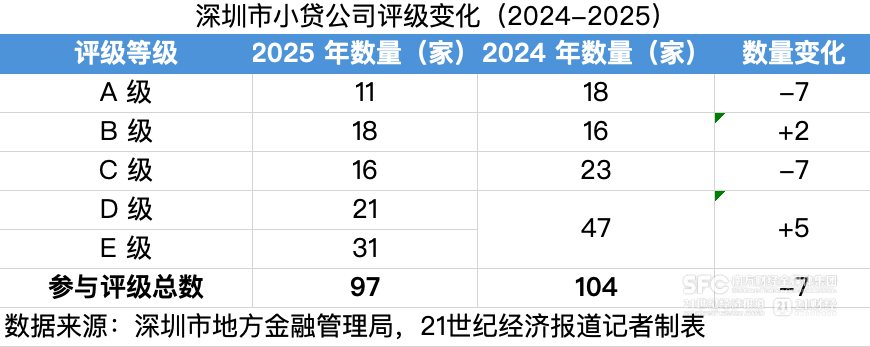
Core Viewpoint - The Shenzhen Municipal Financial Management Bureau has released the list of small loan companies rated C and above for 2025, indicating a decrease in the overall number of rated companies and reflecting the increasing operational pressures in the industry [1][4]. Group 1: Rating Overview - A total of 97 small loan companies were rated in Shenzhen for 2025, with 11 rated A, 18 rated B, 16 rated C, 21 rated D, and 31 rated E [1][3]. - Compared to 2024, the overall number of rated companies decreased by 7, with A-rated companies decreasing by 7, B-rated increasing by 2, C-rated decreasing by 8, and D and E-rated companies increasing by a total of 5 [1][3]. Group 2: Company Classification - The 11 A-rated companies can be categorized into three groups: 3 internet-based companies, 4 state-owned enterprises, and 4 private enterprises [4]. - The top tier of A-rated companies includes internet-based firms such as Zhongrong Small Loan (CNY 19 billion) and Tencent's Financial Payment Small Loan (CNY 15 billion), which utilize major online platforms for customer acquisition [4]. - The second tier consists of state-owned small loan companies, including Shenzhen Guarantee Group's Zhongxia Small Loan (CNY 3 billion) and Longgang District's Jintong Small Loan (CNY 3 billion) [4][5]. Group 3: Regulatory Context - The regulatory approach for the small loan industry is focused on "supporting the strong and limiting the weak," providing policy support to leading institutions while promoting the orderly exit of high-risk and inactive companies [5]. - The Shenzhen Municipal Financial Management Bureau aims to assess the operational management and risk status of small loan companies comprehensively, facilitating a graded regulatory approach to promote the sustainable development of the small loan industry [5][6].

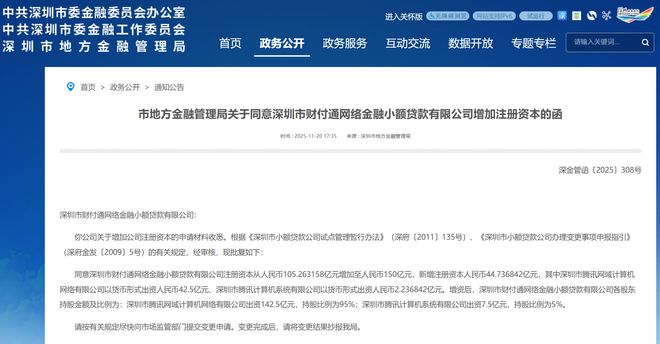
5年增资6次,腾讯旗下小贷注册资本增至150亿,行业第二仅次于字节系
Guan Cha Zhe Wang· 2025-11-25 08:15
Core Points - Shenzhen Financial Management Bureau approved the increase of registered capital for Shenzhen Tencent Financial Technology Microloan Co., Ltd. from RMB 10.5263158 billion to RMB 15 billion, with an additional capital of RMB 4.4736842 billion [1] - Tencent's two subsidiaries contributed to the capital increase, with Shenzhen Tencent Network Co., Ltd. investing RMB 4.25 billion and Shenzhen Tencent Computer Systems Co., Ltd. investing RMB 223.6842 million [1] - Since 2020, Tencent's microloan company has undergone five capital increases, growing from an initial RMB 300 million to RMB 15 billion, representing a 50-fold increase in five years [1] Industry Overview - Nearly 30 microloan companies have increased their capital this year, with notable examples including Ping An's Jinlian Yuntong Microloan increasing from RMB 5 billion to RMB 10 billion [2] - The top three microloan companies by registered capital are ByteDance's Zhongrong Microloan (RMB 19 billion), Tencent's Financial Technology Microloan (RMB 15 billion), and Ping An's Jinlian Yuntong Microloan (RMB 10 billion) [2] - As of September 2025, the number of microloan companies in China decreased to 4,863 from 5,257 at the end of 2024, indicating a trend of consolidation in the industry [2] - Tencent does not hold a consumer finance license, despite being a major player in the microloan sector [2] - Other significant players in the internet microloan space include JD's Jingdong Shengji (RMB 8 billion) and Baidu's Du Xiaoman (RMB 7.4 billion) [2]