
推理引擎

Search documents
AI芯片独角兽一年估值翻番,放话“三年超英伟达”,最新融资53亿超预期
3 6 Ke· 2025-09-18 08:15
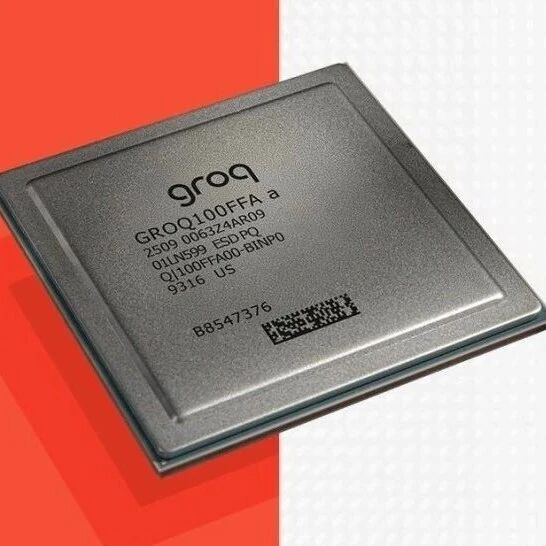
Core Insights - Groq, an AI chip startup, has raised $750 million in funding, exceeding the initial expectation of $600 million, bringing its valuation to $6.9 billion [1][4][5] - The company's valuation has more than doubled in one year, from $2.8 billion to $6.9 billion [2][4][5] - Groq's CEO, Jonathan Ross, emphasizes the importance of inference in the current AI era and the company's goal to build infrastructure for high-speed, low-cost delivery [3][4] Funding and Valuation - The recent funding round was led by Disruptive, with significant investments from BlackRock, Luminus Management, and Deutsche Telekom Capital Partners, among others [6][9] - Groq has raised over $3 billion in total funding to date [6][9] Company Strategy and Operations - Groq plans to use the new funds to expand its data center capacity, including announcing its first Asia-Pacific data center location this year [7][9] - The company has received requests from clients for higher capacity that it currently cannot meet [8] Product and Technology - Groq is known for producing AI inference chips optimized for pre-trained models, with a founding team that includes many former Google TPU engineers [9][10] - The company has developed the world's first Language Processing Unit (LPU) and refers to its hardware as "inference engines," designed for efficient AI model operation [12] - Groq claims its inference acceleration solution is ten times faster than NVIDIA's GPUs while reducing costs to one-tenth [14]



速递|英伟达AI 芯片挑战者Groq融资超预期,估值达69亿美元,融资总额已超 30 亿美元
Z Potentials· 2025-09-18 02:43
Core Insights - Groq, an AI chip startup, has successfully raised $750 million in a new funding round, achieving a post-money valuation of $6.9 billion, significantly higher than previous estimates of around $6 billion [1] - The funding round was led by Disruptive, with participation from major investors including Blackstone, Neuberger Berman, and Deutsche Telekom Capital Partners, along with existing investors like Samsung and Cisco [1] - Groq's valuation has more than doubled in approximately one year, having previously raised $640 million at a valuation of $2.8 billion in August 2024 [1] Company Overview - Groq is focused on developing AI chips, specifically a new type called Language Processing Units (LPUs), which are designed to optimize the performance of AI models, differentiating from traditional Graphics Processing Units (GPUs) [1] - The company also offers data center computing services, catering to developers and enterprises through cloud services or local hardware clusters [2] Performance and Market Position - Groq claims its products significantly reduce costs while maintaining or even enhancing AI performance [3] - The founder, Jonathan Ross, has a strong background in machine learning, having previously developed Tensor Processing Units (TPUs) at Google, which continue to power Google Cloud's AI services [3] - Groq currently supports over 2 million developers in AI applications, a substantial increase from 356,000 developers a year ago [3]
蚂蚁联手人大,发布MoE扩散模型
Hua Er Jie Jian Wen· 2025-09-12 06:02
Core Insights - Ant Group and Renmin University of China jointly released the industry's first native MoE architecture diffusion language model "LLaDA-MoE" at the 2025 Bund Conference, marking a significant advancement towards AGI [1][2] - The LLaDA-MoE model was trained on approximately 20 terabytes of data, demonstrating scalability and stability in industrial-grade large-scale training, outperforming previous models like LLaDA1.0/1.5 and Dream-7B, while maintaining several times the inference speed advantage [1][2] - The model achieved language intelligence comparable to Qwen2.5, challenging the prevailing notion that language models must be autoregressive, and only required activation of 1.4 billion parameters to match the performance of a 3 billion dense model [1][2] Model Performance and Features - LLaDA-MoE demonstrated an average performance improvement of 8.4% across 17 benchmarks, surpassing LLaDA-1.5 by 13.2% and equaling Qwen2.5-3B-Instruct [3] - The model's development involved a three-month effort to rewrite training code based on LLaDA-1.0, utilizing Ant Group's self-developed distributed framework ATorch for parallel acceleration [2][3] - The model's architecture, based on a 7B-A1B MoE structure, successfully addressed core challenges such as load balancing and noise sampling drift during training [2] Future Developments - Ant Group plans to open-source the model weights and a self-developed inference engine optimized for dLLM parallel characteristics, which has shown significant acceleration compared to NVIDIA's official fast-dLLM [3] - The company aims to continue investing in the AGI field based on dLLM, collaborating with academia and the global AI community to drive new breakthroughs [3] - The statement emphasizes that autoregressive models are not the endpoint, and diffusion models can also serve as a main pathway towards AGI [3]