新华中证红利低波动ETF

Search documents
2026公募生死局:中小公募的规模坍塌、治理失序与突围困境
市值风云· 2026-02-24 10:12
Core Viewpoint - The article highlights the severe challenges faced by small and medium-sized public fund companies in China, emphasizing the widening gap between leading firms and their smaller counterparts, which are struggling for survival in a harsh market environment [3][4]. Governance Issues - Frequent changes in management have become a norm for many small public funds, undermining their strategic continuity and stability [5]. - An example is Zhongke Wotu Fund, which has seen its general manager replaced four times in five years, leading to a drastic reduction in its management scale to 0.75 billion yuan, a nearly 75% decline year-on-year [5]. - Xinhua Fund also faces governance challenges, with seven executives leaving and joining in a short period, resulting in a lack of clear long-term strategy [6]. Scale Challenges - The collapse of management scale and product survival crises are evident, particularly as small public funds struggle to compete in a market dominated by ETFs [8]. - Xinhua Fund's ETF, despite a strong performance, was forced into liquidation due to its scale falling below 50 million yuan for 50 consecutive days [9]. - Some small funds resort to aggressive "shell protection" tactics to avoid liquidation, which undermines their credibility and long-term viability [10]. Financial Struggles - The shrinking scale has severely impacted the financial health of small public funds, which rely heavily on scale for management fee income [11]. - In the first half of 2025, leading firms like Huaxia Fund reported daily revenues exceeding 23 million yuan, while smaller firms like Ruida Fund struggled to maintain daily revenues of just a few thousand yuan [11]. - The financial pressure has even led to personal financial issues for executives, exemplified by the chairman of Kaishi Fund facing consumption restrictions due to unpaid debts [12]. Path to Survival - Despite the dire situation, there is potential for small public funds to survive by focusing on niche markets and leveraging unique resources [13]. - Successful examples include Xinyuan Fund, which achieved significant scale by specializing in fixed income through strong ties with its banking shareholder [13]. - The industry may see a shift towards a coexistence of "platform giants" and "boutique firms," with smaller funds needing to find their unique positioning to thrive [13].


三年规模缩水300多亿,17个月ETF清盘,21年老牌公募为何“掉队”?
Xin Lang Cai Jing· 2026-02-10 02:04
Core Viewpoint - The article highlights the challenges faced by Xinhua Fund, a 21-year-old public fund company, including legal disputes, product liquidation, and significant decline in assets under management, indicating a critical turning point for the company [3][20][34] Group 1: Legal Issues and Product Liquidation - Xinhua Fund is currently involved in a legal dispute with Shandong Xiwang Sugar Industry Co., Ltd. and Shandong Xiwang Starch Co., Ltd. over "debt joining disputes," which has drawn attention to the company [3][20] - On February 6, Xinhua Fund announced that its Xinhua CSI Dividend Low Volatility ETF would enter liquidation on February 13 due to its asset value falling below 50 million yuan for 50 consecutive working days, despite achieving a return of 21.07% since inception [3][20][32] Group 2: Decline in Assets Under Management - Xinhua Fund's assets under management peaked at 86.8 billion yuan between 2020 and 2022 but have since declined to 54.194 billion yuan by the third quarter of 2025, a decrease of over 32.643 billion yuan [3][30] - The company's industry ranking has dropped significantly, falling to 85th place as of the third quarter of 2025 [30] Group 3: Governance and Management Changes - The company has undergone multiple changes in ownership and governance, with significant shifts in its shareholder structure, including the transition to state-owned control under Financial Street Group [4][21][24] - Since the change in actual control in 2023, Xinhua Fund has experienced high turnover in its executive team, with seven executives leaving and seven new appointments, leading to concerns about strategic continuity [8][26][27] Group 4: Product Strategy and Market Position - Xinhua Fund has a heavy reliance on fixed-income products, which account for approximately 87% of its total assets, while its equity and ETF offerings remain underdeveloped [14][31] - The company has only three ETF products, with the recent liquidation of the Xinhua CSI Dividend Low Volatility ETF highlighting its struggles to maintain a competitive presence in the ETF market [31][32]

银行ETF领涨,机构:优质区域行股息率超6%丨ETF基金日报
2 1 Shi Ji Jing Ji Bao Dao· 2026-02-06 04:37
Market Overview - The Shanghai Composite Index fell by 0.64% to close at 4075.92 points, with a high of 4088.9 points during the day [1] - The Shenzhen Component Index decreased by 1.44% to 13952.71 points, reaching a peak of 14074.36 points [1] - The ChiNext Index dropped by 1.55% to 3260.28 points, with a maximum of 3288.38 points [1] ETF Market Performance 1. Stock ETF Overall Performance - The median return of stock ETFs was -1.12% [2] - The highest return among scale index ETFs was from Bosera CSI A50 ETF at 0.51% [2] - The top-performing industry index ETF was Tianhong CSI Bank ETF with a return of 2.36% [2] - The highest return in strategy index ETFs was from Xinhua CSI Dividend Low Volatility ETF at 1.45% [2] - The best-performing style index ETF was China Tai CSI Film and Television Theme ETF at 2.06% [2] 2. Stock ETF Performance Rankings - The top three stock ETFs by return were Tianhong CSI Bank ETF (2.36%), Guotai CSI Film and Television Theme ETF (2.06%), and E Fund CSI Bank ETF (1.95%) [6] - The three worst-performing stock ETFs were Huaan CSI Photovoltaic Industry ETF (-5.9%), Huaxia CSI Photovoltaic Industry ETF (-5.63%), and Huatai-PB CSI Photovoltaic Industry ETF (-5.45%) [7] 3. Stock ETF Fund Flows - The top three stock ETFs by fund inflow were Huaxia CSI A500 ETF (1.199 billion), Huatai-PB CSI 300 ETF (1.123 billion), and Huaxia Shanghai Stock Exchange Sci-Tech Innovation Board 50 ETF (474 million) [9] - The three stock ETFs with the highest fund outflows were Guotai CSI All-Index Communication Equipment ETF (579 million), Yongying CSI Shanghai-Hong Kong Gold Industry Stock ETF (569 million), and Jiashi Shanghai Stock Exchange Sci-Tech Innovation Board Chip ETF (352 million) [11] 4. Stock ETF Margin Trading Overview - The top three stock ETFs by margin buying were Huaxia Shanghai Stock Exchange Sci-Tech Innovation Board 50 ETF (612 million), Southern CSI 500 ETF (506 million), and Guotai CSI All-Index Securities Company ETF (364 million) [12] - The highest margin selling amounts were from Southern CSI 500 ETF (92.58 million), Southern CSI 1000 ETF (69.29 million), and Huaxia CSI 1000 ETF (20.04 million) [14] Institutional Perspectives - Ping An Securities expects the dividend configuration value of the banking sector to remain attractive, driven by stable fund inflows from passive index expansions and the sector's high dividend yield of 4.50% [14] - Industrial Securities notes that the dividend yield for major state-owned banks in A-shares is projected to rise to the 4.4%-5% range by 2026, with some quality regional banks exceeding 6% [15] - The banking sector's fundamentals are expected to improve marginally in 2026, with stable interest margins and a positive trend in revenue and profit, making it a high-dividend, low-valuation asset with significant allocation value [15]

基金清盘警报拉响,39只产品密集预警
Huan Qiu Wang· 2026-01-16 06:31
Group 1 - The public fund market is undergoing a significant survival of the fittest phase at the beginning of 2026, with a notable disparity in performance despite a recent rise in the A-share market [1] - As of January 15, 39 funds have issued liquidation warnings, and 7 funds have confirmed termination and entered the liquidation process, indicating a severe scale test for products lacking performance support or facing cooling trends [1] - The crisis in equity funds is primarily due to structural market characteristics, where funds tracking less popular themes like home appliances and automobiles are experiencing continuous net redemptions despite overall index gains [1] Group 2 - The ongoing volatility in the bond market has also contributed to the struggles of several bond funds, with significant redemptions from institutional investors leading to rapid shrinkage in fund sizes [3] - The situation for small public fund companies, such as Kaishi Fund, is particularly dire, with their only bond fund facing imminent liquidation due to net asset value falling below 50 million yuan for 60 consecutive working days [3] - Fund liquidation warnings often trigger a "vicious cycle" of early redemptions by holders, making it increasingly difficult for funds to recover without proactive measures from fund managers [3] Group 3 - Analysts suggest that the normalization of fund liquidations is a necessary step towards market maturity and reflects the optimization of resource allocation [4] - There is a clear trend of capital concentrating in top-quality products and advantageous sectors, leading to the accelerated exit of underperforming "mini funds" [4] - For investors, it is crucial to be cautious of funds with small scales and poor liquidity to avoid liquidation risks, while fund companies should focus on enhancing investment research capabilities to create competitively sustainable products [4]
中信证券最新ETF持仓曝光:增持南方中证1000ETF、天弘银行ETF!爆买华夏、国泰等5只A500ETF合计27亿元(图)
Xin Lang Ji Jin· 2025-04-01 13:38
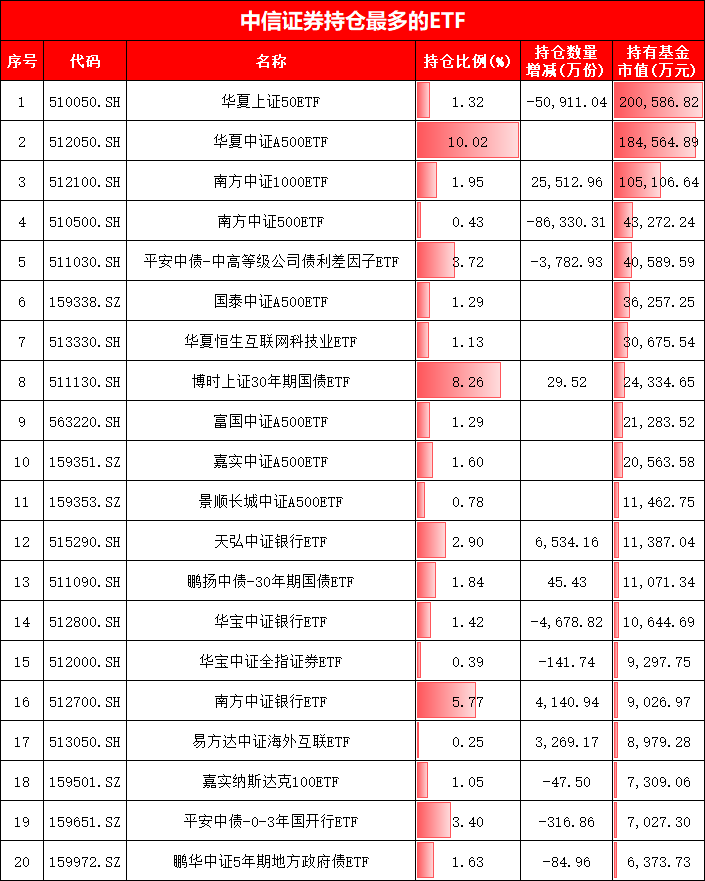
Core Viewpoint - CITIC Securities has made significant adjustments to its ETF holdings, increasing positions in certain ETFs while reducing others, indicating a strategic shift in investment focus towards specific sectors and market segments [1][9]. Group 1: ETF Holdings Overview - CITIC Securities holds the largest position in the Huaxia SSE 50 ETF with a market value of 2 billion yuan, despite a reduction of 50.91 million shares [2][3]. - The second largest holding is the Huaxia CSI A500 ETF, valued at 1.846 billion yuan, reflecting a stable investment strategy as no changes in holdings were reported [2][3]. - The Southern CSI 1000 ETF has seen an increase of 25.51 million shares, indicating a focus on small-cap stocks, which are expected to perform well in the current market environment [2][4]. Group 2: Increases in Holdings - The Southern CSI 1000 ETF was increased by 255 million shares, highlighting CITIC Securities' positive outlook on small-cap stocks and emerging industries [4][5]. - The Tianhong CSI Bank ETF was increased by 6.534 million shares, reflecting confidence in the banking sector amid a favorable macroeconomic environment [5][6]. - The E-Fund SSE 50 ETF saw an increase of 4.492 million shares, emphasizing the importance of large-cap blue-chip stocks in the investment strategy [5][6]. Group 3: Reductions in Holdings - CITIC Securities reduced its holdings in the Southern CSI 500 ETF by 860 million shares, indicating caution towards mid-cap stocks due to potential market uncertainties [7][8]. - The Huaxia SSE 50 ETF also experienced a reduction of 509 million shares, suggesting a strategic shift in focus away from large-cap stocks [7][8]. - The Southern MSCI China A50 ETF was reduced by 261 million shares, further reflecting a cautious approach to blue-chip stocks in the current market context [7][8]. Group 4: New Entrants and Exits - CITIC Securities entered the top ten holders of 46 new non-cash ETFs, indicating a diversification strategy to capture various market opportunities [9][10]. - The firm exited the top ten holders of the Hai Fu Tong SSE Urban Investment Bond ETF, Southern CSI 300 ETF, and the China Merchants CSI Dividend ETF, marking a significant portfolio adjustment [14][15].