新款坦克400

Search documents
长城汽车营收超1535亿仍“少赚钱”,转型路上的利润代价还要付多久?
Da Zhong Ri Bao· 2025-11-12 02:51
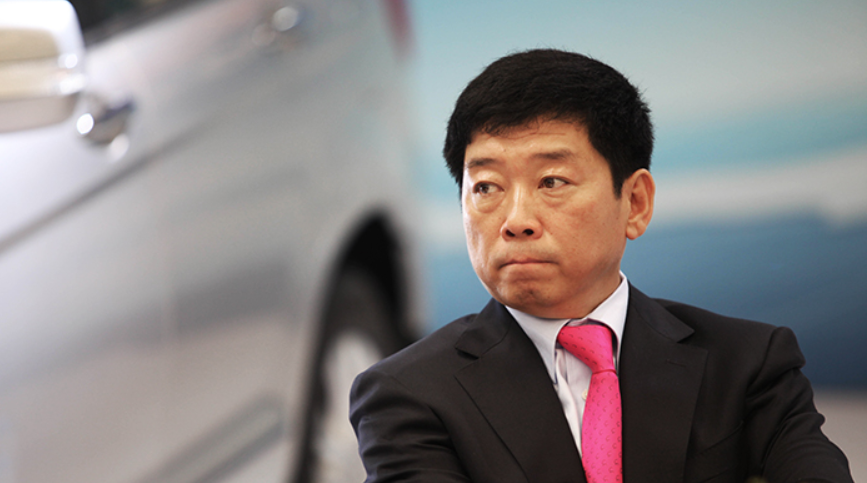
Core Insights - Great Wall Motors reported a revenue of 153.58 billion yuan for the first three quarters of 2025, marking a year-on-year growth of 7.96%, while net profit decreased by 16.97% to 8.635 billion yuan, indicating a "revenue growth without profit increase" scenario [1][3][4] - The company is focusing on balancing sales growth with profit levels, as the increase in revenue has not translated into higher profits, raising concerns about cost control and profitability logic [1][4] Financial Performance - In Q1 2025, Great Wall Motors experienced a revenue decline of 6.63% to 40.02 billion yuan, with net profit dropping 45.6% to 1.751 billion yuan [4] - Q2 2025 showed improvement with revenue of 52.32 billion yuan, a year-on-year increase of 7.72%, and net profit rising 19.42% to 4.586 billion yuan [4] - Q3 2025 revenue reached 61.25 billion yuan, up 20.51% year-on-year, but net profit fell 31.23% to 2.298 billion yuan [4][5] Marketing and R&D Investments - Marketing expenses for the first three quarters reached 7.948 billion yuan, significantly up from 5.110 billion yuan in the previous year, contributing to a decline in gross margin to 18.40% [3][5] - R&D investment for the same period was 6.636 billion yuan, still lower than BYD's 43.748 billion yuan [5] Product and Sales Performance - The average selling price of vehicles exceeded 180,000 yuan, with sales of models priced above 200,000 yuan surpassing 100,000 units, reflecting a 40.83% year-on-year increase [5] - New energy vehicle sales reached 278,500 units, a year-on-year growth of 31.67%, but the company's market share in the overall new energy vehicle market was only 2.48% [8][9] Market Strategy and Brand Positioning - Great Wall Motors aims to embrace the younger market, launching the new Tank 400 model, which is positioned as a "trendy off-road SUV" targeting urban and outdoor users [11][14] - The company is shifting focus from sheer sales volume to sustainable growth, as indicated by Chairman Wei Jianjun's comments on prioritizing healthy development over high sales figures [6][7] International Sales Growth - Overseas sales for the first three quarters reached 334,200 units, a year-on-year increase of 3.06%, accounting for 36.19% of total sales [10]


汽车早报|蔚能电池增资至约21.4亿 巧克力换电计划2026年建成2500座以上换电站
Xin Lang Cai Jing· 2025-10-22 00:37
Group 1: Regulatory Developments - The Ministry of Industry and Information Technology is soliciting opinions on the revision plan for the mandatory national standard for vehicle factory certificates, highlighting the need to update standards to meet new demands such as battery traceability for electric vehicles [1] Group 2: Automotive Export Trends - In September, China's automotive exports exceeded 600,000 units, with a notable increase in new energy vehicle (NEV) exports, which reached 222,000 units, reflecting a year-on-year growth of 100% [1] - For the first nine months of 2025, passenger car exports totaled 4.201 million units, marking a year-on-year increase of 15.6% [1] Group 3: Battery Production Insights - In September, China's total production of power and other batteries reached 151 GWh, representing a year-on-year increase of 50% [2] - From January to September, the cumulative production of power and other batteries was 1,122 GWh, showing a year-on-year growth of 44% [2] Group 4: Company Developments - Wuhan Weinan Battery Co., Ltd. increased its registered capital from approximately 1.87 billion RMB to about 2.14 billion RMB, reflecting a growth of about 14% [3] - Jiangling Motors reported a significant decline in net profit for Q3 2025, down 93.94% year-on-year, with a net profit of 16.406 million RMB [5] Group 5: Infrastructure Expansion - The Chocolate Battery Swap Plan aims to establish over 2,500 battery swap stations across more than 120 cities in China by 2026, with the current number of stations exceeding 700 [6] - Volvo Cars announced a free home charging plan for new electric vehicle buyers in Sweden, offering one year of free home charging starting from February 2026 [7] Group 6: New Product Launches - Great Wall Motors announced the pre-sale of its new Tank 400 model, with a starting price of 309,800 RMB [4]
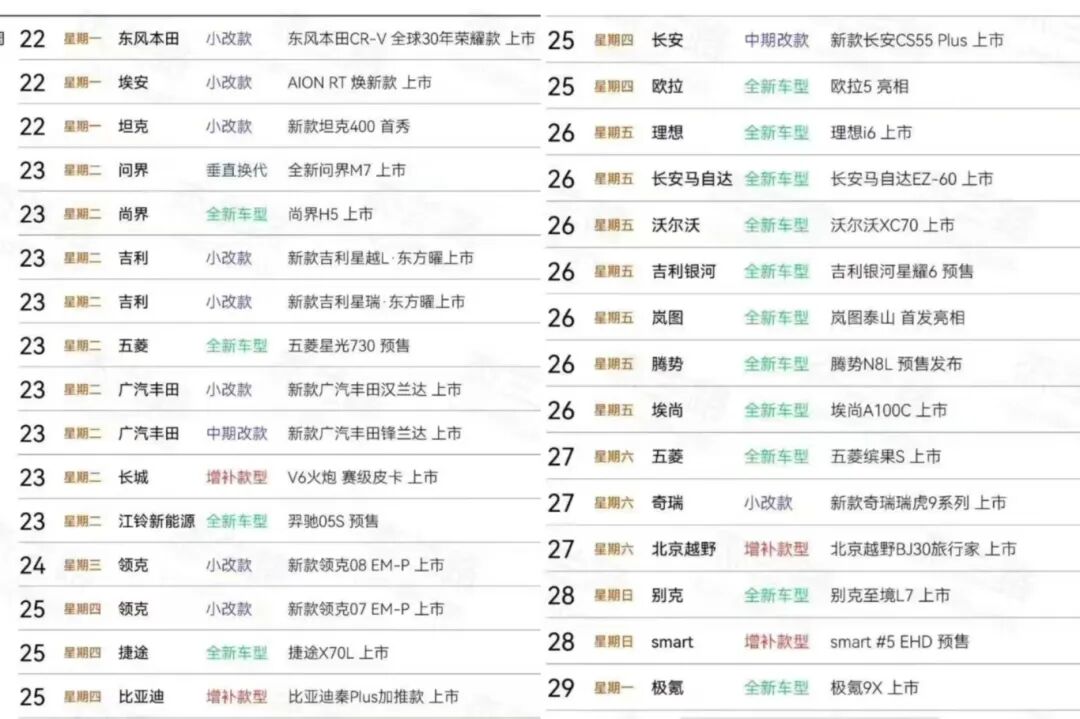
一周发布30款新车,汽车媒体都不够用了
3 6 Ke· 2025-09-23 02:13
Core Viewpoint - The automotive industry is experiencing intense competition and a surge in new car launches, particularly in September, reflecting a shift from an incremental to a saturated market, leading to increased pressure on manufacturers and media alike [1][4][11]. Group 1: New Car Launches - Nearly 20 new car models were launched in the first half of September, covering price ranges from 100,000 to 500,000 yuan, including both new energy and fuel-powered vehicles [1]. - Over 30 new car models are set to be launched in the last week of September, indicating a coordinated effort among brands to release delayed products [1][2]. - The frequency of new car launches is a response to the competitive landscape, as companies aim to capture market share in a transitioning market [4][8]. Group 2: Industry Competition - The automotive market is increasingly competitive, with a notable rise in the number of brands, particularly in the new energy sector, leading to a rapid increase in product offerings and replacement cycles [4][6]. - The shift from a growth market to a saturated market has resulted in a zero-sum game, where one company's sales often come at the expense of another [8][11]. - The pressure to continuously launch new products is a strategy to stimulate consumer demand during peak sales seasons, despite the risk of oversaturation [8][10]. Group 3: Media and Industry Impact - The intense schedule of new car launches has led to increased workloads for media professionals, making it difficult to provide in-depth evaluations of each vehicle [11][13]. - The quality of media coverage may suffer due to the rushed nature of events, resulting in content that lacks unique perspectives and depth [13][15]. - The automotive industry faces challenges in maintaining brand loyalty and vehicle resale values due to the rapid pace of new product introductions [15][17]. Group 4: Future Considerations - The current state of the automotive industry reflects a need for companies to reassess the sustainability of frequent new car launches, considering the associated costs and impacts on brand perception [15][17]. - The ongoing competition may lead to a market consolidation, where only those companies with comprehensive advantages in technology, product, and operations will survive [17].