方程豹系列

Search documents
比亚迪股份:海外市场成增长引擎,预测第四季度营业收入2392.99~3441.27亿元,同比变动-12.9%~25.2%
Xin Lang Cai Jing· 2026-03-02 12:05
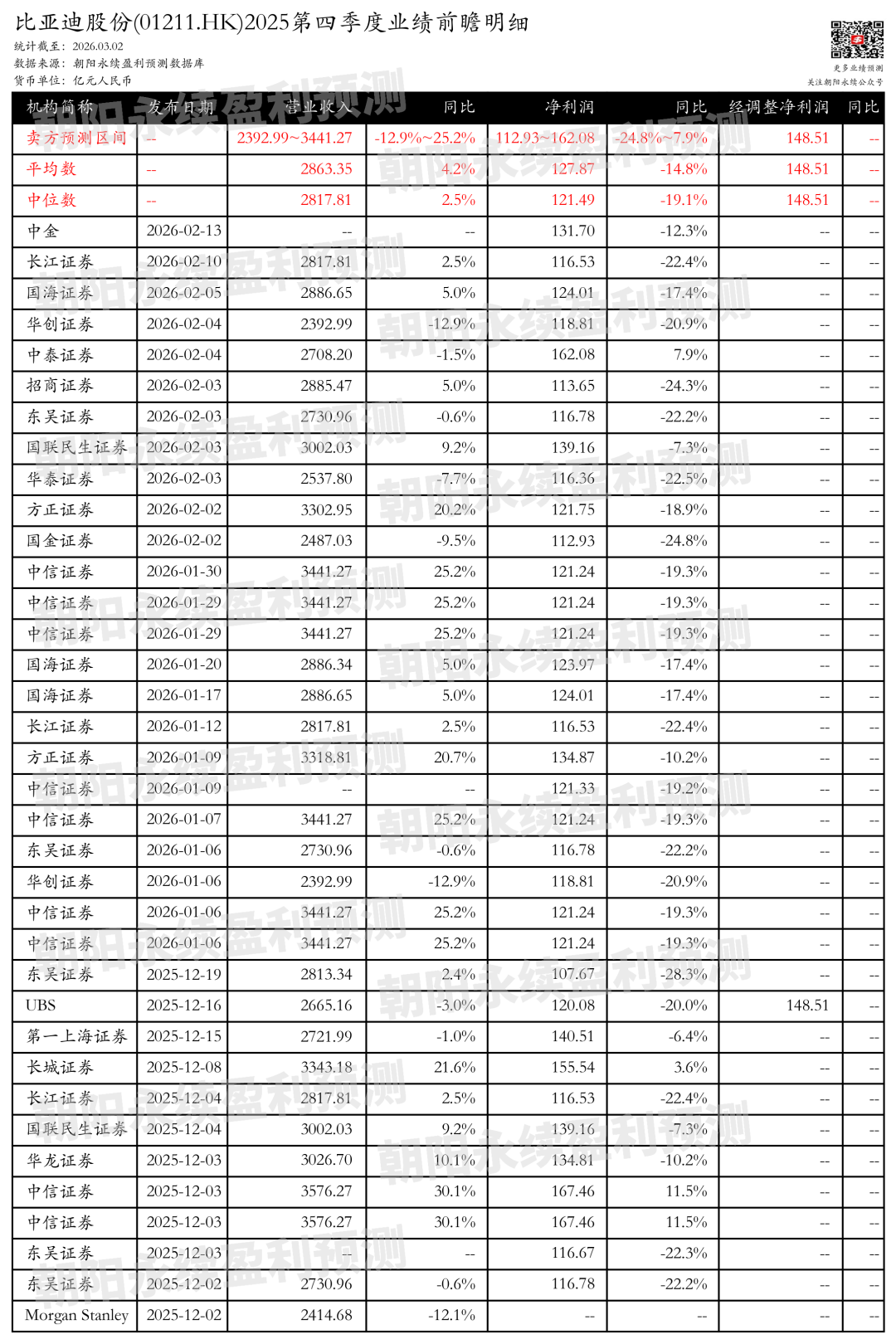
Core Viewpoint - The forecast for Chaoyang Yongxu's quarterly performance indicates a projected revenue range of 239.29 to 344.13 billion yuan, with a year-on-year change of -12.9% to 25.2%, and a net profit forecast of 11.29 to 16.21 billion yuan, reflecting a year-on-year change of -24.8% to 7.9% [1][6] Revenue and Profit Forecast - The predicted revenue range is 2392.99 to 3441.27 billion yuan, with a year-on-year change of -12.9% to 25.2% [1][2] - The forecasted net profit is between 112.93 and 162.08 billion yuan, with a year-on-year change of -24.8% to 7.9% [1][2] - The adjusted net profit is expected to be 148.51 billion yuan [1][2] Performance Analysis by Securities Firms - Various securities firms have provided differing forecasts, with the average revenue estimate at 286.34 billion yuan, showing a year-on-year increase of 4.2% [2][7] - The median revenue forecast is 281.78 billion yuan, reflecting a year-on-year increase of 2.5% [2][7] - Specific firms like Guohai Securities and Zhongjin Securities have provided individual estimates, with Guohai predicting a revenue of 288.67 billion yuan and Zhongjin forecasting 131.70 billion yuan in net profit [2][7] BYD Sales Insights - BYD's sales in January 2026 showed a year-on-year decline of 30.1%, but overseas sales increased by 51.5%, accounting for 48% of total sales [4][9] - The high-end strategy is progressing, with the Fangchengbao series achieving a significant year-on-year sales increase of 247% [4][9] - BYD is entering a "large battery hybrid" era, launching multiple new models aimed at consolidating market share through technological innovation [4][9] Overall Market Expectations - BYD's total sales for 2026 are projected to reach 5.12 million units, representing an 11% year-on-year increase, with exports expected to be between 1.5 to 1.6 million units, reflecting a growth of 44% to 53% [5][10] - The domestic sales are expected to remain stable, while high-end sales in January reached 28,000 units, marking a year-on-year increase of 54% [5][10] - The battery installation volume in January increased by 30%, with expectations of approximately 80 GWh in energy storage battery shipments for 2026 [5][10]


2025新能源汽车大战,谁赢、谁输?
3 6 Ke· 2026-01-22 12:47
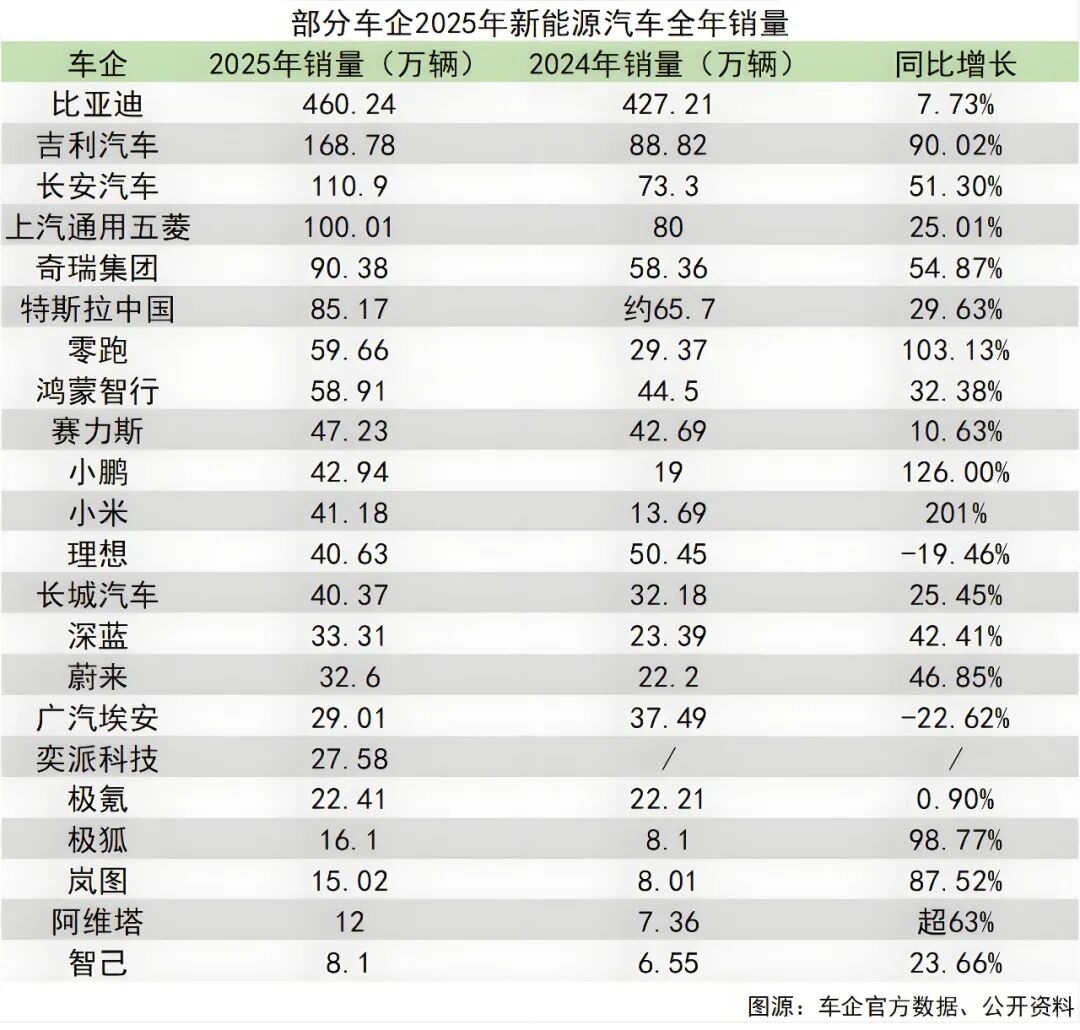
Core Insights - The Chinese automotive industry is experiencing a significant transformation, with total production and sales expected to exceed 34 million units by 2025, driven largely by the growth of new energy vehicles (NEVs) [1] - The market is increasingly dominated by domestic brands, with the top ten companies capturing over 70% of the market share, indicating a pronounced "Matthew Effect" [1] - Profitability has become the primary focus for companies, shifting from merely increasing sales volume to ensuring sustainable profits [1][6] Market Dynamics - NEV production and sales reached 16.62 million and 16.49 million units respectively in 2025, marking year-on-year growth of 29% and 28.2% [1] - The concentration of the NEV market is intensifying, with the top ten companies expected to hold over 74% of the market share by 2025, up from approximately 67% in 2024 [1] Company Performance - BYD leads the market with a total NEV sales volume of 4.60 million units in 2025, including 2.26 million pure electric vehicles, surpassing Tesla to become the global leader in pure electric sales [2] - Geely, Changan, and SAIC-GM-Wuling have joined the "million club," with Geely's NEV sales skyrocketing to 1.69 million units, marking a 90.02% increase year-on-year [3] - New entrants like Xiaomi and Leap Motor are rapidly gaining traction, with Xiaomi achieving over 410,000 units sold in 2025, while Leap Motor's sales reached 596,600 units, reflecting a 103.13% increase [3] Financial Performance - BYD reported revenues of 566.27 billion yuan and a net profit of 23.33 billion yuan for the first three quarters of 2025, maintaining a high gross profit margin of 17.87% [6][7] - New players like Leap Motor and Xiaomi have also reported significant revenue growth, with Leap Motor achieving a 174% increase in revenue for the first half of 2025 [8] Technological Advancements - AI technology has become a core competitive advantage in the NEV sector, transitioning from concept to practical application in 2025 [10] - Major companies are integrating advanced driver-assistance systems (ADAS) into more affordable models, making high-tech features more accessible [11] Management Strategies - Companies are focusing on refined management practices to navigate the competitive landscape, with an emphasis on organizational restructuring and supply chain management [14][16] - Cost control measures are evolving, moving away from extravagant marketing to data-driven customer acquisition strategies [16] Capital and Investment - The importance of capital is underscored by significant fundraising activities, with BYD raising 43.5 billion HKD in a major equity financing round [18] - Companies like NIO and Zero Run are also securing substantial investments to support their growth and technological advancements [18] Export Growth - The export of Chinese NEVs reached 2.62 million units in 2025, representing a year-on-year increase of over 100% and accounting for 36.84% of total automotive exports [19] - BYD remains the leader in exports, with 1.05 million units shipped abroad, benefiting from its overseas manufacturing presence [19]
半年产销数据出炉,长城汽车为何垫底
Zheng Quan Shi Bao Wang· 2025-07-11 07:33
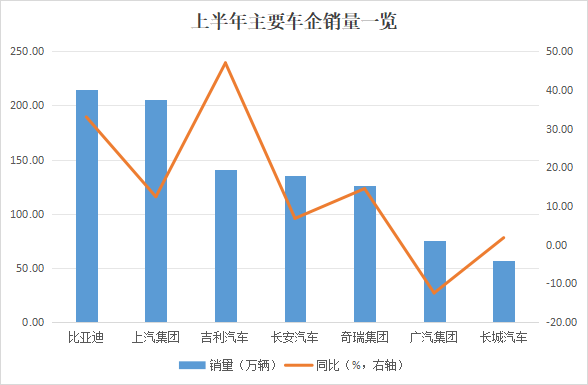
Group 1: Industry Overview - In the first half of the year, domestic automobile production and sales in China exceeded 15 million units, achieving over 10% year-on-year growth [1] - New energy vehicle sales accounted for 44.3% of total automobile sales [1] Group 2: Company Performance - BYD and SAIC Motor both surpassed 2 million units in sales, while Great Wall Motors sold only 569,800 units, ranking last among major automakers [1] - Geely Automotive recorded the highest growth rate at 47% year-on-year, while Great Wall Motors' growth was only 1.81%, significantly below the national average [1] Group 3: Great Wall Motors Specifics - Great Wall Motors' Ora brand saw its sales halved, and the Tank brand sold 103,700 units, down 10.67% year-on-year, a sharp decline from a 99% growth last year [3] - The Tank brand, which is positioned as a high-end off-road vehicle, faces intense competition from new entrants like BYD's Fangchengbao series, which has gained market share due to its cost-performance advantage [3] - Despite weak sales growth, Great Wall Motors increased its marketing expenses by 34.57%, the highest among A-share listed automakers [3] Group 4: Financial Performance - As of July 10, Great Wall Motors' stock price had dropped approximately 17%, contrasting with significant gains for companies like Xpeng Motors and BYD, which saw increases of over 40% [5] - In the first quarter, Great Wall Motors experienced an operating cash outflow of nearly 9 billion yuan, while BYD had an operating cash inflow of 8.58 billion yuan [5] - Great Wall Motors' cash and cash equivalents at the end of the first quarter were 28.6 billion yuan, lower than other major automakers [5] - The company's short-term debt repayment capability is concerning, with a cash to short-term debt ratio of only 0.63, ranking it among the lowest in the A-share market [5]