
万物互联

Search documents
ODM行业专题研究:智能终端迭代加速,ODM渗透持续提升
Guoyuan Securities· 2026-03-26 11:07
Investment Rating - The report maintains a "Buy" recommendation for the ODM industry [5] Core Insights - The ODM industry is experiencing accelerated growth due to the rapid iteration of smart terminal products and increasing penetration of ODM services [1][2] - The global consumption of electronic ODM shipments is projected to grow from 853.5 million units in 2020 to 976.9 million units in 2024, and further to 1,473.0 million units by 2029 [1][26] - The top three players in the global consumer electronics ODM market are expected to hold a combined market share of 56.9% in 2024, with the smartphone ODM sector seeing a concentration of 75.1% among the top three [1][29] Industry Development and Technical Characteristics - The ODM model provides a complete supply chain from product R&D and design to production and delivery, adapting to the evolving needs of brand manufacturers [11][12] - The industry has seen a shift from IDH/EMS models to ODM as companies seek comprehensive service providers capable of managing the entire product lifecycle [16][19] - The increasing complexity of smart products necessitates advanced technical capabilities in areas such as RF design, software development, and supply chain management [22][38] Market Size and Competitive Landscape - The ODM market is characterized by high concentration, with leading companies like Longqi Technology and Huqin Technology dominating the landscape [29][31] - In 2024, Longqi Technology is projected to achieve a shipment volume of 219.1 million units, capturing a market share of 22.4% in the consumer electronics ODM sector [29][30] - The smartphone ODM market is expected to see Longqi Technology leading with a shipment of 172.9 million units, representing a 32.6% market share [31][32] Industry Barriers - Key barriers to entry in the ODM industry include technological, customer resource accumulation, financial, production delivery, and talent barriers [2][41] - The high technical requirements and the need for extensive experience in product development and supply chain management create significant challenges for new entrants [38][44] Industry Trends and Outlook - The penetration of ODM services is expected to continue rising as brand manufacturers increasingly outsource R&D and production to focus on flagship products [46][47] - Emerging markets such as Southeast Asia, India, and Latin America are anticipated to drive significant growth in ODM shipments due to their expanding consumer bases [48][53] - The demand for AIoT products is set to explode, presenting new opportunities for ODM manufacturers as technology continues to evolve [52][53]


AI杀死「旧手机」,鸿蒙孕育「新物种」
36氪· 2026-03-25 10:47
Core Viewpoint - The article discusses the evolution of AI capabilities from simple conversational agents to actionable intelligent systems, particularly through Huawei's HarmonyOS, which integrates AI at the operating system level, enabling seamless task execution across applications and devices [2][4][12]. Group 1: AI Development and Market Trends - The trend of "raising lobsters" refers to the deployment of AI agents like OpenClaw, which allows users to automate tasks on their computers, marking a shift from mere chatbots to practical automation tools [2][6]. - Analysts predict that 2026 will be a pivotal year for AI smartphones, with many manufacturers launching intelligent devices, indicating a consensus that this year will be crucial for the large-scale commercialization of edge AI [6][21]. - The current market for mobile AI agents faces challenges, particularly in their ability to interact with third-party applications due to API authorization issues, limiting their practical value [7][8]. Group 2: HarmonyOS and AI Integration - HarmonyOS aims to embed AI capabilities deeply within the operating system, allowing for a more intuitive user experience where the system understands user intent and coordinates tasks across multiple applications [12][20]. - The architecture of HarmonyOS includes a unified AI system base, an intent understanding engine, and an open interaction protocol, positioning AI as a foundational capability rather than an application add-on [25][26]. - The integration of AI into HarmonyOS allows for proactive features, such as automatically adjusting settings based on user schedules or health metrics, enhancing the overall user experience [18][20]. Group 3: Future of User Interaction - The transition from an application-centric to an intent-centric model in HarmonyOS signifies a shift in how users interact with technology, where expressing needs becomes more important than navigating through applications [20][27]. - The article emphasizes that the future of mobile devices will depend significantly on the operating system's ability to understand and respond to user intentions, rather than just hardware specifications [21][27]. - HarmonyOS has already attracted over 10 million registered developers and thousands of applications, indicating a robust ecosystem that supports continuous evolution and integration of AI capabilities [26].


京东AI智能家装出街,谁慌了
半佛仙人· 2026-03-17 09:18
Core Viewpoint - The article emphasizes that JD Home Decoration is revolutionizing the home renovation industry by leveraging its supply chain, technology, and customer-centric approach to eliminate common pitfalls associated with traditional home renovation processes [5][8]. Group 1: JD Home Decoration's Unique Selling Points - JD Home Decoration guarantees a reliable supply chain and skilled labor, ensuring that customers do not face issues like contractor abandonment or poor material quality [5][7]. - The platform employs over 5,200 skilled workers and has a five-dimensional evaluation system to ensure high-quality workmanship and customer satisfaction [7]. - JD Home Decoration utilizes AI-driven design mechanisms that integrate the expertise of numerous designers, allowing for customized design solutions that cater to individual customer needs [7][21]. Group 2: Innovative Products and Technology - JD has introduced innovative smart home products, such as intelligent window-style fresh air systems, which do not require extensive installation and maintenance [10][13]. - The company integrates its smart hardware with the JoyAI model, enabling seamless automation and control of various home functions based on user preferences and habits [21][24]. - JD's approach to smart home technology focuses on interoperability, allowing different brands and devices to communicate effectively, thus avoiding the common issue of data silos in smart home ecosystems [24][26]. Group 3: Understanding Customer Needs - JD Home Decoration leverages data and insights to understand customer preferences and needs, offering tailored solutions that adapt to different life stages and requirements [26]. - The company aims to transform the renovation experience from a stressful process into a more enjoyable one, positioning itself as a partner that prioritizes customer satisfaction [26].


造车下半场,不再有弯道超车
晚点LatePost· 2026-02-28 10:30
Core Viewpoint - The resilience of business models is more crucial than product specifications in determining the survival quality of companies in the era of refined competition in the automotive industry [2] Group 1: Market Positioning and Brand Recognition - By 2026, the Spring Festival Gala seat has become a scarce commercial asset for the automotive industry, showcasing brands that have crossed the million sales threshold and their market ambitions [3] - Hongmeng Zhixing has transformed from a "cross-border entrant" to a "market leader," reflecting profound changes in the automotive industry's development logic [3][4] Group 2: Technological Advancements and R&D Investment - Hongmeng Zhixing possesses a unique advantage as the only automotive brand displayed and sold in Huawei stores, supported by Huawei's extensive R&D investment exceeding 50 billion yuan since 2019 in areas like assisted driving and intelligent cockpit [5] - The Tuling platform integrates multiple intelligent core components, significantly enhancing vehicle response speed and control precision, with a minimum decision chain delay of under 1 millisecond [5] - The Star River communication function showcases Huawei's deep expertise in communication, improving signal coverage by over 14% and reducing network switching delay to within 1.2 seconds [6] Group 3: Consumer Trust and Market Dynamics - The shift in consumer mindset towards cautious observation has increased the demand for brand stability and service continuity, making Hongmeng Zhixing's association with Huawei's robust business model appealing [9] - The high resale value and net promoter score (NPS) of models like the Wenjie M9 reflect consumer trust and satisfaction, driven by continuous software updates and standardized service delivery [10][11] Group 4: Sales Performance and Data Utilization - Hongmeng Zhixing achieved over 1 million deliveries in record time, with the Wenjie M7 surpassing 400,000 units and the Wenjie M8 and M9 targeting significant sales milestones [14] - The cumulative assisted driving mileage reached 7.013 billion kilometers, with a user activity rate of 98%, demonstrating the brand's data-driven growth and technological advantages [16] Group 5: Industry Impact and Ecosystem Development - The development of the flagship model, the Zun Jie S800, exemplifies a collaborative approach that has led to breakthroughs for over 200 suppliers, enhancing the local high-end manufacturing and intelligent networking industry [18] - Hongmeng Zhixing is not just creating automotive products but building a complete technology ecosystem that includes chips, operating systems, and cloud services, fostering a collaborative model that enhances the entire supply chain [22] Group 6: Future Outlook and Competitive Landscape - The automotive market is transitioning from a product-driven to a brand-driven model, with Hongmeng Zhixing establishing a comprehensive business model that emphasizes sustainable growth through a complete closed-loop system [24] - The achievement of one million sales marks a pivotal moment for the Chinese smart electric vehicle industry, indicating a shift in competitive dynamics where companies lacking systematic capabilities will struggle to compete [25]

赛微电子:MEMS行业正处于关键发展期
Zheng Quan Ri Bao Zhi Sheng· 2026-02-25 14:08
Core Viewpoint - The MEMS industry is experiencing significant growth opportunities due to the rise of IoT and artificial intelligence, with a projected market size increase from $15.4 billion in 2024 to $19.2 billion by 2030, reflecting a CAGR of 3.7% [1] Industry Summary - The MEMS market is expanding as traditional sensors, actuators, and passive components are gradually being replaced, leading to increased penetration of MEMS technology [1] - The MEMS industry operates under both Foundry and IDM models, with foundry companies supporting Fabless and Fablite design firms to drive innovation and ecosystem development [1] - The competitive landscape varies across different MEMS application fields, with domestic alternatives emerging in mid-to-high-end markets within communications, biomedical, industrial automotive, and consumer electronics [1] Company Summary - The company is a leading domestic MEMS chip manufacturer operating primarily under a Pure-Foundry model, distinguishing itself from competitors such as TSMC, Teledyne, and others [1] - The company has a clear role positioning within the MEMS supply chain and demonstrates strong development determination, which is crucial for maintaining core competitiveness [1] - Key factors influencing the company's competitiveness include technological development, process innovation, and the application of new materials [1]

赛微电子接待4家机构调研,包括淡水泉基金、孝庸基金、领丰资本、腾飞资本等
Jin Rong Jie· 2026-02-25 14:07
Core Viewpoint - Company focuses on MEMS chip manufacturing and aims to enhance competitiveness through strategic acquisitions and operational improvements [1][2][3] Group 1: Company Overview - Company specializes in MEMS chip manufacturing and is enhancing production capacity and yield in both domestic and international lines [3] - The acquisition of Qingdao Zhancheng Technology Co., Ltd. aims to strengthen the company's position in MEMS EDA and chip design services, leveraging Zhancheng's expertise and client base [5] - The transfer of control of Swedish subsidiary Silex is a strategic move to ensure stable operations amid international political uncertainties, while retaining approximately 45% ownership for investment returns and decision-making participation [6] Group 2: Industry Insights - The MEMS industry is projected to grow from $15.4 billion in 2024 to $19.2 billion by 2030, with a CAGR of 3.7%, driven by the demand for smart sensors and IoT applications [2][11] - The company is one of the few pure foundry MEMS manufacturers in China, coexisting with IDM models, and believes that the pure foundry model can help design companies save on investments [9][11] - The competitive landscape shows that domestic companies are beginning to replace traditional suppliers in high-end markets, particularly in communications, biomedical, industrial automotive, and consumer electronics [11][12] Group 3: Production and Development Plans - The Beijing FAB3 line is currently underutilized but is ramping up production of silicon microphones and other MEMS devices, with plans for further development in various MEMS technologies [7][8] - The company is optimistic about improving yield and capacity utilization in the Beijing FAB3 line as demand increases, despite current low utilization rates [7][8] - The company is committed to continuous innovation and development in MEMS technology, focusing on the integration of hardware and software to enhance market competitiveness [9][12]
从户外“失明”到精准感知:Nebula 410如何改写商用机器人视觉逻辑?
半导体行业观察· 2026-02-20 03:46
Core Viewpoint - The article discusses the challenges faced by a company specializing in commercial quadruped robots, particularly regarding the performance of depth cameras in bright outdoor environments, and highlights the significant improvements achieved with the Nebula 410 depth camera from Guangjian Technology [1][2][3] Group 1: Product Performance - The previous depth camera struggled in bright sunlight, failing to recognize objects even 1 meter away, leading to delays in collision warnings and decreased customer satisfaction [1] - The Nebula 410 depth camera successfully operates in extreme lighting conditions, with a tested illumination of over 100,000 lux, maintaining clear 3D point cloud visibility and accurately detecting objects like paper clips [2] - The Nebula 410 features an 8-meter detection range and a 98° field of view, significantly enhancing the robot's ability to navigate and avoid obstacles in various environments [2][3] Group 2: Integration and Algorithm Capabilities - The Nebula 410 is approximately one-third smaller than previous models, allowing for easier integration into new lightweight home companion robots [3] - It utilizes Guangjian's proprietary 3D SLAM algorithm, eliminating the need for additional laser radar for navigation and obstacle avoidance, thus improving safety and reducing blind spots to just 3 cm [3] - The implementation of the Nebula 410 has led to a 60% reduction in customer complaints and a decrease in order delivery time by half a month [3] Group 3: Future Opportunities and Events - Guangjian Technology will participate in the Munich Shanghai Optical Expo on March 18, 2026, to discuss the WFP nano-photonics chip technology behind the Nebula 410 [3][11] - The company aims to explore potential custom optimizations for different scenarios, such as improving detection stability in dusty environments for mining inspection robots [3] - There is a growing demand for domestic optical chips and high-power compound semiconductor suppliers from major telecom operators, with plans for multi-million dollar orders within the year [11][12]

半导体所在大规模单片集成高速光互连研究方面取得新进展
半导体芯闻· 2026-02-14 08:56
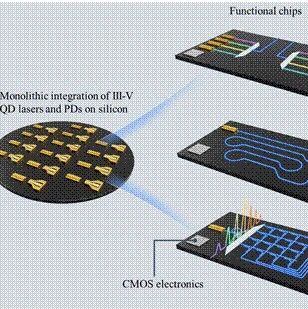
Core Insights - The article discusses significant advancements in silicon-based photonic integration technology, which is crucial for meeting the increasing demand for high-performance interconnect capabilities in the context of exponential data growth driven by AI, IoT, and big data [1] Group 1: Technological Advancements - Silicon photonic integration is identified as a revolutionary technology that merges light and electricity, enabling high bandwidth, low latency, high energy efficiency, and lightweight interconnect solutions [1] - Recent research by a team led by researchers Yang Tao and Yang Xiaoguang has made progress in large-scale monolithic integration of high-speed optical interconnects using a silicon-based epitaxial quantum dot platform [2] Group 2: Research Findings - The research results were published in "Laser & Photonics Reviews," highlighting the development of a wafer with an 8-layer InAs/GaAs quantum dot structure on a CMOS-compatible silicon substrate [2] - The team successfully fabricated direct modulation lasers and waveguide photodetectors, achieving a maximum 3-dB bandwidth of 4.5 GHz for lasers and 2.02 GHz for detectors [1][2] Group 3: Performance Metrics - The direct modulation rate of the laser reached 12.5 Gbit/s, while the data reception capability of the detector was 5 Gbit/s [1] - High-speed signal interconnects were demonstrated with a rate of 1.01 GHz based on a free-space optical coupling integrated structure [1]
专访迅翼卫通董事长李庆安:太空基础设施建设将牵引出万亿产业生态
Zhong Guo Jing Ying Bao· 2026-02-11 14:21
Core Viewpoint - The competition in low Earth orbit satellite internet is intensifying, and the connection between commercial aerospace and ordinary consumers is becoming a new topic of discussion. Chengdu Xunyi Satellite Communication Technology Co., Ltd. aims to make satellite communication as ubiquitous as mobile networks, targeting to be a key player in the "integrated space-ground" smart terminal for the 6G era [1]. Group 1: Company Position and Technology - Xunyi Satellite is at the forefront of satellite phased array technology globally, with advantages in "universality" and "full orbit compatibility" compared to competitors like Starlink, which operates a closed-loop system [2]. - The company has developed terminals that can work with high, medium, and low Earth orbit satellites, achieving cross-satellite system "roaming" despite significant technical challenges [2]. - After ten years of development, Xunyi Satellite has established a technological barrier in satellite phased array technology, leading the overall technical level in this field compared to Europe and the U.S. [2]. Group 2: Market Outlook and Consumer Focus - The industry is on the brink of rapid growth, with the technology now mature enough for exponential market expansion as satellite networks continue to develop [2]. - The company believes that direct satellite connectivity for mobile phones is an inevitable trend, although current satellite phones and communication devices do not yet meet the complete "6G integrated" standard [3]. - Xunyi Satellite aims to develop consumer-grade satellite terminals, envisioning a future where satellite communication becomes as common as fiber optics, thus tapping into a vast consumer market [4]. Group 3: Space Economy and Strategic Vision - The recent application for launching 200,000 satellites is seen as a serious and visionary strategy for developing the "space economy," which could create a new industry ecosystem worth tens of trillions over the next 30 years [5]. - The company emphasizes that the initial capital influx in the commercial aerospace sector is necessary to attract top talent and support high-risk research and development [5]. - The current industry landscape is rapidly forming, with leading companies in the rocket and terminal sectors becoming clearer, indicating a need for patient capital to support long-term investments in this significant endeavor [5].
苹果利润神话的本质与国产手机的突围
Xin Lang Cai Jing· 2026-02-08 16:26
Core Insights - Apple's success transcends commercial and technological boundaries, capturing and shaping the ultimate imagination of technology products as extensions of identity, taste, and lifestyle [1] - Apple captures over 80% of the industry's profits with less than 20% of sales, demonstrating its ability to set rules rather than just compete [1] - The profit model of Apple has evolved from traditional revenue-cost-profit formulas to a new formula based on user value and ecosystem leverage, emphasizing long-term user relationships [1] Group 1: Profit Model and Market Position - Apple's profit model allows it to maintain high overall profit margins despite fluctuations in iPhone sales and hardware gross margins [1] - In contrast, Chinese smartphone companies like Xiaomi, OPPO, and vivo are projected to have net profit margins below 10% by 2025, less than one-third of Apple's [1][2] - The disparity in profitability is attributed to differences in business models and industry positioning rather than technology or product quality [2] Group 2: Challenges and Opportunities for Chinese Companies - Chinese smartphone companies face challenges in establishing differentiated advantages amid hardware homogenization and brand recognition limitations [2] - The shift towards AI and interconnected devices presents an opportunity for Chinese companies to redefine competition and create unique ecosystems [2] - Companies like Huawei, Xiaomi, and OPPO are attempting to build open intelligent ecosystems that differ from Apple's, potentially generating greater industry value and social impact [2] Group 3: Long-term Strategy and Future Outlook - The essence of Apple's profit myth lies in the "war of definition," where it sets standards for high-end experiences and indispensable technology [2][3] - Chinese smartphone companies must adopt a long-term perspective, recognizing that building competitive advantages in areas like chip development and ecosystem construction requires significant time and investment [3] - The mobile industry is entering a phase of competition focused on profits, ecosystems, and future definitions, with the outcomes likely to shape the global technology landscape [3]
