
星闪车钥匙

Search documents
破界·共生·领航:星闪2025技术跃升与生态爆发新图景
艾瑞咨询· 2025-12-29 00:05
Core Viewpoint - The article emphasizes the transformative impact of NearLink technology in the wireless short-range communication sector, highlighting its role in enhancing connectivity across various applications, including smart homes, consumer electronics, and automotive electronics [1][3]. Group 1: Technological Advancements - In March 2025, the International NearLink Alliance released the 2.0 standard, which includes new core specifications for audio transmission and integrated sensing, establishing a comprehensive end-to-end protocol system [4]. - The technology boasts a low latency of 0.25 milliseconds, which is 1/30 of traditional technologies, and a transmission rate of 12 Mbps, enabling lossless audio transmission and improved performance in interference-prone environments [5][4]. - The release of two national standards in December 2025 marks a significant advancement in the NearLink technology standard system, promoting the standardized development and large-scale application of the new generation of wireless short-range communication [4]. Group 2: Ecosystem Expansion - NearLink has achieved a shipment of over 100 million devices by September 2025, validating its commercial value, with over 1,200 alliance members and more than 600 commercial products [2][7]. - The ecosystem is supported by over 300 chip module development boards, facilitating the integration of NearLink technology into various consumer products, thus enhancing user experience across multiple categories [7]. - The collaboration with over 100 developer partners, along with the provision of SDKs and development tools, has lowered the barriers for product development and fostered a positive feedback loop of industry growth and innovation [7]. Group 3: Application in Smart Homes - NearLink technology has entered a phase of product proliferation and commercial explosion in the smart home sector, with a range of devices including smart TVs, air conditioners, and routers leveraging its capabilities [13]. - The integration of NearLink in smart TVs has addressed traditional pain points such as imprecise operation and lag, enhancing user interaction and earning innovation awards [14]. - The smart air conditioning solutions utilizing NearLink technology provide personalized comfort by accurately sensing human presence, setting a benchmark for the industry [16]. Group 4: Application in Consumer Electronics - NearLink is driving innovation in wireless audio, wearable devices, and peripherals, enhancing user experience through high bandwidth and low latency [21]. - The audio solution developed with NearLink technology supports high-definition audio transmission and significantly improves connection stability and interference resistance [22]. - The introduction of NearLink in wearable devices, such as the Huawei WATCH 5, enhances interaction capabilities and integrates seamlessly with smart home devices [24]. Group 5: Application in Automotive Electronics - NearLink technology addresses key pain points in automotive wireless connectivity, enhancing precision and reliability in user interactions [32]. - The digital key solution utilizing NearLink technology significantly improves location accuracy and connection stability, gaining traction among major automotive manufacturers [33]. - The integration of NearLink in vehicle remote controls enhances user experience by providing precise and responsive control in dynamic environments [35]. Group 6: Future Outlook - The focus for NearLink in 2026 will be on transitioning from consumer-level applications to industrial-level scenarios, emphasizing the dual collaboration of technology capability and ecosystem facilitation [39]. - The strategy includes deepening user experience in existing sectors while expanding into new industrial applications, ensuring that NearLink evolves into a foundational technology for the Internet of Things [41][42].


星闪:让万物互联“飙”进未来
Xin Lang Cai Jing· 2025-12-26 16:58
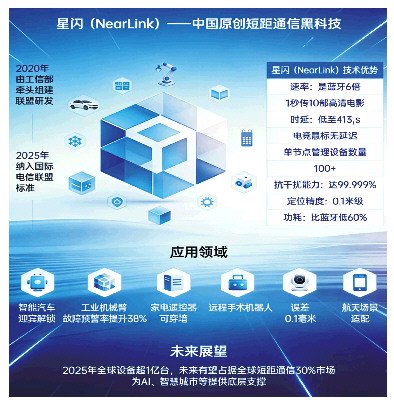
Core Viewpoint - The article highlights the emergence of "NearLink," a Chinese-developed short-range wireless communication technology that significantly enhances connectivity and performance for smart devices, addressing the limitations of existing technologies like Bluetooth and Wi-Fi [2][3]. Group 1: Technology Development - NearLink was initiated in 2020 by the Ministry of Industry and Information Technology, gathering over 400 organizations, including Huawei and China Mobile, to develop a faster, more responsive, energy-efficient, and stable short-range communication technology [2]. - The first technical standard for NearLink was published in 2022, and in 2023, Huawei launched the first terminal product supporting NearLink, enabling high-quality lossless audio transmission [3]. Group 2: Performance Metrics - NearLink operates in two modes: one for low-power scenarios with transmission speeds six times faster than traditional Bluetooth, and another for high-speed needs capable of transmitting 8K ultra-high-definition video [4]. - The latency of NearLink can reach as low as 20 microseconds, making it 1500 times faster than traditional Bluetooth and 500 times faster than Wi-Fi, surpassing human neural response speed [4]. Group 3: Application Scenarios - NearLink can connect up to 4096 devices simultaneously, significantly outperforming traditional Wi-Fi routers, which can only handle 32 devices [6]. - In smart home applications, devices using NearLink can operate seamlessly without interference, even in environments with many connected devices [6]. Group 4: Energy Efficiency - NearLink is designed to be energy-efficient, consuming 60% less power than traditional Bluetooth and 80% less than Wi-Fi, leading to extended battery life for devices [8]. - For instance, smartwatches equipped with NearLink can have their battery life extended by 30%, and industrial sensors can see battery life increase from three months to eight months [8]. Group 5: Industry Impact - In the automotive sector, NearLink enhances vehicle key functionalities, improving accuracy and responsiveness for features like automatic unlocking and guest welcome [10]. - In industrial applications, NearLink facilitates real-time data transmission, significantly reducing operational delays and improving efficiency in manufacturing and healthcare settings [11]. Group 6: Future Prospects - To achieve widespread adoption comparable to Bluetooth and Wi-Fi, NearLink needs to expand its ecosystem and reduce costs, as the current chip price is approximately 15 yuan, nearly double that of traditional Bluetooth chips [12]. - The anticipated reduction in chip costs by 30% by 2026 is expected to make NearLink more accessible to consumers and encourage broader adoption across various device categories [12].
京东:已为15万全职骑手缴纳五险一金,平台别一味规避劳动关系;小米卢伟冰:2027年进军欧洲汽车市场;字节跳动否认将推出手机产品
雷峰网· 2025-08-20 00:45
Group 1 - Li Xiang expressed deep gratitude to Wang Xing from Meituan, calling him the biggest benefactor in his entrepreneurial journey, especially during a critical financing period in 2019 when Meituan invested $300 million in Li Auto [4][5] - Meituan's stock price was struggling at the time of investment, but the decision to invest was pivotal for Li Auto's success [4][5] Group 2 - Meitu's revenue for the first half of 2025 reached 1.8 billion yuan, a year-on-year increase of 12.3%, with net profit rising 30.8% to nearly 400 million yuan, driven by AI-powered subscription services [8] - The company's stock price has surged nearly fivefold over the past year, indicating a strong recovery and market interest [8] Group 3 - JD.com has provided social insurance for over 150,000 full-time delivery riders since March 1, 2023, with an average monthly contribution of about 2,000 yuan per rider [9][10] - The company emphasizes the importance of formal labor contracts and benefits for riders, urging the industry to follow suit [9][10] Group 4 - ByteDance denied rumors of launching its own smartphone, focusing instead on providing AI capabilities to various hardware manufacturers [10][11] - The company previously acquired some patents from Smartisan Technology but has shifted its focus to educational hardware [11][12] Group 5 - Xiaomi reported a total revenue of 116 billion yuan for Q2 2025, a 30.5% year-on-year increase, with net profit rising 134.2% to 11.9 billion yuan [13] - The company plans to enter the European electric vehicle market by 2027, while also committing to not engage in price wars in its home appliance sector [13] Group 6 - Huawei's new Pura 80 series will feature a "Star Flash" car key function, enhancing vehicle access and security [16] - The technology aims to improve user experience by allowing smartphones to unlock vehicles with greater precision and speed [16] Group 7 - Anker Innovations is considering an IPO in Hong Kong, aiming to raise approximately $500 million, with plans already in motion [19][20] - The company's stock has risen over 50% this year, reflecting strong market performance [19][20] Group 8 - The mobile smart terminal ecosystem alliance, including OPPO, vivo, Xiaomi, Honor, and Lenovo, launched a privacy permission system to enhance data protection and user experience [21] - This initiative marks a significant step towards standardized privacy protection in the Android ecosystem [21] Group 9 - New Oriental Education's CEO was rumored to be under investigation, causing a significant drop in stock prices, which was later denied by the company [22] - The stock had previously reached a two-year high before the rumors surfaced, highlighting the volatility in the education sector [22] Group 10 - Apple’s official account on Xiaohongshu gained 170,000 followers within 24 hours of its launch, indicating strong engagement with the platform [24][25] - The penetration rate of iOS devices among Xiaohongshu users is nearly 50%, showcasing the platform's significance in the digital ecosystem [24][25]



华为手机、手表等新品集体发布,均将标配星闪车钥匙
Xuan Gu Bao· 2025-06-11 14:58
Group 1 - Huawei officially launched the Pura 80 series smartphones on June 11, which are the first smartphones in the industry to support the Star Flash car key feature [1] - The Star Flash car key technology is expected to enter a "commercial explosion period," with over 50 million smartphones projected to gain this capability through OTA upgrades by 2025 [1] - The Star Flash technology offers higher positioning accuracy, longer connection distances, and better security, with features such as automatic unlocking when within 3 meters of the vehicle [1] Group 2 - Digital Video Technology has joined the Star Flash Alliance led by Huawei, becoming a supporting unit for the smart automotive industry promotion group and security group [2] - Huayang Group's wholly-owned subsidiary, Huayang Multimedia, is a member of the Star Flash Alliance and is actively promoting the application of Star Flash technology, having provided digital key NFC module products for Seres [2] Group 3 - The global market size for Star Flash technology is predicted to exceed $6 billion by 2025, with a compound annual growth rate of 117.2%, and is expected to expand to $15.1 billion by 2030 [1]