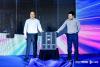
智者一号

Search documents
港深合作研发“纳米仿天然骨材料” 机器人“灵巧手”在香港孵化深圳量产
Nan Fang Du Shi Bao· 2025-10-28 23:06
Core Insights - The Greater Bay Area (GBA) is experiencing a surge in technological innovation and collaboration, particularly in robotics, brain-like intelligence, and medical materials, reflecting the region's commitment to building an open and integrated innovation ecosystem during the 14th Five-Year Plan period [3][4][10]. Group 1: Robotics and Innovation - Shenzhen-based company has developed a multi-modal tactile perception robot called "Dexterous Hand," which is now in mass production, showcasing the region's advancements in robotics [3]. - The company, Dai Meng (Shenzhen) Robotics Technology Co., focuses on high-resolution multi-modal tactile perception and dexterous manipulation, enabling robots to perform complex tasks [11]. - The GBA's supportive environment for innovation provides entrepreneurs with a sense of security, facilitating the growth of startups like Dai Meng [3][12]. Group 2: Medical Materials Development - A research team from the Li Ka Shing Faculty of Medicine at the University of Hong Kong has developed a new elastic calcium phosphate "nano-bone material" that accelerates bone healing, marking a significant advancement in orthopedic surgery [4][5]. - The research has received mainland patents and is in the early stages of clinical translation, indicating a strong potential for practical application [5]. - The collaboration between Hong Kong and Shenzhen leverages Hong Kong's research strengths and Shenzhen's industrial capabilities, enhancing the translation of research into clinical practice [5][6]. Group 3: Brain-like Intelligence and Collaborative Ecosystem - The Guangdong Provincial Institute of Intelligent Science and Technology has launched the world's first brain-like computing platform, "Wisdom One," highlighting the region's focus on brain-like intelligence innovation [6][7]. - The institute aims to build a collaborative innovation ecosystem by integrating resources from Macau and the GBA, fostering technology transfer and talent development [8][9]. - The establishment of the Macau University-Guangdong Provincial Institute Joint Laboratory signifies a commitment to nurturing talent and enhancing research collaboration between the two regions [9]. Group 4: Overall Innovation Landscape - The GBA is positioning itself as a global technology innovation center, with a focus on creating a synergistic environment for research, development, and commercialization of cutting-edge technologies [7][10]. - The upcoming 15th National Games will showcase various innovative technologies from the GBA, including AI tour guides and smart robots, further emphasizing the region's technological prowess [12].



5G通信ETF(515050)、创业板人工智能ETF华夏(159381)盘中双双创下价格新高!科技成长受益于产业周期和政策周期共振
Mei Ri Jing Ji Xin Wen· 2025-10-27 07:34
Group 1 - The A-share market continues its upward momentum, with major indices opening higher and the technology sector showing strong rebounds, particularly with companies like Jingwang Electronics hitting the daily limit [1] - The global launch of the first brain-like computing system "Zhizhe No. 1" in the Hengqin Guangdong-Macao Deep Cooperation Zone is expected to significantly enhance computing power through intuitive neural network algorithms, impacting sectors like healthcare and industry [1] - Google is set to provide up to 1 million dedicated AI chips to Anthropic, a competitor of OpenAI, in a deal worth several billion dollars, indicating a deepening partnership in the rapidly growing AI sector [1] Group 2 - The technology growth sector continues to lead the market, with indices like the ChiNext Index and the STAR 50 significantly outperforming the broader market, particularly in the communications and electronics sectors [2] - The 5G Communication ETF (515050) tracks the CSI 5G Communication Theme Index, with a current scale exceeding 8 billion yuan, focusing on companies in the Nvidia, Apple, and Huawei supply chains [2] - The index has a high purity of "hard technology," with communications and electronics sectors accounting for nearly 80% of its weight, emphasizing the importance of network infrastructure and terminal support [2] Group 3 - The ChiNext Artificial Intelligence ETF (159381) tracks the ChiNext Artificial Intelligence Index, focusing on companies in the AI sector, with a significant weight in optical modules and coverage of domestic software and AI application firms [3] - The top three weighted stocks in this ETF are Zhongji Xuchuang (20.95%), Xinyi Sheng (20.42%), and Tianfu Communication (5.39%) [3] - The ETF has a low comprehensive fee rate of only 0.20%, making it competitive within its category [3]

全球首款类脑智算体“智者一号”发布
Ke Ji Ri Bao· 2025-10-26 23:38
Core Insights - The "Wisdom One" is the world's first brain-like computing device, integrating supercomputing capabilities into a mini-fridge-sized unit, providing a new path for energy efficiency in traditional supercomputing centers and intelligent computing clusters [1][2] - Developed by two incubated companies under the Guangdong Provincial Institute of Intelligent Science and Technology, "Wisdom One" features 1152 CPU cores, 4.8TB of memory, and 204TB of storage, with noise levels below 45 decibels and power consumption only one-tenth of traditional supercomputing devices [1] - The device's unique intuitive neural network algorithm simulates human brain operations, enabling it to efficiently run various model training and inference tasks, including large models [1][2] Technical Features - "Wisdom One" integrates advanced computing technology in a compact form, achieving high performance with low power consumption and noise [1] - The device maintains a stable temperature below 70 degrees Celsius even under maximum load, showcasing its efficient thermal management [1] - The algorithm allows AI to possess reasoning capabilities, enabling it to learn from minimal data while retaining old skills and processing multiple types of information simultaneously [2] Industry Impact - The launch of "Wisdom One" expands the deployment forms and applicable boundaries of supercomputing, providing critical technological support for a greener, more flexible, and user-friendly future computing system [2]
松延动力人形机器人3小时卖掉200台;iPhone Air正式开售后遇冷
Mei Ri Jing Ji Xin Wen· 2025-10-26 23:28
Group 1 - The core point of the article is the rapid sales success of the humanoid robot "Xiao Bumi" by Songyan Power, which sold over 200 units within three hours of its launch, indicating a significant market interest in affordable humanoid robots [1] - The pricing of "Xiao Bumi" at 9998 yuan positions it as the first high-performance humanoid robot under 10,000 yuan, potentially expanding consumer access and usage [1] - The launch aims to bring emotional value to consumers before humanoid robots become commonplace in households, suggesting a strategic focus on consumer experience [1] Group 2 - The iPhone Air experienced a strong initial demand with a record-breaking sales figure of over 100 million yuan in just one second during pre-orders, but faced a cooling market upon official release, leading to excess inventory [2] - The rapid market changes highlight the necessity for companies to possess keen market awareness and flexible strategies to adapt to consumer feedback and evolving market conditions [2] - The second-hand market for iPhone Air saw prices drop to levels close to or below the official retail price, indicating a shift in consumer perception and demand dynamics [2] Group 3 - The launch of the world's first brain-like computing system, "Zhizhe No. 1," represents a significant advancement in smart computing, condensing supercomputing capabilities into a compact device [3] - This innovation is expected to enhance energy efficiency in traditional supercomputing centers and smart computing clusters, marking a new era in intelligent computing [3] - The release of "Zhizhe No. 1" is likely to stimulate innovation and competition within the industry, encouraging increased R&D investment and exploration of new AI applications and business models [3]
松延动力人形机器人3小时卖掉200台;iPhone Air正式开售后遇冷|数智早参
Mei Ri Jing Ji Xin Wen· 2025-10-26 23:20
Group 1 - The humanoid robot "Xiao Bumi" by Songyan Power sold over 200 units within 3 hours of its launch, priced at 9998 yuan, marking it as the world's first high-performance humanoid robot under 10,000 yuan [1] - The price reduction of humanoid robots is expected to increase consumer accessibility and usage, leading to the exploration of more application scenarios and a broader market scale [1] - The expansion of the market is anticipated to lower upstream supply chain costs, resulting in a beneficial effect across the entire industry [1] Group 2 - The iPhone Air experienced a strong initial demand, selling out in 5 minutes during pre-orders and achieving over 100 million yuan in sales within 1 second on JD.com [2] - However, after its official release, the iPhone Air faced a cooling market, with excess inventory available in physical stores and second-hand markets, where prices were comparable to or lower than the official retail price [2] - The rapid market changes highlight the necessity for participants to possess keen market awareness and flexible strategy adjustment mechanisms to respond to evolving market conditions [2] Group 3 - The launch of the "Zhi Zhe No. 1," the world's first brain-like computing system, represents a significant advancement in intelligent computing, condensing supercomputing capabilities into a mini-fridge-sized device [3] - This innovation provides a new pathway for enhancing energy efficiency in traditional supercomputing centers and intelligent computing clusters, marking a new era in smart computing [3] - The release of "Zhi Zhe No. 1" is expected to stimulate innovation and competition within the industry, encouraging companies and research institutions to increase R&D investments and explore new AI application scenarios and business models [3]

实现算力指数级提升,全球首款类脑智算体发布
Xuan Gu Bao· 2025-10-26 15:15
Core Insights - The world's first brain-like intelligent computing system, "Zhizhe No. 1," has been launched in the Hengqin Guangdong-Macao Deep Cooperation Zone, showcasing a miniaturized supercomputing capability condensed into a device the size of a mini fridge [1] - Brain-like intelligent computing (brain-like intelligent computing) simulates the neural network structure and information processing mechanisms of the human brain, achieving efficient, low-consumption, and interpretable intelligent processing through hardware and algorithmic innovation [1] - The brain-like chip and integrated storage-computing architecture are expected to break through the traditional von Neumann bottleneck, leading to exponential improvements in computing density and energy efficiency [1] - The advantages of miniaturization, algorithm interpretability, and low energy consumption in brain-like intelligent computing are reshaping the underlying logic of intelligent computing, transitioning applications from a "one-size-fits-all" approach to a "tailored" service model across sectors like healthcare, education, and industry [1] Related Companies - A-share related concept stocks include Zhejiang University NetNew and Hengwei Technology [2]
晚报 | 10月27日主题前瞻
Xuan Gu Bao· 2025-10-26 14:49
Group 1: Brain-like Computing - The world's first brain-like computing device, "Zhi Zhe No. 1," has been launched, integrating supercomputing capabilities into a mini-fridge-sized device, providing a new path for energy efficiency in traditional supercomputing centers and intelligent computing clusters [1] - Brain-like computing simulates the structure and information processing mechanisms of the human brain, achieving efficient, low-energy, and interpretable intelligent processing through hardware and algorithmic innovation [1] - The development of brain-like chips and storage-computing integrated architecture is expected to break the traditional von Neumann bottleneck, significantly enhancing computing density and energy efficiency [1] Group 2: Warehousing and Logistics - The China Federation of Logistics and Purchasing has initiated a proposal to oppose "involution-style" competition in the warehousing industry, emphasizing the need for fair pricing based on production costs and market demand [2] - Warehousing operators are encouraged to focus on digital transformation through technology upgrades and process optimization to enhance operational efficiency and core competitiveness [2][3] - The warehousing and logistics industry is undergoing profound changes driven by e-commerce growth, manufacturing upgrades, and global supply chain restructuring, with a projected market size of 3.5 trillion yuan by 2030 [3] Group 3: Air Battery - The Ministry of Industry and Information Technology has highlighted the importance of technological innovation in the development of new battery materials, including all-solid-state batteries and metal-air batteries, to accelerate their industrialization [3] - Metal-air batteries, utilizing common metals like zinc and magnesium, offer advantages in energy density, charging time, range, environmental impact, and safety compared to lithium-ion batteries, indicating a broad application prospect [4] Group 4: Photoresist - A research team from Peking University has successfully analyzed the micro-3D structure and entanglement behavior of photoresist molecules in liquid environments, leading to a solution that significantly reduces photoresist defects in advanced chip manufacturing [4] - This breakthrough not only addresses long-standing issues in chip yield but also provides a powerful tool for in-situ research of chemical reactions at the atomic/molecular scale, promoting defect control and yield improvement in semiconductor manufacturing [4] Group 5: Large Aircraft - Brunei has approved its national airline to operate Chinese-made passenger aircraft, marking a significant legal foundation for the entry of Chinese jets into the Brunei market and reflecting recognition of China's aviation design capabilities [5] - China Commercial Aircraft Corporation predicts that by 2042, the global fleet of passenger aircraft will reach 48,455, with Chinese aircraft accounting for 9,969 units (21% of the total), indicating a potential shift in market dynamics [5] Group 6: Autonomous Driving - NVIDIA has announced a collaboration with Uber to develop autonomous driving technology, leveraging Uber's extensive real-world driving data to train NVIDIA's models [6] - This partnership aims to maintain leadership in the autonomous driving sector, with NVIDIA's infrastructure expected to accelerate development processes [6] Group 7: Multi-modal Applications - Ant Group is set to launch a new AGI multi-modal application called "Lingguang," featuring an "AGI camera" function that can recognize and understand the world [7] - The launch of "Lingguang" signifies Ant Group's entry into the AGI multi-modal space, with potential revenue projections of over 10 billion yuan within three years [7] Group 8: Macro and Industry News - China and the U.S. held trade discussions in Kuala Lumpur, reaching preliminary consensus on several important economic and trade issues [8] - As of September 30, China's total installed power generation capacity reached 3.72 billion kilowatts, a year-on-year increase of 17.5% [8] - The People's Bank of China will conduct a 900 billion yuan MLF operation to maintain liquidity in the banking system [8] - The stock private equity position index has risen to 79.68%, the highest this year, indicating increased market confidence [8]


豆包联动七家国家一级博物馆,打造AI看展新体验;OpenAI正研发用于音乐创作的AI丨AIGC日报
创业邦· 2025-10-26 01:08
Group 1 - Grok has launched a new AI companion named Mika, adding to its existing lineup of five AI companions [2] - OpenAI is developing an AI for music creation, collaborating with students from Juilliard School for score annotation [2] - Doubao, a subsidiary of ByteDance, has partnered with seven national first-class museums in China to create a digital exhibition experience [2] - The world's first brain-like computing system, "Zhizhe No. 1," has been unveiled, featuring 1152 CPU cores, 4.8TB DDR5 memory, and 204TB storage, with noise levels controlled below 45 decibels and power consumption at one-tenth of traditional supercomputers [2]

全球首款类脑智算体“智者一号”亮相
Ke Ji Ri Bao· 2025-10-25 10:01
Core Viewpoint - The launch of the world's first brain-like computing system, "Zhi Zhe Yi Hao," marks a significant advancement in computing technology, showcasing compact size and high performance with low power consumption [1] Group 1: Product Specifications - "Zhi Zhe Yi Hao" is the size of a mini refrigerator, integrating 1152 CPU cores, 4.8T DDR5 memory, and 204T storage space [1] - The system operates at a noise level of below 45 decibels, making it suitable for various environments [1] - Its power consumption is only one-tenth that of traditional supercomputing devices, highlighting its efficiency [1]
小型化“个人超算”来了!全球首款类脑智算体在横琴发布
Nan Fang Du Shi Bao· 2025-10-24 16:16
Core Viewpoint - The launch of the "Zhizhe No. 1," a compact supercomputer equipped with original brain-like algorithms, marks a significant milestone in making supercomputing accessible to individuals and small enterprises [1][6]. Group 1: Product Features - "Zhizhe No. 1" is designed to be slightly larger than a mini refrigerator, promoting a new era of small-scale, green, personalized, and accessible computing [3]. - The supercomputer integrates 1,152 CPU cores, 4.8TB of DDR5 memory, 204TB of storage, and a 40G high-speed network interface, making it suitable for local data training for medium to large enterprises [8]. - The core technology of "Zhizhe No. 1" is the Intuitive Neural Network (INN), which allows for efficient training and inference of various models, including large models [10]. Group 2: Technological Advancements - The INN algorithm enables the AI to provide reasoning alongside its conclusions, enhancing its interpretability compared to traditional AI systems [10]. - "Zhizhe No. 1" can complete training on 10 billion tokens in just 30 hours, achieving training and inference speeds of 100,000 tokens per second and 500,000 tokens per second, respectively [10]. - The platform reduces hardware costs by approximately 50% and energy consumption by nearly 90%, while maintaining a noise level comparable to a typical office environment [10]. Group 3: Market Implications - The introduction of "Zhizhe No. 1" is expected to empower various sectors, including finance, healthcare, and manufacturing, by making supercomputing capabilities widely available [10].