
智能仓储机器人

Search documents
向着团圆,出发
Xin Lang Cai Jing· 2026-02-15 17:59
Core Viewpoint - The article highlights the significance of the Spring Festival travel rush in China, emphasizing the emotional journey of family reunions and the various transportation methods utilized by travelers to return home for the holiday [2][9]. Transportation Trends - The Spring Festival travel peak sees a massive influx of travelers across various transportation modes, with railways, highways, and air travel experiencing significant passenger volumes [2][4]. - On February 15, Guangzhou South Station is expected to handle approximately 649,000 passengers, with trains departing almost every minute during peak times [2]. - The Ministry of Transport reports that from February 2 to February 14, the total inter-regional movement of people reached about 3 billion [7]. Innovations in Travel Services - New service initiatives, such as "love mother and baby rooms" and warm music in train stations, have been introduced to enhance the travel experience for families [11][12]. - Technological advancements, including the use of intelligent robots for logistics and drone surveillance for road conditions, are being implemented to improve efficiency and safety during the travel period [13][14]. Changing Travel Patterns - A notable trend this year is "reverse travel," where many parents travel to cities where their children work, reflecting a shift in traditional family reunion practices [15][19]. - The travel market is seeing a significant increase in demand for family-oriented travel packages, with a notable rise in multi-generational trips during the Spring Festival [20]. Emotional Aspects of Travel - The anticipation of family reunions is a central theme, with travelers expressing deep emotional connections to their families and the significance of shared experiences during the holiday [21].


A股发展能力百强榜出炉,谁是未来的增长引擎?|上市公司观察
Sou Hu Cai Jing· 2026-01-26 12:44
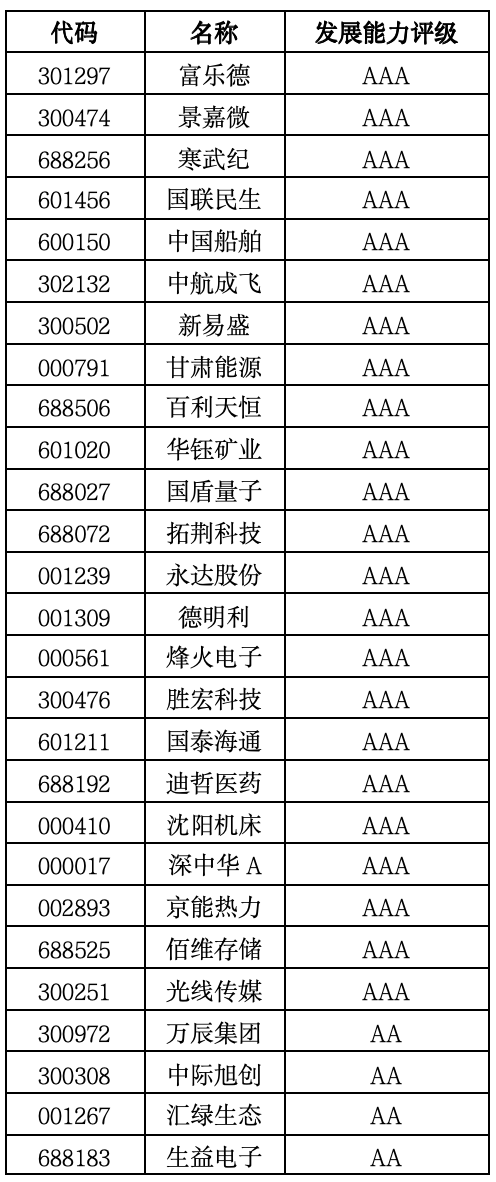
Core Insights - The article emphasizes that a company's growth capability, determined by its foresight, adaptability to technological changes, market expansion execution, and competitive landscape shaping, is crucial for future success [1][2] - The latest competitiveness rating data from JIAN Jin Xin highlights the top 100 companies in the A-share market based on their development capabilities, showcasing their strong potential in R&D investment, market expansion, and strategic foresight [1][2] Group 1: Development Capability Assessment - The assessment of "development capability" focuses on several key factors: R&D investment ratio, contribution from new products/markets, patent quantity and quality, strategic foresight, and growth stability [2] - Higher scores indicate stronger growth momentum and greater long-term value potential within their respective sectors [3] Group 2: Key Sectors and Companies - The list is heavily concentrated in sectors such as technology, high-end manufacturing, pharmaceuticals, new energy, and military industry, which are seen as "hardcore growth tracks" [3] - Notable companies in the semiconductor and AI chip sector include Cambricon, Jingjia Micro, and others, which are pivotal for domestic substitution and China's technological self-reliance [3][4] - In the biopharmaceutical sector, companies like Baillie Tenheng and Dize Pharmaceutical have made significant breakthroughs in cancer treatment [4] - The military and aerospace sectors are represented by companies like AVIC Chengfei and China Shipbuilding, which are crucial for national strategic security [4] Group 3: Emerging Technologies and Innovations - New energy and new materials companies are at the forefront of the energy revolution, with firms like Fulede and Gansu Energy rapidly rising due to technological upgrades and innovative models [5] - Emerging tech companies such as Fulede and Cambricon have quickly become market stars due to their disruptive technologies and clear strategic paths [5] Group 4: Development Capability Ratings - A detailed list of companies with their development capability ratings includes top-rated firms like Fulede, Jingjia Micro, and Cambricon, all rated AAA [6][7] - The ratings serve as a roadmap for assessing a company's growth potential and strategic vision [9]


京东押注、顺丰菜鸟抖音入局,快递成AI机器人“黄金试验场”?
Xin Lang Cai Jing· 2026-01-14 05:40
Core Insights - The logistics and express delivery industry is increasingly focusing on automation and AI robotics, with major players like SF Express and JD Logistics leading the charge in technological transformation [1][3][12] Group 1: Industry Trends - The logistics industry is recognized as a "golden testing ground" for AI robotics due to its physical and standardized nature, allowing for clear execution interfaces and evaluation standards [9][10] - The global AI logistics robot market is projected to grow significantly, with the market size expected to reach 118.3 billion yuan in 2024 and 344.1 billion yuan by 2030, reflecting a compound annual growth rate of 19.5% [12] - The Chinese market is anticipated to perform even better, with a projected size of 44 billion yuan in 2024 and 133.9 billion yuan by 2030, at a growth rate of 20.4% [12] Group 2: Company Strategies - JD Logistics is leading with an aggressive strategy of "full-chain self-research + ecological investment," planning to purchase 3 million robots over the next five years to enhance its supply chain [4][5] - SF Express is focusing on "AI large models + green intelligence," establishing a dedicated technology company for AI and robotics [4][5] - Alibaba's Cainiao is leveraging "cloud computing + AI" to enhance its robotic ecosystem and international expansion, with plans to release new logistics technologies by 2025 [6][7] Group 3: Competitive Landscape - Major players like ByteDance are entering the logistics space, developing their own logistics robots and investing in core components to strengthen their market position [7] - Other companies such as ZTO, YTO, and Yunda are taking on the role of "application followers," focusing on practical implementations rather than upstream investments [7] Group 4: Economic Considerations - The logistics industry faces rising labor costs, making cost reduction through technology upgrades a critical need, where even a 0.1 yuan decrease in cost per package can lead to significant profit margins [10][11] - AI robots have already demonstrated their value in reducing labor needs and increasing efficiency, with JD's robots reportedly reducing workforce requirements by 58% and improving picking efficiency by 270% [11] Group 5: Future Developments - The industry is exploring new business models such as "Robots as a Service" (RaaS) to alleviate long-term investment pressures and adapt to fluctuating demand [17] - Future trends indicate a shift from "replacing human labor" to "human-robot collaboration," and from being a "cost center" to a "value center" that leverages data for supply chain optimization [17]



广州发布60个“AI+”应用场景 覆盖制造交通等多个领域
Guang Zhou Ri Bao· 2025-08-07 08:28
Core Viewpoint - The event held in Guangzhou marks a significant step in integrating artificial intelligence (AI) with the real economy, showcasing 60 AI application scenarios from state-owned enterprises across various sectors such as manufacturing, transportation, and urban governance [1][2]. Group 1: AI Application Scenarios - The first batch of AI application scenarios was derived from the operational needs of 15 state-owned enterprises, providing practical and representative use cases for AI technology implementation [2]. - Key sectors for AI applications include manufacturing, transportation, urban governance, energy and environmental protection, and tourism, with specific examples such as GAC Group's focus on intelligent cockpit and driving, and Guangzhou Bus Group's needs for intelligent warehousing robots [2][3]. - Some scenarios highlight industry-leading initiatives, such as Lingnan Group's "Easy Travel AI Tourism Intelligent Platform" and Guangzhou Water Investment Group's smart drainage and water supply management systems [2]. Group 2: AI Industry Ecosystem - Guangzhou's AI industry ecosystem is expanding, with a total of 33 registered large models, 19 of which were added this year, covering key areas like smart cities and intelligent manufacturing [4]. - The city has established over 30 AI professional parks and has a fund scale exceeding 70 billion, attracting over 30 strategic scientists and training approximately 12,000 AI-related talents annually [4]. - The Panyu Algorithm Competition has drawn participation from over 40 countries, fostering the growth of more than 60 enterprises and establishing a benchmark for talent and industry integration [4]. Group 3: Infrastructure and Project Development - State-owned enterprises in Guangzhou are actively enhancing AI infrastructure, with Guangzhou Data Science Group leading the construction of a public computing power center that manages over 11,000 P of computing resources [6]. - Notable projects include GAC Group's upcoming L3 autonomous driving vehicle and the launch of the first vertical smart trading model by the Trading Group, which streamlines the entire bidding process [7]. - The construction of the China AI (Guangzhou) Industrial Park, with an investment of 8 billion, aims to create a comprehensive AI hub for research, transformation, and office space [7]. Group 4: Future Plans - Guangzhou plans to release 100 key AI application scenarios within the year, covering critical industries such as manufacturing, healthcare, transportation, finance, and education [8]. - The city aims to create a one-stop platform for AI technology, facilitating the transition from laboratory innovations to practical industry applications [8]. - Future initiatives will focus on identifying and promoting more replicable and scalable AI application scenarios, positioning Guangzhou as a leading hub for AI innovation and application [8].