智谱模型

Search documents
张钹、杨强与唐杰、杨植麟、林俊旸、姚顺雨(最新3万字发言实录)
Xin Lang Cai Jing· 2026-01-12 04:37
Core Insights - The AGI-Next conference highlighted the current challenges and future opportunities in AI development, particularly focusing on the capabilities and limitations of large models [3][4][5]. Group 1: Key Discussions on AGI and AI Development - Zhang Bo emphasized five fundamental deficiencies in current large models, advocating for a definition of AGI that includes executable and verifiable capabilities [3]. - Yang Qiang discussed the differentiation of agents based on their ability to autonomously set and plan goals, rather than relying on human-defined parameters [3]. - Tang Jie noted that while scaling remains a valid approach, the true exploration should focus on enabling models to possess autonomous scaling capabilities [4]. Group 2: Scaling and Model Capabilities - Yang Zhilin explained that the essence of Scaling Law is to convert energy into intelligence, emphasizing the importance of efficient approaches to reach the limits of intelligence [4]. - Lin Junyang expressed optimism about the potential for Chinese teams to achieve global leadership in AI within the next 3-5 years, estimating a 20% probability of success [4]. - Yao Shunyu highlighted the differentiation between vertical integration and layered model applications, suggesting that model companies may not necessarily excel in application development [4]. Group 3: Future Directions and Challenges - The discussion pointed out that the path from scaling to genuine generalization capabilities remains a core challenge for AI models [12][14]. - The need for models to develop memory and continuous learning structures akin to human cognition was identified as a critical area for future research [35][36]. - The exploration of self-reflection and self-awareness capabilities in AI models was deemed a significant yet controversial topic within the academic community [36][47]. Group 4: Technical Innovations and Model Architecture - The introduction of new optimization techniques, such as the Muon optimizer, was highlighted as a means to enhance token efficiency and overall model performance [55][58]. - The development of the Kimi Linear architecture aims to improve linear attention mechanisms, making them more effective for long-context tasks [64]. - The integration of diverse data sources and the enhancement of model architectures are seen as essential for achieving better agent capabilities in AI [67].



姚顺雨对着唐杰杨植麟林俊旸贴大脸开讲!基模四杰中关村论英雄
Xin Lang Cai Jing· 2026-01-10 14:39
Core Insights - The AGI-Next summit organized by Tsinghua University gathered key figures in the AI industry, showcasing high-density technical discussions and insights into the future of AI development [1][3]. Group 1: AI Development Trends - The evolution of large models has transitioned from simple tasks to complex reasoning and real-world applications, with expectations for significant advancements by 2025 [8][10]. - The current trajectory of AI models reflects a growth pattern similar to human cognitive development, moving from basic tasks to more sophisticated reasoning and real-world problem-solving [9][12]. - The introduction of Reinforcement Learning with Verified Rewards (RLVR) aims to enhance model capabilities by allowing autonomous exploration and feedback acquisition [15][16]. Group 2: Challenges and Opportunities - The challenge of generalization remains a core issue, with models needing to improve their ability to apply learned knowledge to new, unseen problems [11][13]. - The integration of coding and reasoning capabilities into AI models represents a significant shift from conversational AI to task-oriented AI, marking a pivotal change in the industry [19][20]. - The need for a hybrid approach combining API and GUI interactions is emphasized to enhance AI's operational capabilities in real-world environments [25][26]. Group 3: Future Directions - The focus on multi-modal capabilities, memory structures, and self-reflective abilities in AI models is seen as essential for achieving higher levels of intelligence and functionality [31][34][36]. - The exploration of new paradigms for scaling AI capabilities beyond traditional methods is crucial for future advancements in the field [49][50]. - The development of models that can autonomously define their learning tasks and reward functions is highlighted as a potential breakthrough in AI research [49][50]. Group 4: Competitive Landscape - Chinese open-source models are gaining significant traction and influence in the global AI landscape, with expectations for continued growth and leadership in the field [28][73]. - The advancements in AI capabilities, particularly in coding and reasoning, position Chinese models competitively against leading international counterparts [72][73].

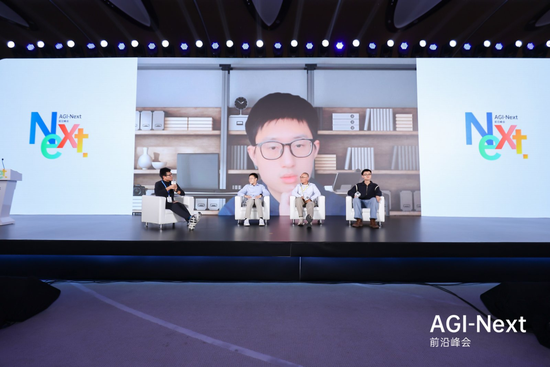
唐杰、杨植麟、林俊旸、姚顺雨罕见同台,「基模四杰」开聊中国AGI
36氪· 2026-01-10 14:14
Core Insights - The article discusses the emergence of AI and its impact on various industries, highlighting the importance of foundational models in determining competitive advantages in the AI landscape [5][6][7]. Group 1: Key Players and Developments - The AGI-Next summit featured key figures from major Chinese AI companies, including Zhiyuan, Tencent, and Alibaba, emphasizing their roles in advancing foundational models [5]. - The discussion revealed a consensus that the capabilities of foundational models will dictate future competition, with a focus on becoming the next major entry point in the AI market [5][6]. Group 2: Paradigm Shifts in AI - The article notes a shift in AI exploration paradigms, with a focus on new metrics for measuring model intelligence, such as Token Efficiency and Intelligence Efficiency [7][8]. - The participants agreed that the next phase of AI development will prioritize autonomous learning, which is seen as a critical direction for future advancements [6][7]. Group 3: Market Segmentation - There is a clear distinction between ToC (consumer) and ToB (business) applications, with the former requiring tightly integrated models and products, while the latter focuses on enhancing productivity through strong models [8][10]. - The article highlights that in the ToB market, companies are willing to pay a premium for superior models, indicating a growing divide between strong and weak models [10][11]. Group 4: Future Trends and Challenges - The discussion points to the need for a new standard in measuring model intelligence as the AI landscape evolves, with a focus on balancing model capabilities and practical applications [7][8]. - The article emphasizes the importance of context and environment in improving AI interactions, suggesting that better contextual inputs can significantly enhance model performance [15][16]. Group 5: Cultural and Structural Factors - The article discusses the differences in research culture between China and the U.S., noting that Chinese researchers tend to favor safer, more established projects over innovative explorations [71][72]. - It also highlights the need for a more adventurous spirit in the Chinese AI landscape to foster innovation and breakthrough developments [70][78].

智谱香港IPO拟发行逾3700万股 发行价116.2港元
Sou Hu Cai Jing· 2025-12-31 02:54
Group 1 - The company, Zhihui Huazhang Technology Co., Ltd., plans to issue 37,419,500 H-shares at a price of HKD 116.2 per share, with trading expected to start on January 8 of the following year [1] - The China Securities Regulatory Commission has approved the listing of up to 43,032,400 overseas ordinary shares on the Hong Kong Stock Exchange, while also promoting the "full circulation" of unlisted domestic shares [1] - Zhihui disclosed its prospectus on December 19, aiming to become the "first global large model stock" [3] Group 2 - The company's revenue projections for 2022, 2023, and 2024 are RMB 57.4 million, RMB 124.5 million, and RMB 312.4 million, respectively, indicating a compound annual growth rate of approximately 130% [3] - In the first half of 2025, the company expects to generate revenue of RMB 190 million, achieving double growth for three consecutive years [3] - As of September 30, the company has empowered 12,000 enterprise clients, over 80 million terminal user devices, and more than 45 million developers, making it the largest independent general large model vendor in China [3] - Founded in 2019, the company originated from Tsinghua University's technology transfer and is recognized as a pioneer in large model research and a leader in domestic large model technology [3]

智谱IPO获备案,冲刺“全球大模型第一股”
Sou Hu Cai Jing· 2025-12-24 03:12
Core Viewpoint - The China Securities Regulatory Commission has issued a notice regarding Beijing Zhiyu Huazhang Technology Co., Ltd.'s overseas issuance and domestic unlisted shares "full circulation" filing, with plans to issue up to 43,032,400 shares for listing on the Hong Kong Stock Exchange, aiming to become the "first global large model stock" [1][3] Financial Performance - Zhiyu's projected revenues for 2022, 2023, and 2024 are 57.4 million, 124.5 million, and 312.4 million yuan respectively, indicating a compound annual growth rate of 130% over three years; revenue for the first half of 2025 is expected to reach 190 million yuan, marking three consecutive years of doubling growth [1] - The company's revenue primarily comes from large model-related businesses, establishing it as one of the largest independent large model vendors in China [1] Business Scale - As of September 30, 2025, Zhiyu's models have empowered 12,000 global enterprise clients and over 80 million terminal devices, covering more than 45 million developers, making it the independent general large model vendor with the most terminal devices enabled in China [3] - Founded in 2019 and originating from Tsinghua University's research achievements, Zhiyu is one of the earliest companies to focus on large model research and development in China [3] Competitive Landscape - Zhiyu has completed six rounds of financing in its six years of operation, with five rounds occurring this year, leading to a current valuation of approximately 40 billion yuan [3] - The company is in competition with AI model startup MiniMax (Xiyu Technology) to become the first publicly listed AI model developer in China [3] - The co-founder and CEO of Zhiyu, Zhang Peng, expressed confidence in the company's position, stating that the title of "China's first AI stock" should naturally belong to them, emphasizing the need for a final push in their efforts [3]

AI开源社区来了国家队!华为百度第一时间加入
量子位· 2025-05-09 02:04
Core Viewpoint - The establishment of the Modelers Community, led by China Telecom's Tianyi Cloud, aims to create an open platform for AI developers, providing resources such as models, data, and tools, while fostering collaboration across the entire AI industry chain [2][6][46] Group 1: Community Structure and Governance - The Modelers Community has officially formed a council responsible for managing and developing the community [3][6] - The council consists of representatives from various sectors of the AI industry, including chip companies, model and data enterprises, research institutions, and ecological organizations, totaling 14 members [7][9] - The governance structure includes committees focused on governance, construction, and operations, along with a secretariat for coordination [11][16] Group 2: Resources and Offerings - The community provides a wide range of resources, including various AI models, datasets, and tools optimized for different computing facilities [18][21] - Notable open-source models such as DeepSeek and Qwen have been included, with adaptations for domestic hardware [19][21] - The community also offers free domestic computing resources in collaboration with industry members [21] Group 3: Collaboration and Impact - The Modelers Community aims to bridge the gap between academia and industry, facilitating the practical application of academic research through demos and collaborative projects [24][28] - Small and medium enterprises benefit from the community by accessing open-source models that enhance their product offerings [26][28] - Future plans include partnerships with universities for joint talent development, expanding the community's reach [29] Group 4: Need for the Community - The Modelers Community addresses gaps in existing open-source platforms, particularly in the AI domain, by promoting collaboration and resource sharing among developers [30][42] - It aims to resolve issues related to data ownership and the challenges of integrating various AI tools and models [40][44] - The community's neutral and public-oriented approach distinguishes it from other platforms, making it a vital organizer for the AI industry [43][45]