曦云C600通用GPU

Search documents
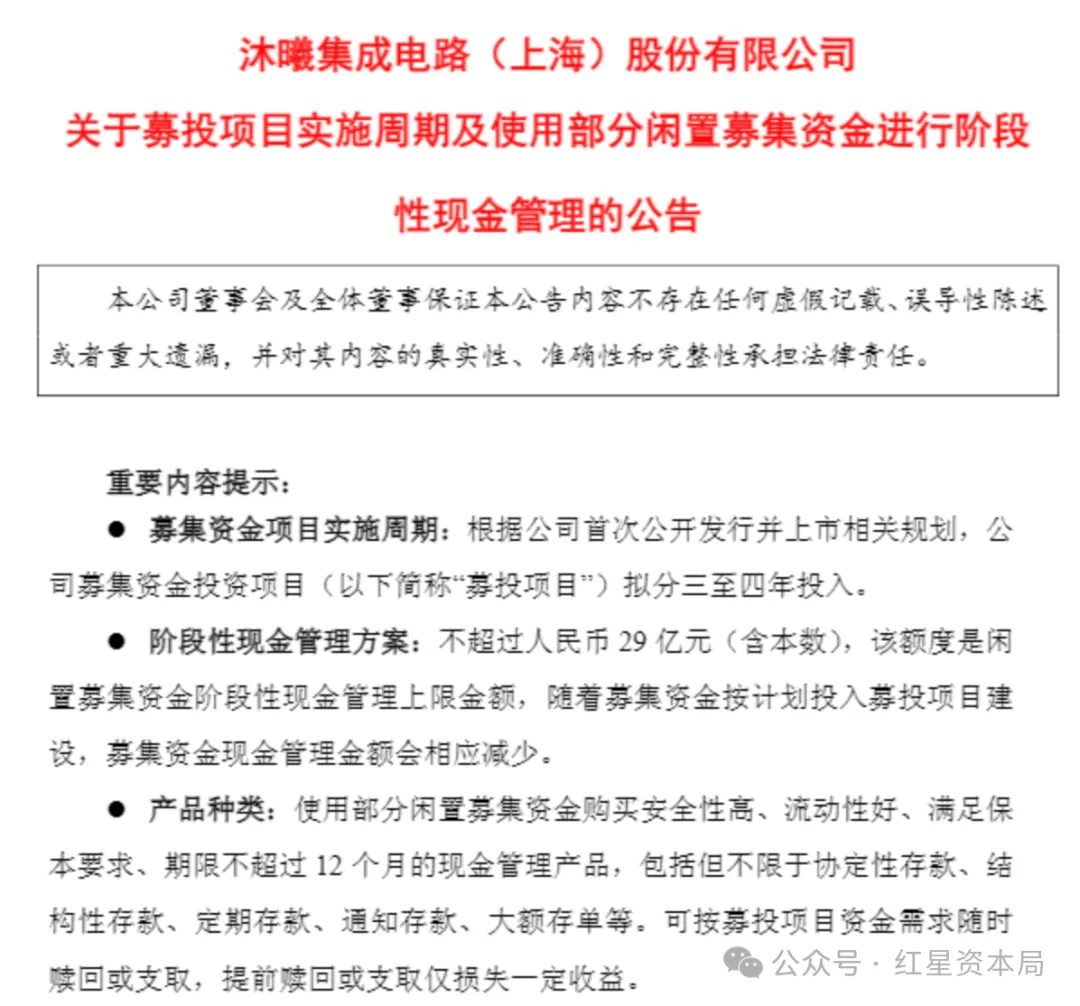
沐曦股份募资39亿“研发芯片”,上市两个月后要拿29亿“做理财”,称部分资金在投入项目前将有闲置;公司股价较高点已跌超40%
Sou Hu Cai Jing· 2026-02-06 14:47
Core Viewpoint - Muxi Co., Ltd. announced a plan for the phased investment of raised funds over three to four years, optimizing cash management for idle funds not exceeding RMB 2.9 billion to enhance financial returns without affecting project progress [1][5]. Group 1: Fund Management and Investment Plans - The company will manage idle raised funds by investing in high-security, liquid cash management products with a maturity of no more than 12 months, ensuring funds can be redeemed as needed for project requirements [4]. - The total net amount raised during the IPO was RMB 3.899 billion, with projects including the development and industrialization of new high-performance general-purpose GPUs and AI inference GPUs [4][5]. - The cash management amount will decrease as funds are allocated to the investment projects, aligning with the planned investment schedule [5]. Group 2: Industry Context and Performance - The integrated circuit industry is characterized by high investment and long R&D cycles, necessitating phased expenditures for equipment procurement and validation [4]. - Muxi Co., Ltd. is a leading enterprise in high-performance general-purpose GPUs, focusing on core technology breakthroughs and creating a competitive product system for various applications [7]. - The company expects a revenue of RMB 1.6 billion to 1.7 billion for 2025, representing a year-on-year growth of 115.32% to 128.78%, while projecting a net loss narrowing to RMB 650 million to 798 million [6][7]. Group 3: Market Performance - On February 4, Muxi Co., Ltd. shares rose by 0.17% to RMB 505 per share, reflecting a 382.5% increase from the IPO price of RMB 104.66, but a 43.5% decline from the highest price of RMB 895 on the first trading day [8].

沐曦股份中签率出炉!继摩尔线程后又一国产GPU股将登陆,发行价104.66元/股,市值419亿元,最早2026年达盈亏平衡
Xin Lang Cai Jing· 2025-12-07 15:04
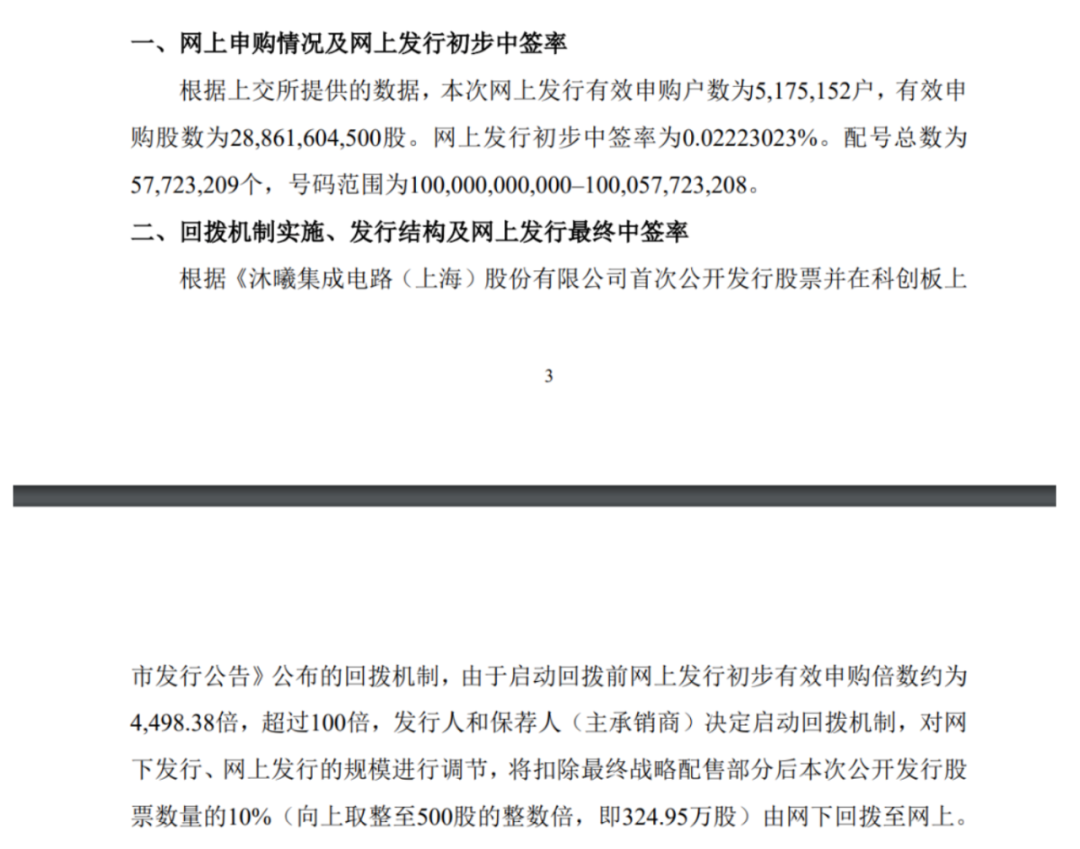
Core Viewpoint - Muxi Co., Ltd. has successfully launched its IPO, becoming the second domestic GPU company to list on the A-share market after Moore Threads, with a final issuance price of 104.66 yuan per share, leading to a market valuation of approximately 41.87 billion yuan [1][3][9]. Group 1: IPO Details - The final issuance quantity after the call-back mechanism is 40.1 million shares, accounting for 10.02% of the total share capital post-issuance [4][13]. - The offline final issuance quantity is 22.83 million shares, representing 70.26% of the total issuance after deducting the strategic placement, while the online final issuance quantity is 9.67 million shares, accounting for 29.74% [1][10]. - The final online winning rate is 0.03348913% [1]. Group 2: Financial Metrics - The issuance price of 104.66 yuan per share corresponds to a 2024 diluted static price-to-sales ratio of 56.35 times, which is lower than the average level of comparable companies in the industry [3][12]. - The expected total fundraising amount is 4.197 billion yuan, which will be used for various GPU research and development projects [4][13]. Group 3: Company Performance and Market Position - Muxi Co., Ltd. is a leading enterprise in the domestic high-performance general-purpose GPU market, focusing on the independent development of high-performance GPU chips and computing platforms [6][15]. - The flagship product, the Xiyun C series GPU chip, has achieved domestic leadership in various performance metrics, with an estimated market share of about 1% in China's AI chip market for 2024 [7][16]. - The company has shown significant revenue growth, with a compound annual growth rate of 4074.52% from 2022 to 2024, and a revenue of 1.236 billion yuan for the first nine months of 2025, reflecting a year-on-year growth of 453.52% [9][18].
超节点火爆 国产AI算力跑出追赶新路线
Zhong Guo Jing Ying Bao· 2025-08-04 07:26
Core Insights - The 2025 World Artificial Intelligence Conference (WAIC) highlighted the significance of "super nodes" in AI computing infrastructure, with Huawei showcasing its Ascend 384 super node, which boasts a computing power of 300 PFLOPs, nearly double that of NVIDIA's GB200 NVL72 system [1][3] - Domestic AI chip manufacturers are increasingly embracing the super node trend, moving beyond mere parameter comparisons to collaborative efforts, as seen in a rare joint appearance of executives from four domestic AI chip companies [2][11] - The demand for AI computing power is rapidly increasing, leading to the emergence of the "super node" concept as a recognized solution to meet the needs of large-scale AI models [3][4] Super Node Development - The super node concept, proposed by NVIDIA, involves connecting multiple high-performance AI servers to form a larger, more powerful computing node, specifically designed for complex AI model calculations [3][4] - Current super node implementations are characterized by high-performance GPUs interconnected within a single node, with a focus on maintaining consistent bandwidth and latency [4][5] - The future of domestic super node solutions will involve maximizing computing power within individual cabinets and connecting multiple cabinets through optical interconnects [6] Industry Collaboration and Innovation - The WAIC showcased various super node products from multiple vendors, including high-density liquid cooling systems and innovative interconnect technologies, indicating a competitive landscape among domestic manufacturers [7][8] - The emergence of the "AI factory" concept by domestic GPU manufacturers aims to address the efficiency bottlenecks in training large models, emphasizing the need for a comprehensive AI training infrastructure [9][10] - The establishment of the "Model-Chip Ecological Innovation Alliance" signifies a deeper integration between domestic AI models and chips, promoting collaboration among various stakeholders in the industry [11][12]
【WAIC2025】 AI算力创新竞速,国产化实践走出超节点等新路
Jing Ji Guan Cha Bao· 2025-07-28 12:39
Core Insights - The 2025 World Artificial Intelligence Conference (WAIC 2025) was held in Shanghai, showcasing innovations in AI chips, servers, and intelligent computing centers, emphasizing domestic R&D and solutions for various application scenarios [1][2]. AI Chip Innovations - Companies like Muxi and Houmo Intelligent presented their self-developed AI chips, with Muxi showcasing the Xiyun C600 general-purpose GPU, designed for cloud AI training and inference [3][4]. - Houmo Intelligent introduced the M50 chip, claiming a 5-10 times efficiency improvement over traditional architectures, with a processing power of 160 TOPS at only 10W, supporting large models locally [5]. Market Trends - The demand for computing power is growing exponentially alongside model iterations, with a shift towards edge AI chips as models migrate from cloud to edge applications [3][5][6]. - The industry is witnessing a trend towards high-efficiency inference becoming mainstream, with inference computing power expected to be 100 to 1000 times that of training power [6]. Supernode Developments - Major Chinese companies like Huawei and Xinhua San showcased their supernode solutions, with Huawei's Ascend 384 supernode being the largest in the industry, achieving 300 PFLOPs of computing power [7][8]. - The LightSphere X supernode, developed by a consortium including Shanghai Yidian and ZTE, utilizes innovative optical interconnect technology for high bandwidth and low latency [9][10]. Industry Collaboration - The development of supernodes requires cross-industry collaboration, as no single chip company can achieve the necessary technological advancements alone [8][10]. - The industry is encouraged to adopt open-source development to accelerate product development and market entry, with a focus on collaborative efforts in computing infrastructure and services [10][12].