
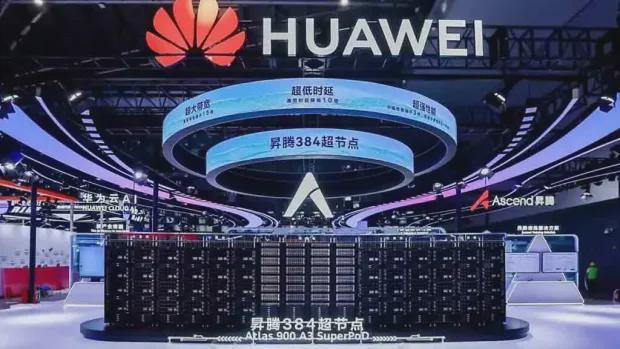
昇腾384超节点

Search documents
政府工作报告提芯片自研新突破
第一财经· 2026-03-05 09:47
Core Viewpoint - The article highlights significant advancements in China's semiconductor industry, particularly in AI chips, storage chips, and semiconductor equipment, as emphasized in the government work report during the National People's Congress session [3][4][6]. Group 1: Government Initiatives and Industry Growth - The government work report indicates a 10.9% increase in integrated circuit production over the past year, showcasing the industry's robust growth [3]. - The total R&D investment in society is projected to exceed 3.92 trillion yuan by 2025, with a research intensity of 2.8%, and basic research funding reaching nearly 280 billion yuan, marking a historic high of 7.08% [3]. Group 2: AI Chip Developments - Several AI chip companies have made notable progress, with Moore Threads launching a new chip architecture that improves computing density by 50% compared to the previous generation [4]. - Huawei introduced the largest AI supernode in the industry, connecting 384 Ascend AI chips to provide up to 300 PFLOPs of dense BF16 computing power [4]. - Domestic AI chip manufacturers like Cambricon have seen revenue growth exceeding four times year-on-year, marking their first profitable year post-IPO [5]. Group 3: Storage Chip Advancements - In the context of storage shortages and price increases, domestic manufacturers are seizing market opportunities, with Changxin Technology becoming the fourth largest DRAM manufacturer globally [5]. - Changxin Technology launched DDR5 and LPDDR5X mobile memory series, claiming top-tier performance in speed and capacity [5]. - Yangtze Memory Technologies is expanding production, with plans for its third phase in Wuhan to be completed this year, potentially benefiting around 200 upstream and downstream companies [5]. Group 4: Semiconductor Equipment Innovations - New Kai Lai showcased 31 types of semiconductor process and testing equipment at the Shanghai Semiconductor Equipment Exhibition, including various advanced deposition and measurement products [6]. - The company also released two domestic electronic engineering EDA design software and a new high-speed real-time oscilloscope with a bandwidth exceeding 90 GHz, significantly enhancing domestic measurement instrument capabilities [6]. - The advancements in the semiconductor equipment sector reflect a strong momentum in China's chip industry across multiple dimensions [6].

华为超节点赶超英伟达:驾驭“光”很关键
Guan Cha Zhe Wang· 2026-02-10 03:20
Core Insights - The emergence of SuperPods as a new AI computing infrastructure has become a focal point in the industry since 2025, with Huawei's Ascend 384 SuperPod leading the way in performance metrics compared to foreign competitors [1][3] - The demand for computing power is far from being met, with token consumption expected to exceed trillions daily in China, highlighting the inadequacy of simply stacking servers to address the computing gap [3][4] Group 1: SuperPod Characteristics - SuperPods are not merely about stacking chips; they represent a fundamental restructuring of traditional computing architectures, enabling equal interconnectivity among CPUs, NPUs, and memory units [4][6] - Key features of a true SuperPod include high bandwidth to eliminate communication delays, low latency, and the ability to form a logically unified system through unified memory addressing [6][7] Group 2: Efficiency and Performance - SuperPods can significantly enhance computing efficiency, with potential model utilization rates increasing from 30% to 45%, effectively a 50% improvement, which can help mitigate the limitations of chip manufacturing processes [7][8] - The architecture of SuperPods differs from traditional systems, as Huawei employs optical communication technology, allowing for greater scalability and interconnectivity compared to NVIDIA's copper-based systems [8][9] Group 3: Innovation and Ecosystem - Huawei's systematic innovation in chip design, optical components, and foundational protocols has positioned it uniquely in the market, leveraging over 20 years of experience in optical technology [9][12] - The company is also developing general computing SuperPods, with the TaiShan 950 SuperPod set to launch in Q1 2026, aimed at replacing various server applications [11][12] Group 4: Software and Community Engagement - The success of SuperPods relies not only on hardware but also on a robust software ecosystem, including open-source initiatives like CANN and openEuler, which are crucial for fostering industry collaboration [14] - Huawei has engaged a large developer community, with 3.8 million registered developers for Kunpeng and nearly 4 million for Ascend, emphasizing the importance of open-source collaboration in the AI era [14]

华为打造“最强超节点”,这项全球领先技术很关键
Guan Cha Zhe Wang· 2026-02-10 03:10
Core Viewpoint - The emergence of SuperPod as a new AI computing infrastructure has become a focal point in the industry since 2025, with Huawei's Ascend 384 SuperPod leading the way in performance metrics compared to foreign competitors [1][3]. Group 1: SuperPod Concept and Advantages - SuperPod is not merely about stacking chips; it represents a fundamental restructuring of traditional computing architecture, enhancing communication efficiency among CPU, NPU, and memory units [4][6]. - The key advantages of SuperPod over traditional clusters include significantly improved computational efficiency, with potential model computing utilization rates increasing from 30% to 45%, equating to a 50% performance boost [7][8]. Group 2: Technical Challenges and Innovations - Building a true SuperPod is complex; Huawei's Ascend 384 SuperPod consists of 12 computing cabinets and 4 bus cabinets, while NVIDIA's NVL72 system is confined to a single cabinet due to architectural differences [8]. - Huawei employs optical communication technology for interconnection, allowing for greater scalability beyond single cabinet limitations, while traditional systems face constraints with electrical signal transmission [8][9]. Group 3: Systematic Innovation and Ecosystem Development - Huawei's systematic innovation includes proprietary chip development, optical device capabilities, and foundational protocols, enabling the creation of SuperPods that leverage full optical interconnectivity [9][12]. - The company is also developing general computing SuperPods, such as the TaiShan 950, which aims to replace various server applications by 2026 [9][11]. - A robust software ecosystem, including open-source initiatives like CANN and openEuler, is essential for the operation of SuperPods, with a focus on collaborative development within the industry [14].

我国在西藏下的一盘大棋
虎嗅APP· 2026-01-17 03:06
Economic Growth and Investment - Tibet's economic growth rate reached 7.2% year-on-year in the first half of 2025, ranking first in the country, continuing a trend since 2023 [2] - Fixed asset investment in Tibet grew by 24.8% year-on-year in the first half of 2025, 19.6% in 2024, and 35.1% in 2023, indicating strong investment-driven growth [2] Infrastructure Development - Major infrastructure projects such as the Sichuan-Tibet Railway, Yarlung Tsangpo River downstream hydropower project, and New Tibet Railway have drawn significant attention to Tibet [2] - These projects are expected to create nearly one million jobs, significantly increasing local income and stimulating various sectors [8] Economic Structure - Tibet exhibits a "non-typical dual economic structure," where traditional industries coexist with modern industries built through external aid, leading to a weak connection between agriculture and industrial development [3][4] - The industrial sector in Tibet has historically been underdeveloped, with industrial added value lower than that of the construction sector, indicating a reliance on construction for economic growth [6][7] Strategic Importance - Tibet's strategic position has gained importance as China shifts focus to developing the Chengdu-Chongqing economic circle, making Tibet a key area for national development [2][8] - The region's potential for clean energy, particularly hydropower, positions it as a crucial player in China's future energy landscape, with a significant portion of its hydropower resources yet to be developed [11][12] Future Prospects - The "East Data West Computing" strategy emphasizes the need for large-scale data centers in western regions, with Tibet being central to providing clean and stable electricity for digital economy support [12] - The development of hydropower resources in Tibet could transform it into a regional energy hub, reducing dependence on traditional energy sources and enhancing its geopolitical significance [17]

AI领航,万象新生:2025中国十大科技进展革新发展纪元
Mei Ri Jing Ji Xin Wen· 2026-01-13 07:29
Group 1: AI Infrastructure Investment - Alibaba plans to invest over 380 billion yuan in cloud and AI hardware infrastructure over the next three years, exceeding the total investment of the past decade [14] - The "Qianwen" project, a personal AI assistant developed by Alibaba, aims to compete directly with ChatGPT, marking a significant move in the AI application landscape [14] Group 2: AI Intelligent Agents - Monica launched the world's first general-purpose AI agent, Manus, which can autonomously understand, plan, and execute complex tasks, outperforming OpenAI's models in benchmark tests [15] - The release of Manus signifies a shift from "dialogue interaction" to "human-machine collaboration" in AI technology [15] Group 3: Controlled Nuclear Fusion - China's "China Circulation No. 3" achieved significant breakthroughs in controlled nuclear fusion, reaching temperatures exceeding 100 million degrees, marking a step towards practical applications [16] - The advancements in fusion technology are expected to provide a clean and abundant energy source for the future [16] Group 4: Humanoid Robotics - The first-ever half marathon featuring humanoid robots took place in Beijing, showcasing a "human-machine co-running" model [17] - The event highlights the growing capabilities and integration of humanoid robots in competitive environments [17] Group 5: Supernodes and Computing Power - Huawei showcased the Ascend 384 supernode, which significantly enhances computing power for AI applications, achieving a 15-fold improvement in bandwidth compared to traditional technologies [18] - This technology addresses the bottlenecks in traditional cluster interconnections, supporting high-end computing scenarios [18] Group 6: Neutrino Research - The Jiangmen Neutrino Experiment completed the infusion of 20,000 tons of liquid scintillator, becoming the first large-scale neutrino detection facility in operation [19] - This experiment aims to answer fundamental questions about the nature of matter and the universe [19] Group 7: Open Source Models - China's open-source model, M2, ranked among the top five globally, marking a significant achievement in the open-source AI landscape [20] - The model's low cost and high performance are expected to reshape the competitive dynamics in the AI field [20] Group 8: Commercialization of AI - 2025 is marked as the year of commercialization for large models and embodied intelligence, with several companies receiving significant orders [21][22] - The transition from AI infrastructure investment to practical applications is a key focus for the industry [26] Group 9: AI System-Level Entry - The launch of the Doubao mobile assistant by ByteDance sparked a competitive battle for AI system-level entry, highlighting the strategic importance of direct user engagement [23] - The assistant's features aim to bypass traditional app entry points, indicating a shift in user interaction with technology [23] Group 10: Commercial Spaceflight - The Zhuque-3 rocket successfully completed its mission, demonstrating advancements in reusable rocket technology [13][24] - This development is crucial for the future of commercial spaceflight and the potential for sustainable space exploration [24]


未来智造局 | 国产AI芯片加速追赶 为算力经济注入“中国芯”
Xin Hua Cai Jing· 2025-12-26 15:38
Core Insights - The domestic GPU industry is poised for historic development opportunities by 2025, driven by technological breakthroughs and a growing ecosystem, reflecting strong market recognition of domestic "hard technology" [1][2] - The rapid development of domestic GPUs not only supports cutting-edge industries like artificial intelligence but also enhances supply chain security, contributing to high-quality economic development [1] Industry Development - The demand for computing power has surged due to the global rise of AI models, with China accelerating the construction of robust computing infrastructure [2] - By 2025, major tech companies in China, including Alibaba, Tencent, and ByteDance, are expected to invest approximately 450 billion yuan in AI computing power, with 30% allocated for domestic chip validation and adaptation [2] - The domestic GPU industry is transitioning from technological exploration to commercialization and scaling, with leading companies innovating architectures and integrating ecosystems to catch up with international giants [2][3] Technological Innovations - Domestic GPU manufacturers are striving to capture market share through technological innovation and differentiation strategies, with some companies achieving significant breakthroughs [3] - The introduction of supernodes as core computing units in intelligent computing centers is a key focus, with Huawei showcasing its Ascend 384 supernode, achieving a total computing power of 300 PFLOPS, surpassing international competitors [3] Market Dynamics - The emergence of open-source domestic models like DeepSeek is driving explosive growth in AI applications, with future demand for inference computing power expected to be significantly higher than training power [4] - The domestic GPU sector faces challenges in general computing and high-performance scenarios due to technological gaps and ecological barriers, particularly in comparison to NVIDIA's established CUDA ecosystem [5] Ecosystem Development - To address ecological shortcomings, domestic companies are exploring paths such as chiplet technology, collaboration with model manufacturers, and enhancing software ecosystems [5][6] - Strategic collaborations among companies like Wallen Technology, Jiyue Star, and Shanghai Yidian Smart Computing aim to create a comprehensive ecosystem for domestic chips, models, and computing power [6] Capital Market Trends - The domestic GPU industry is experiencing a notable IPO boom, with significant fundraising activities, including the record-setting IPO of Moore Threads on the STAR Market [7][8] - The market's enthusiasm for domestic AI chip companies is fueled by high valuations of international competitors like NVIDIA and AMD, alongside the successful turnaround of companies like Cambricon [8] - Analysts highlight that the accelerated IPO processes reflect strong market recognition of the domestic GPU sector, with funds raised primarily aimed at R&D and ecosystem development [8]


计算筑基,华为以硬核技术与千行万业共同智创未来
Huan Qiu Wang Zi Xun· 2025-12-23 09:20
Core Insights - The article emphasizes the critical role of data, algorithms, and computing power as the three foundational pillars of artificial intelligence (AI) [1] - Huawei's report predicts that by 2035, the total computing power in society will increase by 100,000 times compared to 2025, indicating a historic transformation in computing infrastructure to meet the exponential demand from AI applications [1] - Huawei is actively promoting the innovation of computing infrastructure and the intelligent transformation of industries through its strategic initiatives and partnerships [1][2] Group 1: Computing Infrastructure Innovation - Huawei has introduced the industry's largest super node, the Ascend 384 super node, which can provide up to 300 PFLOPs of dense BF16 computing power, optimizing the requirements for model training and inference [3] - The company is also applying the super node concept to general computing with the TaiShan 950 super node, achieving a 2.9 times performance improvement without database modifications and enhancing memory utilization by 20% [3] - Huawei is committed to building a robust foundation for digital economic development by investing in key areas such as computing, storage, and connectivity [4] Group 2: AI Application and Industry Transformation - AI is rapidly reshaping various industries, and Huawei is implementing its "All Intelligence" strategy to integrate AI technology with the real economy [5] - The company has successfully applied AI in its own R&D, manufacturing, and supply chain processes, significantly enhancing productivity and operational efficiency [6] - In collaboration with local industries, Huawei is driving the intelligent transformation of key sectors such as government, healthcare, electricity, steel, transportation, and finance [6][7] Group 3: Collaborative Ecosystem Development - Huawei is establishing innovation centers in Hunan to support the development of a national-level advanced manufacturing industry cluster in computing [4][9] - The company has developed a replicable and scalable reference architecture for industry intelligence transformation, which includes intelligent perception, connectivity, foundational platforms, and AI models [8] - Huawei is collaborating with local universities and research institutions to foster a cooperative ecosystem that promotes technological innovation and application [9]
单套1.35亿元!华为独家中标中移动超节点采购
Guan Cha Zhe Wang· 2025-12-03 03:53
Core Viewpoint - China Mobile has awarded a procurement project for a super node testing device to Huawei, with a bid of 135 million yuan, indicating a significant investment in advanced computing infrastructure [1] Group 1: Huawei's Innovations - Huawei's "Scale-up super large-scale super node computing platform" was recognized as its top invention, showcasing a new architecture that allows for flexible resource allocation among AI processors [1] - The Ascend 384 super node features 384 Ascend NPUs and 192 Kunpeng CPUs, achieving a total computing power of 300 Pflops, which is 1.7 times that of NVIDIA's NVL72 [2] - The total network bandwidth of the Ascend 384 super node reaches 269 TB/s, surpassing NVIDIA's NVL72 by 107% [2] Group 2: Industry Trends - The demand for computing power in large models is rapidly increasing, while traditional computing architectures face challenges such as low resource utilization and frequent failures [4] - Super nodes are emerging as a new norm in AI infrastructure, with several domestic manufacturers exploring super node systems [4] - Inspiring innovations include the launch of the world's first single-cabinet 640-card super node by Sugon, which enhances computing density by 20 times compared to traditional solutions [4][5] Group 3: Future Developments - Huawei plans to launch the Atlas 950 super node in Q4 2026, featuring 8192 Ascend 950DT chips and achieving FP8 computing power of 8 EFLOPS [12] - The Atlas 950 super node is projected to be significantly more powerful than NVIDIA's upcoming NVL144, with a total computing power 6.7 times greater and memory capacity 15 times larger [14] - Future plans include the Atlas 950 SuperCluster, which will consist of 64 Atlas 950 super nodes, achieving a total FP8 computing power of 524 EFLOPS, surpassing the current largest cluster, xAI Colossus [14]

数智浪潮奔涌,广西如何踏浪弄潮?
Guang Xi Ri Bao· 2025-12-03 03:41
Core Insights - The 27th China International High-Tech Achievements Fair showcased over 5,000 innovative products and technologies from more than 5,000 companies and organizations worldwide, highlighting the rapid advancement of AI and digitalization [1] - The event emphasized the importance of domestic computing power development, with Huawei's Ascend 384 super node demonstrating a threefold performance increase in training mainstream large models compared to traditional clusters, significantly reducing training time by nearly 70% [1][2] - The integration of AI in various sectors, particularly in healthcare and daily life, is expanding, with practical applications such as intelligent robots for household chores and advanced medical AI systems gaining traction [2][3] Group 1: AI Technology and Applications - The Ascend 384 super node's breakthrough indicates a shift towards cost-effective and efficient computing power, aligning with Guangxi's strategy to become an AI cooperation hub with ASEAN [2] - The event featured practical AI applications, such as robots performing household tasks and advanced medical systems that enhance surgical efficiency by over ten times, attracting international interest for collaboration [2][3] - AI applications in healthcare, such as early prediction systems for high-risk conditions and drug toxicity prediction platforms, are particularly relevant for ASEAN countries with uneven medical resource distribution [3] Group 2: Business Models and Market Integration - The emergence of shared robots for rent at the fair reflects a growing trend towards making advanced technology accessible to small and medium enterprises, allowing them to benefit from automation without heavy capital investment [4][5] - The concept of "Guangxi integration" is highlighted as a means to connect various AI resources and technologies, facilitating a more efficient approach to meet diverse industry needs in ASEAN [5][6] - Companies are seeking to establish joint laboratories and training facilities in Guangxi to leverage local talent and resources, aiming to shorten delivery cycles and enhance product development [6][7] Group 3: Regional Collaboration and Development - ASEAN representatives expressed strong interest in the "North-South Research + Guangxi Integration + ASEAN Application" model, viewing it as a win-win strategy for aligning Chinese technology with regional needs [9][10] - Suggestions from ASEAN stakeholders include organizing events to promote technology and talent exchange, addressing the need for standardized guidelines and support for businesses entering the ASEAN market [10][11] - The demand for AI solutions in sectors like agriculture, healthcare, and manufacturing in ASEAN countries presents significant opportunities for Guangxi to facilitate cross-border collaboration and technology transfer [11][12]
【深圳特区报】为强国建设注入澎湃动能——从高交会看中国式现代化的创新注脚
Sou Hu Cai Jing· 2025-11-25 08:33
Group 1 - The 27th China International High-Tech Achievements Fair (CIHTAF) showcased over 5,000 cutting-edge achievements and facilitated more than 170 billion yuan in intended transactions and financing, attracting over 450,000 attendees [2][11] - CIHTAF serves as a significant platform for the transformation of high-tech achievements and reflects China's commitment to integrating into the global innovation network through openness and innovation-driven development [2][6] - The fair featured 22 specialized exhibition areas with over 5,000 renowned enterprises and international organizations, highlighting advancements in deep-sea energy development, nuclear power technology, and autonomous systems [4][5] Group 2 - The event marked a shift in China's information industry, showcasing advancements such as Huawei's Ascend 384 super node and non-invasive brain-machine interfaces, indicating a move towards self-reliance in core technologies [5][6] - CIHTAF has evolved significantly since its inception in 1999, expanding from 2 million square meters and 2,856 exhibitors to 400,000 square meters with over 90% of exhibits being high-tech products, including AI, robotics, and commercial aerospace [6][11] - The fair has facilitated 1,023 supply-demand matches and investment projects, with intended transaction and financing amounts exceeding 170 billion yuan, demonstrating its role in driving technological innovation and economic growth [11][12] Group 3 - CIHTAF has become a global innovation magnet, attracting over 120 countries and regions, and fostering international collaboration through specialized pavilions and procurement activities [7][9] - The event has seen participation from major international firms, indicating recognition of China's market potential and innovation environment, with companies like Remote and Hansa Flex seeking deeper cooperation [8][9] - The fair emphasizes the importance of integrating technology research, industry application, and market navigation, creating a comprehensive ecosystem for innovation [12][13]
