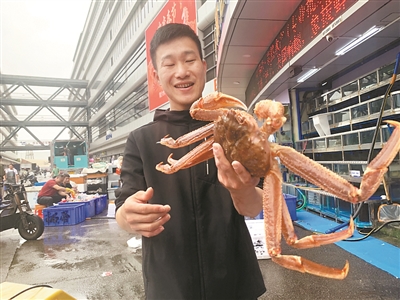
松叶蟹

Search documents
春节来新黄沙 叹“海鲜自由”
Guang Zhou Ri Bao· 2026-02-16 02:04
Core Insights - Huangsha Aquatic Center is experiencing a vibrant trading atmosphere during the Spring Festival, with daily transactions exceeding 600 tons and peak periods reaching 1,000 tons, ensuring ample supply for consumers [2][4] - The center features over 200 varieties of fresh seafood from more than 20 countries, with a notable 10% decrease in prices for mid-to-high-end seafood compared to the previous year, attributed to stable supply [1][4] Group 1: Market Operations - The Huangsha Aquatic Center has been operational 24/7 since its establishment in 1994, maintaining continuous service during the Spring Festival to meet consumer demand [2] - The market's management has implemented rigorous safety and quality controls to ensure that seafood reaches consumers in optimal condition [2][5] Group 2: Pricing and Supply - Mid-to-high-end seafood prices have decreased by approximately 10% year-on-year, with specific examples including松叶蟹 priced at 160 yuan per jin and 帝王蟹 at around 220 yuan per jin, with stable daily sales of 2,000 to 3,000 jin [4][5] - The best-selling seafood item is 石斑鱼, with daily sales reaching 6,000 to 7,000 jin, and prices for 珍珠斑 and 东星斑 have decreased by 10% and 30% respectively compared to last year [4] Group 3: Consumer Protection and Quality Assurance - The Huangsha Aquatic Center has established a professional inspection team to ensure fair trading practices, including comprehensive checks on electronic scales used by vendors [5] - A dedicated testing center conducts rigorous quality checks on seafood, providing a traceable "digital health record" for products, ensuring consumer safety [6]

4道海鲜2个椰子要1930元?三亚发布情况通报
第一财经· 2026-01-07 11:16
Core Viewpoint - The article discusses the issue of high seafood prices in Sanya, where a tourist reported being charged 1930 yuan for a meal, prompting an investigation by local authorities into potential price gouging in the seafood sector [3][9]. Group 1: Incident Overview - On January 7, 2026, Sanya's Market Supervision Administration announced an investigation into complaints about excessive pricing at seafood restaurants [3]. - A tourist reported being taken to a seafood restaurant by an unlicensed vehicle, where they were charged 1930 yuan for four seafood dishes and two coconuts [9]. - The prices for the seafood included 250 yuan per kilogram for large prawns, 1376 yuan for giant prawns, 158 yuan for bread snails, and 796 yuan for snow crabs [9]. Group 2: Regulatory Response - The Sanya authorities are actively working to maintain a fair tourism market and have urged consumers to report any similar incidents [5]. - Tourists are encouraged to keep evidence of any price gouging and to report it through the 12345 hotline or the Sanya Trustworthy Travel platform [5]. - The local enforcement agency is addressing complaints related to overcharging in the seafood consumption sector [9].

七百元的松叶蟹被换成六十多元的面包蟹
Xin Lang Cai Jing· 2025-12-28 19:26
Core Insights - The article highlights the increasing complaints from consumers regarding deceptive practices in group buying, where businesses change the promised products or services after purchase, leading to significant consumer dissatisfaction [1][2]. Group 1: Consumer Complaints - Consumers have reported various deceptive practices in group buying, including the replacement of high-value items with cheaper alternatives without prior notice [2]. - A significant number of complaints related to group buying have been recorded, exceeding 8,000 on a consumer complaint platform [1]. Group 2: Legal and Regulatory Issues - The article discusses the legal implications of businesses changing group buying terms, indicating that such actions may constitute a breach of contract under civil law and e-commerce regulations [2]. - Consumers are entitled to demand the original service promised or seek refunds and compensation if businesses fail to deliver as agreed [2]. Group 3: Misleading Pricing Practices - Instances of false pricing, where businesses advertise inflated original prices to create a false sense of discount, have been identified as a common issue in group buying [3]. - Consumers can claim triple the amount of the price difference as compensation for fraudulent pricing practices, with a minimum compensation amount set at 500 yuan [3]. Group 4: Recommendations for Improvement - Legal experts suggest that platforms should enhance their responsibilities by implementing strict monitoring of merchants and establishing a compensation system for consumers whose rights are violated [5]. - Businesses are encouraged to clearly communicate the terms and conditions of group buying offers to avoid misunderstandings and potential legal issues [5]. - Regulatory authorities are urged to strengthen oversight of the group buying market and impose stricter penalties for violations to protect consumer rights [5].
日料店不用日本水产、超市改国内平替 水产股上涨
Di Yi Cai Jing· 2025-11-19 23:31
Core Viewpoint - China has suspended the import of Japanese seafood due to Japan's failure to provide promised technical materials regarding product safety, which has led to a significant decline in Japanese seafood exports to China [1][3]. Group 1: Impact on Japanese Seafood Exports - Japan's agricultural and seafood exports are projected to decline for the first time in four years, with a year-on-year decrease of 1.8% in the first half of 2024, totaling 701.3 billion yen (approximately 70.13 billion yuan) [3]. - Exports to mainland China have plummeted by 43.8%, amounting to only 78.4 billion yen, with seafood exports experiencing a dramatic drop of 92.3%, reduced to just 3.5 billion yen [3]. Group 2: Domestic Market Response - Japanese seafood's market share in China is already low, and many restaurants have alternative sources for ingredients, indicating minimal impact on local dining establishments [3]. - Major retail chains have largely ceased importing Japanese seafood since the nuclear wastewater discharge incident, with a shift towards sourcing local seafood products instead [1][3]. Group 3: Market Reaction - Following the announcement of the import suspension, the seafood sector saw a collective surge, with several key stocks hitting the daily limit up, including Guolian Aquatic (300094.SZ) and others [3].



天价账单与象粪甜品:餐饮乱象拷问行业底线
3 6 Ke· 2025-08-18 04:03
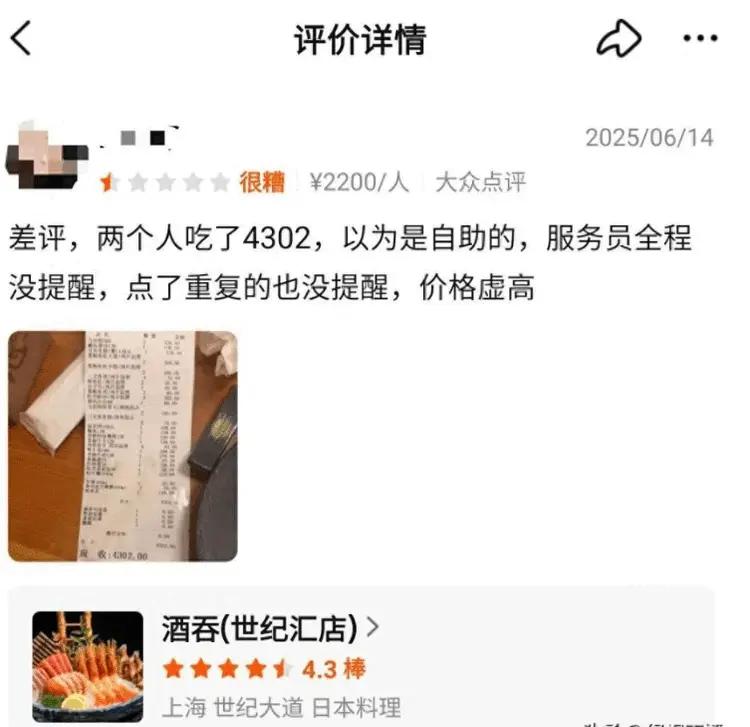
Core Insights - The restaurant industry in the Yangtze River Delta is facing a significant trust crisis, with a total of 315,000 complaints in the first half of 2025, of which 21.4% are related to pricing disputes and food safety complaints have increased by 17.3% year-on-year [1][3] - The national restaurant revenue growth rate has slowed to 4.3%, while consumer confidence has dropped to a five-year low, indicating a disconnect between pricing practices and consumer trust [1][3] Pricing Issues: Consumer Traps - High-end restaurants are exploiting information asymmetry, leading to consumer confusion and unexpected high bills, as seen in a case where a couple's meal cost 4,302 yuan instead of the expected 960 yuan [3][5] - Complaints about ambiguous pricing, such as "market price" and "additional charges," account for 85% of pricing-related disputes, highlighting a trend of misleading pricing practices [5][7] Food Safety and Innovation Concerns - The incident involving a dessert made from elephant dung reflects a troubling trend where restaurants prioritize sensationalism over food quality, risking violations of food safety laws [8][10] - The use of unconventional ingredients, such as insects, is being marketed as "creative cuisine," but this often violates food safety regulations, leading to a potential erosion of consumer trust [10][12] Industry Challenges: Regulatory and Self-Regulatory Failures - The restaurant industry is plagued by low entry barriers, slow regulatory responses, and inadequate standards, with 68% of disputes arising from a lack of preventive measures [12][13] - The existing food safety laws are ambiguous regarding "new ingredients," leading to inconsistent enforcement across regions, and platforms like Dazhong Dianping are failing to properly categorize restaurants, exacerbating consumer confusion [12][13] Solutions: Building a Transparent Consumption Ecosystem - To address these issues, the industry must implement a "three confirmations" system for consumers to verify pricing and meal types, which has shown to reduce disputes significantly [13][15] - Platforms should improve their algorithmic logic to prevent misleading classifications, and regulatory bodies need to increase penalties for pricing fraud and food safety violations [15][16]