标准普尔500指数基金

Search documents
This single mom saved $1 million in 15 years to retire at 49. How to use her strategies to catch up on retirement savings.
Yahoo Finance· 2026-01-31 20:20
Core Insights - The article discusses the challenges and strategies for late savers, particularly those starting to save for retirement later in life, emphasizing that it is possible to achieve financial independence with a focused plan and discipline [3][5][8]. Group 1: Personal Stories and Experiences - Jackie Cummings Koski, a single mother, began saving for retirement after her divorce in 2004 and retired in 2019 with a portfolio of approximately $1.2 million at age 49, despite a modest income that peaked at just over $100,000 [2]. - Cummings Koski's approach included saving 30% to 40% of her income and investing in an S&P 500 index fund, which significantly reduced her taxable income and allowed her to live comfortably on $40,000 to $45,000 annually [1][2]. Group 2: Financial Planning Insights - Financial experts suggest that late savers can still catch up by adopting a clear plan and maintaining discipline, despite the urgency due to a compressed timeline [3][8]. - A significant portion of Americans aged 55 to 64 lack adequate retirement savings, with only 77% having specific retirement accounts, and just half of those aged 60 and older feeling their savings are on track [4]. Group 3: Strategies for Late Savers - The article outlines a hypothetical plan for a 50-year-old starting with no assets and $50,000 in debt to accumulate $1 million by age 65, emphasizing the importance of acknowledging emotions and assessing financial situations [9][11]. - Key strategies include committing to a low-cost lifestyle, maximizing contributions to retirement accounts, and focusing on increasing income through job promotions and side hustles [15][24][25]. Group 4: Behavioral Changes and Mindset - Financial planners emphasize the need for late starters to shift from idealized retirement planning to realistic behavioral planning, which includes tracking expenses and income to reduce anxiety and optimize savings [12][27]. - Understanding personal definitions of retirement is crucial, as it influences savings strategies and expectations [28].
股神的84年智慧,浓缩至五点
财富FORTUNE· 2026-01-01 13:24
Core Viewpoint - The article reflects on Warren Buffett's investment philosophy and legacy, emphasizing the importance of his investment principles and the implications of his retirement for investors and the market [1][9][20]. Group 1: Buffett's Investment Principles - Principle One: Avoid blindly copying Buffett's stock-picking strategy; instead, invest 90% in S&P 500 index funds and 10% in short-term government bonds for stability [11][14]. - Principle Two: If choosing stocks independently, focus on a few high-quality companies rather than diversifying too much; Buffett's portfolio is heavily weighted in a few key stocks [15]. - Principle Three: Maintain a long-term perspective and be prepared to endure market fluctuations; successful investors often hold stocks through downturns [16]. Group 2: The Concept of "Economic Moat" - Principle Four: Invest in companies with a "moat," meaning they possess a sustainable competitive advantage that can withstand market changes [17]. - Principle Five: "Be fearful when others are greedy, and greedy when others are fearful," highlighting the need for courage in investment decisions during market volatility [18]. Group 3: Legacy and Future of Berkshire Hathaway - Buffett's retirement raises questions about the future of Berkshire Hathaway and whether the company's success can continue without his direct influence [20][21]. - The article suggests that Buffett's investment philosophy will remain relevant, but the challenge lies in whether successors can uphold these principles effectively [20].


“新兴市场教父”莫比乌斯:基金持有95%现金以应对关税风险
智通财经网· 2025-04-30 06:51
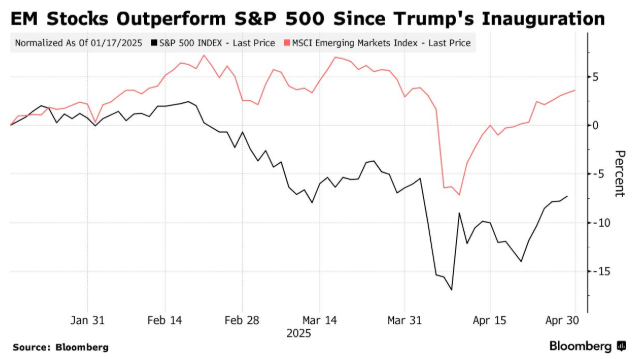
Group 1 - Mark Mobius holds 95% of his fund in cash, indicating a cautious approach due to trade uncertainties that may last up to six months [1] - Mobius believes that emerging markets like India will perform well once uncertainties stabilize, but he emphasizes the need to wait for clearer conditions [1] - A recent Bank of America survey shows that investor sentiment regarding the economic outlook is at its lowest in 30 years, reflecting increased risk due to tariff tensions [1] Group 2 - Mobius manages approximately $300 million in assets and expects India to benefit from the U.S. seeking to reshape global supply chains away from reliance on China [3] - He is optimistic about Indian stocks related to software and electronic hardware, while also holding a small amount of S&P 500 index funds to track the market [3] - Mobius anticipates that the S&P 500 index will recover by the end of the year as investor confidence in U.S. investments improves [3]