
氢能汽车

Search documents
【快讯】每日快讯(2026年3月24日)
乘联分会· 2026-03-24 08:42
Domestic News - Shenzhen is accelerating the commercialization of intelligent connected vehicles, with plans to establish a unified government supervision platform and explore pilot projects in various transportation scenarios [7] - The China Charging Alliance reported that from January to February 2026, the increase in charging infrastructure reached 918,000 units, a year-on-year increase of 44.8%, with public charging facilities decreasing by 53.8% and private charging facilities increasing by 110.4% [8] - XPeng Motors has established a Robotaxi division to oversee product definition, project integration, research, testing, and operations, with plans to launch passenger demonstration operations in the second half of 2026 [9] - Haima Automobile is working to further reduce the manufacturing and usage costs of hydrogen vehicles, having deployed 50 hydrogen vehicles in Hainan with a total mileage exceeding 2 million kilometers [10] - Li Auto has built over 4,000 supercharging stations and plans to launch its first automatic charging station in Q2 2026, marking the beginning of a "no-sense charging era" [12] - Dongfeng Fengxing showcased its new energy SUV FRIDAY and flagship MPV Xinghai V9 at the Bangkok International Motor Show, targeting local market needs [13] - Alibaba's Qianwen has launched a new ride-hailing feature that allows users to make personalized requests for vehicle selection [14] - Huawei's Qiankun intelligent driving solution has recorded over 50 million uses for its parking-to-parking feature [15] International News - In the U.S., electric vehicle-related search volume increased by approximately 20% following a rise in national average gasoline prices to $3.94 per gallon, the highest in nearly three years [16] - Elon Musk announced plans to build a chip manufacturing center in Austin, Texas, aimed at producing 2nm process chips for Tesla and SpaceX projects [17] - Toyota plans to invest $1 billion in its U.S. factories to enhance production capacity for electric and hybrid vehicles as part of a larger investment strategy [18] - Suzuki announced the full acquisition of solid-state battery company Kanadevia, which specializes in high-density, fast-charging batteries, highlighting Suzuki's strategy to enter the high-performance electric vehicle market [19] Commercial Vehicles - Geely Remote and Hong Kong Polytechnic University have deepened their collaboration in research and development, focusing on methanol-powered commercial vehicles and smart transportation [20] - Tesla's electric semi-truck, the Semi, has officially entered the stage of large-scale delivery, with plans to deliver between 5,000 to 15,000 units in 2026 [22] - BYD showcased its electric commercial vehicles at the Shenzhen International Commercial Vehicle Expo, highlighting its advancements in electric technology [23] - Yuchai's bus engines have been exported to Senegal, enhancing local public transportation efficiency [24]





氢价降至15元/公斤时,氢能车将比肩电动车
第一财经· 2026-03-17 01:21
Core Viewpoint - The cost of hydrogen refueling for hydrogen vehicles is expected to become comparable to the charging cost of electric vehicles in the coming years, driven by government initiatives to reduce hydrogen prices significantly by 2030 [3][4]. Group 1: Hydrogen Pricing and Market Dynamics - The Chinese government aims to reduce the average price of hydrogen for end-use to below 25 yuan per kilogram by 2030, with a target of 15 yuan per kilogram in certain regions [3][5]. - Currently, hydrogen prices for vehicles are above 35 yuan per kilogram, which limits the competitiveness of hydrogen vehicles compared to traditional fuel vehicles [4][6]. - Achieving the target price of 15 yuan per kilogram would allow hydrogen vehicles to compete directly with electric vehicles in terms of operational costs, enhancing market acceptance [4][5]. Group 2: Supply Chain and Production Challenges - The high hydrogen prices are primarily due to supply shortages, necessitating local governments to seek hydrogen resources actively [4][5]. - To address the supply issue, various regions are investing in clean energy hydrogen production, such as the 11.09 billion yuan green hydrogen project in Guangdong, which aims to produce 80,000 tons of green hydrogen annually [5][6]. - The hydrogen industry in China is expected to see significant growth, with a target of doubling the number of fuel cell vehicles to 100,000 by 2030 [5][6]. Group 3: Industry Development and Future Outlook - By the end of 2025, it is projected that China will have nearly 40,000 hydrogen fuel cell vehicles and 574 hydrogen refueling stations, leading the world in hydrogen infrastructure [6]. - The hydrogen industry is at a critical juncture, facing challenges such as limited application scenarios, high costs, and difficulties in storage and transportation, which require ongoing support from the government [6].
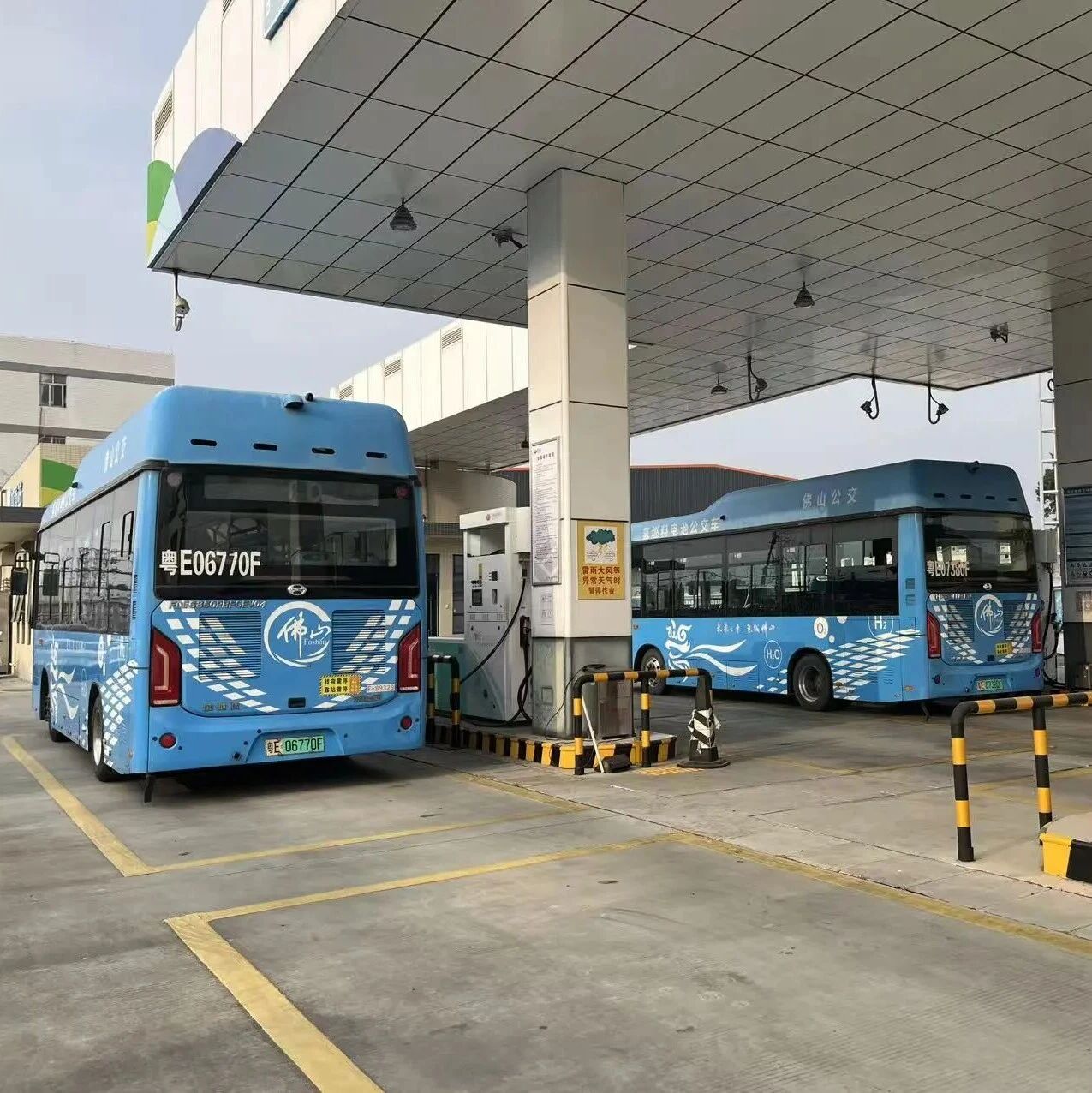
一边是加氢站“喊饿” 一边是氢能轿车“乏人问津”
Xin Lang Cai Jing· 2026-01-28 18:54
Core Insights - The hydrogen refueling stations in Guangdong are struggling with low utilization rates, with some stations averaging only 300 kg of hydrogen refueling per day, primarily due to high hydrogen costs and insufficient demand from customers [1][9] - The hydrogen industry in China is experiencing rapid development, but the commercialization of hydrogen energy remains challenging due to various bottlenecks, including high operational costs and regulatory hurdles [9] Group 1: Current Challenges in Hydrogen Stations - Many operational hydrogen stations in Guangdong are underperforming, with about one-third of them refueling less than 30% of their capacity, and some stations refueling as low as 100 kg per day [2] - The high cost of hydrogen is a significant barrier, with prices reaching 30-35 yuan per kg, making it difficult for public transport companies and logistics vehicles to adopt hydrogen fuel [1][2] - The lengthy process to obtain government subsidies, which can take up to two years, further exacerbates the financial strain on hydrogen stations [1][2] Group 2: Infrastructure and Regulatory Issues - The construction of hydrogen stations faces challenges related to land approval, requiring multiple departmental approvals, which is time-consuming and costly [2] - Many regions in Guangdong rely on purchasing hydrogen from local chemical plants, leading to high transportation costs that push the price of hydrogen close to 55 yuan per kg [2] - The investment cost for hydrogen station equipment is substantial, accounting for 30% to 80% of total investment, which becomes a burden when utilization rates are low [2] Group 3: Market Dynamics and Future Prospects - The operational scenarios for hydrogen vehicles are limited, primarily involving government-supported buses and sanitation vehicles, leading to uncertainty in market demand [3] - Some stations, like YunTao Hydrogen's facility, have managed to lower prices to 27.5 yuan per kg but still face challenges in achieving commercial viability due to land use restrictions [4][6] - The industry is exploring innovative solutions, such as mobile hydrogen stations and strategic partnerships to ensure stable and low-cost hydrogen supply, aiming to reduce costs further by 2027 [5][6] Group 4: Recommendations for Industry Development - Experts suggest that to promote hydrogen vehicle adoption, there needs to be an increase in hydrogen station construction and optimization of land use policies [7] - There is a call for streamlined approval processes for hydrogen station construction to facilitate faster development and deployment of infrastructure [7] - The establishment of a unified regulatory framework for hydrogen energy is essential to support the industry's growth and address safety concerns [7]
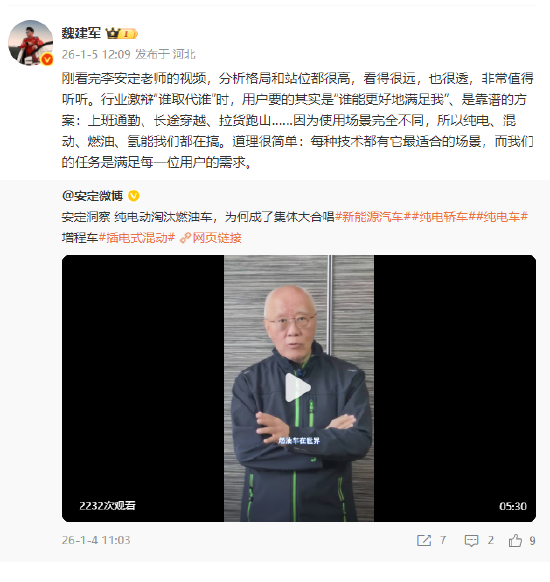
魏建军谈“纯电电动车取代燃油车”观点:每种技术都有适合场景,要满足每一位用户的需求
Xin Lang Cai Jing· 2026-01-05 05:22
Core Viewpoint - The discussion around "pure electric vehicles replacing fuel vehicles" is seen as a strategic move by certain individuals to influence consumer perception and attract investment in the electric vehicle sector [1][5]. Group 1: Industry Perspectives - The intention behind promoting electric vehicles is to brainwash consumers into believing that electric is the future, thereby discouraging choices for fuel vehicles [1][5]. - This aggressive stance aims to send a strong positive signal to the capital market regarding the future of the electric vehicle industry, seeking more financial investment [1][5]. - The promotion also serves to generate media attention, enhancing personal and brand visibility [1][5]. Group 2: Current Market Dynamics - Despite rapid development driven by capital, electric vehicle sales still lag behind fuel vehicles, indicating that a complete victory for electric vehicles is uncertain due to the current limitations in battery energy density [1][5]. - The chairman of Great Wall Motors, Wei Jianjun, supports the analysis presented by Li Anding, emphasizing that the focus should be on which technology best meets user needs across different scenarios, including commuting, long-distance travel, and cargo transport [6]. - Wei Jianjun highlights that each technology, whether electric, hybrid, fuel, or hydrogen, has its optimal application, and the goal is to satisfy diverse user requirements [6].
中国汽车工业协会2026年新年献词
中汽协会数据· 2025-12-31 06:32
Core Viewpoint - The Chinese automotive industry has shown resilience and growth in 2025, overcoming external pressures and challenges while achieving significant advancements in both scale and quality [2][3]. Group 1: Industry Performance - The automotive industry maintained a production and sales volume exceeding 30 million units for three consecutive years [2]. - New energy vehicles (NEVs) experienced rapid growth, with their sales accounting for nearly 50% of new car sales [2]. - The industry achieved breakthroughs in globalization, with new developments in overseas markets and joint ventures [2]. Group 2: Innovation and Technology - The first L3 autonomous driving models were approved for road testing, marking a significant milestone in automotive innovation [2]. - Breakthroughs were made in the research and application of hydrogen vehicles and solid-state batteries, enhancing the competitive edge in smart connected NEVs [2]. Group 3: Future Outlook - 2026 marks the beginning of the "15th Five-Year Plan," which is crucial for further enhancing the scale and quality of the automotive industry [3]. - The industry will focus on innovation, green development, digital integration, open cooperation, and quality safety as guiding principles [3]. - The automotive industry aims to support domestic market growth while expanding its international presence, establishing Chinese automotive brands as globally recognized quality symbols [4]. Group 4: Industry Collaboration and Standards - The Chinese Automotive Industry Association has played a pivotal role in facilitating industry communication and collaboration through various forums and events [3]. - Efforts are being made to improve industry standards and promote the transformation of advanced technologies and achievements [3]. - The association emphasizes self-regulation within the industry to maintain fair competition and a healthy development environment [4].
海马汽车:公司与小鹏汽车的合作已于2021年12月31日协议到期终止
Zheng Quan Ri Bao Wang· 2025-12-29 12:12
Core Viewpoint - Haima Automobile has successfully established a zero-carbon emission automotive ecosystem project at its Haikou base, integrating photovoltaic power generation, water electrolysis for hydrogen production, and hydrogen vehicle operation [1] Group 1: Project Details - The project includes a hydrogen production and refueling station with a daily capacity of approximately 107 kg of green hydrogen [1] - Currently, the hydrogen station is utilized for research and demonstration operations of hydrogen vehicles [1] Group 2: Partnerships - The collaboration between Haima Automobile and Xiaopeng Motors has officially ended as of December 31, 2021 [1]
海马汽车:目前已投放50台氢能汽车开展示范运营
Mei Ri Jing Ji Xin Wen· 2025-12-25 01:01
Core Viewpoint - The company has successfully initiated a collaboration with Toyota to develop hydrogen energy vehicles, with ongoing testing and demonstration operations currently in place [1] Group 1: Partnership and Collaboration - The company signed a strategic cooperation framework agreement with Toyota Motor (China) Co., Ltd. in March 2023 [1] - The collaboration focuses on research and industrialization in the hydrogen energy vehicle sector [1] Group 2: Current Operations - Currently, 50 hydrogen energy vehicles have been deployed for demonstration operations [1] - The company aims to deepen cooperation in hydrogen technology research and demonstration operations in the future [1] Group 3: Future Plans - The partnership will work towards advancing the industrialization of hydrogen energy vehicles in the Hainan Free Trade Port [1]
海马汽车:公司将抓住封关历史机遇从三方面助力产业发展并规划自身布局
Zheng Quan Ri Bao Wang· 2025-12-22 10:49
Core Viewpoint - Haima Automobile aims to leverage historical opportunities presented by the Hainan Free Trade Port through strategic initiatives in three key areas [1] Group 1: Strategic Initiatives - The company plans to fully utilize the core policies of the Hainan Free Trade Port, actively researching and seeking the implementation of these policies in specific cooperative projects [1] - Haima Automobile intends to steadily expand its export scale based on its resource conditions and operational status, aiming to enhance performance by leveraging the strong profitability of export products while effectively managing risks [1] - The company will continue to focus on hydrogen energy as a differentiated strategy, promoting the research, demonstration operation, and full industry chain development of hydrogen vehicles, aiming to create a model project for a "zero carbon emission automotive ecosystem" in Hainan Free Trade Port [1]
海马汽车:抓住封关历史机遇,从三方面助力产业发展并规划自身布局
Jin Rong Jie· 2025-12-22 01:27
Core Viewpoint - The company, as the only complete vehicle manufacturer in Hainan, plans to leverage the historical opportunity presented by the Hainan Free Trade Port's closure operation starting December 18 to enhance its business strategy and contribute to the local industry development [1] Group 1: Strategic Initiatives - The company aims to utilize the core policies of the Hainan Free Trade Port, particularly focusing on processing and value-added initiatives, and is actively researching the implementation of these policies in specific cooperation projects [1] - The company plans to steadily expand its export scale based on its resource conditions and operational status, while effectively managing risks to enhance its performance through profitable export products [1] - The company will continue to focus on hydrogen energy as a differentiated strategy, promoting the research, demonstration operation, and full industry chain development of hydrogen vehicles, aiming to create a model project for a "zero carbon emission automotive ecosystem" in Hainan Free Trade Port [1]
海马汽车: 公司光伏制氢技术目前主要为公司旗下的氢能汽车示范运营提供绿色能源保障
Zheng Quan Ri Bao· 2025-12-19 04:04
Core Viewpoint - The company is focused on developing a complete zero-carbon emission automotive ecosystem through its photovoltaic hydrogen production technology, which includes the entire chain from photovoltaic power generation to hydrogen production via water electrolysis and hydrogen fuel cell vehicle operation [1] Group 1: Photovoltaic Hydrogen Production - The core application of the company's technology is to establish a full industrial chain for zero-carbon emission vehicles, specifically for hydrogen fuel cell vehicles [1] - The company provides green energy support for its hydrogen fuel cell vehicle demonstration operations [1] Group 2: Collaboration with Aerospace Sector - The company has successfully collaborated with the China Aerospace Science and Technology Corporation's 101 Research Institute to build an integrated photovoltaic hydrogen production and refueling station located in Haikou [1] - This station primarily serves the hydrogen fuel cell vehicle demonstration operations [1] Group 3: Emerging Industries and Economic Trends - The company maintains a high level of attention and actively tracks research in emerging industries, particularly in relation to the construction of the Hainan Free Trade Port and relevant industrial policy trends [1]