
担保贷款凭证(CLO)

Search documents
AI冲击之下“铁索连环”,美国杠杆贷款遭重创,高达1500亿美元CLO证券面临冲击
Hua Er Jie Jian Wen· 2026-02-28 01:30
Core Insights - The disruptive potential of artificial intelligence (AI) is rapidly impacting the credit market, leading to significant adjustments in the U.S. leveraged loan market and posing systemic threats to the large collateralized loan obligation (CLO) market [1][2] Group 1: Market Impact - The U.S. leveraged loan market has experienced its most severe monthly sell-off in over three years, primarily affecting borrowers in the software and services sector [1][2] - The Bloomberg U.S. Leveraged Loan Index fell by 1.34% in February, marking the largest monthly decline since September 2022, driven by concerns over AI's potential to disrupt traditional business models [2] Group 2: CLO Market Risks - Estimates suggest that between $40 billion and $150 billion of assets packaged into U.S. CLOs may face disruptive impacts from the AI boom, as highlighted by JPMorgan strategists [3] - CLO managers are currently assessing their portfolios to determine which loans are most sensitive to AI impacts, following significant sell-offs triggered by the release of advanced AI tools like the Claude chatbot [3] Group 3: Refinancing Pressures - The upcoming debt maturity wave raises refinancing risks, with approximately $51 billion of software debt rated B- or lower maturing by 2028, and another $50 billion by 2029 [4] - The private credit market's exposure in the software sector limits its ability to refinance syndicated assets, complicating the previously common "public-to-private" acquisition model [4] - Despite expectations of a gradual integration of AI into the real economy, there are warnings about the potential for a "displeasing reset" in financial markets due to leveraged speculation on AI [4]
2026年展望:宏观经济、股票、基金、住房抵押贷款支持证券、商业抵押贷款支持证券及循环贷款工具的洞察分析
Refinitiv路孚特· 2026-02-09 06:03
Macro Perspective - Despite global risks such as geopolitical tensions and potential economic recession, the severity of these risks is expected to be relatively low by 2026. Traditional valuation metrics show no strong evidence of bubbles in credit and equity markets [3][4] - Global financial conditions have steadily improved since the tariff increases in April 2025, with central banks indicating they do not intend to reduce balance sheets to pre-crisis levels, which helps mitigate financial stability risks [3] - Inflation remains above some central banks' targets, but there is little evidence suggesting a return to high inflation. If unemployment rises quickly in 2026, the Federal Reserve has room for further easing [3][4] Equity Market Outlook - The fundamentals for equities remain strong, supported by robust earnings performance, near-historical profit margins, and strong consumer demand. The "Magnificent-7" companies are expected to expand their earnings further [4][6] - The key risk in the equity market is investor patience regarding returns from artificial intelligence investments, as current valuations are close to levels seen during the internet bubble [6][7] Retail Consumer Sector - The LSEG retail/restaurant index predicts moderate growth in 2025, with revenue expected to increase by 5.9% and earnings by 4.6%, driven by strong consumer demand. Growth momentum is expected to accelerate in 2026, with earnings projected to grow by 10.9% and revenue by 5.8% [9] Fund Flows - In 2025, U.S. dollar money market funds dominated fund flows, driven by high interest rates from the Federal Reserve, maintaining yields above 4% to 5%. This attracted both U.S. and non-U.S. investors [12] - Exchange-traded funds (ETFs) led stock market inflows, totaling $502 billion, while U.S. equity funds saw a significant drop in inflows compared to the previous year [12] Agency Mortgage-Backed Securities (MBS) - The agency MBS market is expected to remain stable in 2026 due to steady issuance, moderate home price growth, and potential declines in mortgage rates. Recent policy measures may impact affordability and liquidity, but their effects remain uncertain [15] - The non-agency MBS market had a strong year in 2025, with issuance up 42% from 2024, driven by increased demand in the non-qualified mortgage sector [17][18] Commercial Mortgage-Backed Securities (CMBS) - The institutional CMBS market performed strongly in 2025, with issuance up over 34%, supported by lower interest rates and a favorable financing environment. However, the multifamily sector showed signs of weakness with rising vacancy rates [20] - The non-institutional CMBS market achieved record issuance levels despite complex macroeconomic conditions, indicating a recovery in commercial real estate fundamentals [21]


超额回报光环褪色、银行业“反击”,私募信贷热潮正在降温
Zhi Tong Cai Jing· 2025-12-30 11:43
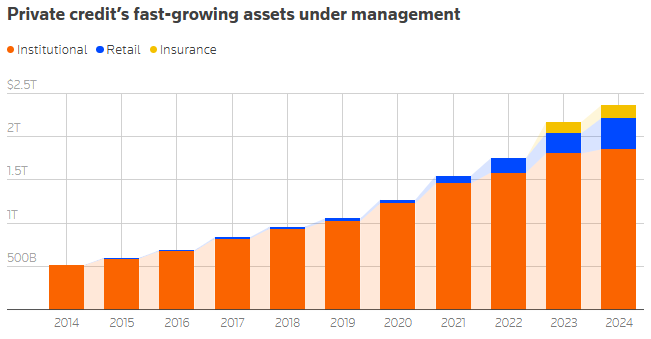
Core Viewpoint - The private credit industry, once distinct for its unique advantages, is increasingly resembling the public credit market, leading to a decline in return rates as banks recover and direct lending institutions invest heavily in retail tools [1][9]. Group 1: Industry Growth and Trends - The private credit industry's asset size has steadily grown to $2.4 trillion by 2024, with traditional closed-end funds raising $113 billion in the first half of 2025 [2]. - New funding sources, such as perpetual funds like Blackstone's BCRED, are rapidly gaining popularity, raising $48 billion in the first half of 2025, accounting for 40% of inflows into traditional institutional funds [2]. - The pursuit of retail funds is expected to continue, with estimates suggesting that individual wealth allocated to private credit could grow nearly fourfold to $1.5 trillion by 2029 [2]. Group 2: Challenges and Market Dynamics - A significant amount of raised capital, amounting to $543 billion, remains uninvested as of the end of 2024, indicating challenges in finding suitable investment opportunities [5]. - The additional premium that direct lending institutions charge over publicly issued bonds is under pressure, having halved in Europe to just over 1 percentage point, and sometimes even lower in the U.S. [8]. - Private credit is becoming a common financing tool in traditional acquisition markets, with borrowers increasingly leveraging competition between markets and lenders [9]. Group 3: Evolving Financing Structures - Direct lending institutions are adapting by offering more flexible loan structures, such as installment loans, to attract borrowers like private equity firms [8]. - Private credit managers are exploring new growth areas, with firms like Blue Owl becoming key players in financing AI assets, while Apollo utilizes its insurance arm to provide tailored financing to higher-rated companies [8]. - The lines between private and traditional credit are blurring, with retail fund growth potentially narrowing the gap and leading to a world of lower returns and higher liquidity [9].

美国2025年CLO销售达到2015亿美元,创历史新高
Sou Hu Cai Jing· 2025-12-17 20:25
Core Insights - The issuance of leveraged loan collateralized loan obligations (CLOs) by asset management firms has reached a record high this year, driven by strong investor demand for high-yield loans [1] - The issuance volume of CLOs in 2025 has reached $201.5 billion, surpassing the previous record of $201.2 billion set last year [1] - The anticipated interest rate cuts by the Federal Reserve are expected to lower leveraged buyout costs and generate more loans, extending the current CLO issuance trend into 2026 [1]