
汽油动力汽车

Search documents
2025年克罗地亚共售出69140辆新乘用车
Shang Wu Bu Wang Zhan· 2026-01-13 15:21
Core Insights - In 2025, Croatia sold a total of 69,140 new passenger cars, representing an 8.3% increase compared to 2024 [1] - December sales saw a year-on-year growth of 15.4%, reaching 4,206 vehicles [1] Brand Performance - The top-selling brands in Croatia were Skoda (9,458 units, 13.7% market share), Volkswagen (8,594 units, 12.4%), Opel (6,063 units, 8.7%), Renault (5,300 units, 7.7%), and Suzuki (4,299 units, 6.2%) [1] - Among emerging Asian brands, Geely sold 895 units and BYD sold 365 units [1] Fuel Type Distribution - Gasoline vehicles dominated the market with 32,574 units sold, accounting for 47.1% of the market share [1] - Hybrid vehicles followed with sales of 25,270 units, representing 36.5% of the market [1] - Diesel vehicles sold 8,684 units, making up 12.6% of the market [1] - Electric vehicles totaled 1,334 units sold, which is 1.9% of the market [1] - Gasoline-powered vehicles also had sales of 1,278 units, accounting for 1.8% [1]

电动车推动欧洲车市连续第五个月增长 大众、比亚迪等份额上升
智通财经网· 2025-12-23 07:17
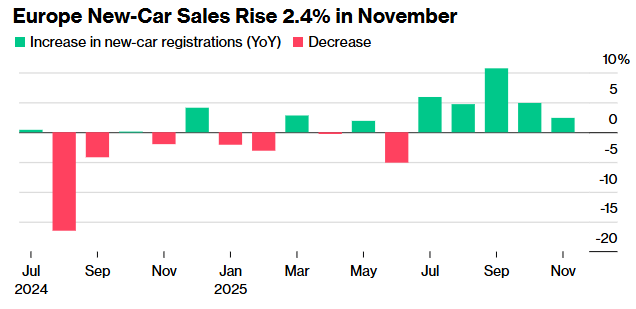
Group 1 - In November, new vehicle registrations in Europe increased for the fifth consecutive month, driven by the growth in electric vehicle sales, with a year-over-year increase of 2.4% to 1.08 million units [1] - Spain and Germany saw the largest increases in new vehicle registrations, while Italy's sales stagnated, and France and the UK experienced slight declines [1] - Sales of pure electric vehicles surged by 37%, surpassing the 34% increase in plug-in hybrid vehicles, marking the first time since March that pure electric vehicle sales outpaced hybrids [1] Group 2 - The European Commission proposed to lift the ban on the sale of new fuel vehicles starting in 2035, which could alter the long-term sales outlook for electric vehicles in Europe [4] - Analysts noted that manufacturers like Volkswagen, BYD, and Renault are increasing their market share in electric vehicles, while competitors such as Tesla, BMW, and Mercedes-Benz are seeing declines [4] - Upcoming sales incentives for electric vehicles in Germany and Spain are expected to have a positive impact on the market [4] Group 3 - High new car prices, a weak economy, and various political and social crises are affecting Germany, the largest automotive market in the region, leading to hesitance in investment decisions from both individuals and businesses [5] - Major manufacturers, including Volkswagen and BMW, are considering gradually increasing the availability of electric vehicles equipped with small range-extending fuel engines as the EU may relax restrictions on fuel vehicle sales post-2035 [6]

特朗普提议削减燃油经济性规定以促进汽油车发展
Xin Lang Cai Jing· 2025-12-04 00:55
Core Viewpoint - The proposal by President Trump aims to roll back fuel economy standards set by former President Biden, facilitating easier sales of gasoline-powered vehicles and countering Biden's climate initiatives [1][2]. Group 1: Fuel Economy Standards - The National Highway Traffic Safety Administration (NHTSA) proposes to significantly lower fuel economy requirements for vehicles from 2022 to 2031, with a target of 34.5 miles per gallon by 2031, down from 50.4 miles per gallon [1][2]. - NHTSA plans to reduce the fuel economy standard for 2022 and then increase it by 0.25% to 0.5% annually until 2031 [2]. Group 2: Economic Impact - The proposed changes are estimated to reduce the average upfront cost of vehicles by $930 [2]. - By 2050, fuel consumption is projected to increase by approximately 100 billion gallons, leading to an additional fuel expenditure of up to $185 billion for Americans, along with a projected 5% increase in carbon dioxide emissions [2].
美国众议院投票推翻加州汽油车禁令
news flash· 2025-05-01 14:58
Core Points - The U.S. House of Representatives voted to overturn a federal exemption that allowed California to ban gasoline-powered vehicles by 2035 and set stricter emissions standards than the federal government [1] Group 1 - The vote resulted in 246 in favor and 164 against, indicating significant support for the repeal among lawmakers [1] - The federal exemption was originally issued during the Biden administration by the Environmental Protection Agency (EPA) [1] - The policy faced opposition from automobile manufacturers, fuel producers, and former President Donald Trump [1]