
油气ETF

Search documents
量化择时周报:继续等缩量-20260329
ZHONGTAI SECURITIES· 2026-03-29 10:21
- The report introduces a timing model based on the distance between the short-term moving average (20-day) and the long-term moving average (120-day) of the Wind All A Index. The model identifies market conditions by observing the difference between these two averages. The latest data shows the 20-day moving average at 6633 and the 120-day moving average at 6485, with a difference of 2.28%, indicating a typical consolidation phase[3][7][12] - The mid-term industry allocation model highlights sectors with strong performance trends. It suggests focusing on industries related to computing power (e.g., semiconductor equipment ETF 159516.SZ, communication ETF 515880.SH), cyclical sectors (e.g., oil and gas ETF, energy chemical ETF 159981.SH), and the new energy sector. If a volume contraction signal appears, attention should shift to non-ferrous metals and military industries[3][6][8] - The report evaluates the market's valuation levels using PE and PB metrics. The Wind All A Index PE is positioned near the 90th percentile, indicating a relatively high valuation, while the PB is at the 50th percentile, reflecting a moderate valuation level[8][12] - The timing model suggests maintaining a 50% equity allocation for absolute return products based on the Wind All A Index, considering the current market environment and valuation levels[6][8][12]
油价高位博弈加剧,12只油气ETF单周净流出30亿
第一财经· 2026-03-21 01:59
Core Viewpoint - The article discusses the recent fluctuations in international oil prices and the subsequent withdrawal of funds from oil and gas ETFs, highlighting the contrasting performance of these ETFs amidst high oil prices and market volatility [2][4][5]. Group 1: Oil Price Trends - Brent crude oil prices surged past $112 per barrel on March 19, marking a year-to-date increase of over 60%, before retreating around the $100 mark [2]. - The volatility in oil prices has led to significant fluctuations in the net asset values of oil and gas ETFs, with some experiencing annual gains of 20% to 50% [2][4]. - As of March 20, Brent crude and WTI crude both saw declines exceeding 3% due to geopolitical premium dilution and the influx of strategic reserves [4][12]. Group 2: Fund Flows and ETF Performance - Despite impressive annual gains, there has been a notable outflow of funds from oil and gas ETFs, with a net outflow of 29 billion yuan in the past week and 96 billion yuan over the last two weeks [2][6]. - The top-performing oil and gas ETFs include the S&P Oil & Gas ETF from Fidelity, which leads with a 52.29% annual gain, followed by the S&P Oil & Gas ETF from Harvest with a 45.35% gain [4][10]. - The concentration of holdings in major oil companies (the "Big Three") is significant, with some ETFs having over 30% of their portfolios in these stocks, which increases the risk of fund withdrawals during price corrections [7][9]. Group 3: Market Sentiment and Future Outlook - Market sentiment is shifting as investors become cautious about high volatility and potential price corrections, leading to a "profit-taking" mentality [5][6]. - The International Energy Agency's announcement of releasing 400 million barrels from strategic reserves is expected to impact supply dynamics and oil price stability [13][14]. - Analysts suggest that while geopolitical factors have elevated oil prices, the market is beginning to refocus on fundamental supply and demand dynamics, especially with signs of weakening demand [12][14].


地缘冲突引爆资源行情,油气ETF单周吸金超206亿
第一财经· 2026-03-09 13:33
Core Viewpoint - The article discusses the significant shift in the A-share ETF market, driven by geopolitical conflicts, leading to a substantial inflow of funds into resource-related ETFs, particularly in oil and gas sectors, while core broad-based ETFs experienced notable outflows [3][4][11]. Fund Flows and Market Dynamics - As of March 6, nearly 400 billion yuan was withdrawn from core broad-based ETFs like the CSI 300 and CSI 500, while industry-themed ETFs saw a net inflow of 443.23 billion yuan, indicating a clear trend of funds moving from broad-based to thematic investments [4]. - Oil and gas ETFs emerged as the top performers, attracting over 206 billion yuan in a single week, with several products seeing their shares increase by over 300% [4][5]. - Specific oil and gas ETFs, such as the Guotai CSI Oil and Gas Industry ETF and the Penghua Oil ETF, attracted more than 40 billion yuan each within a few trading days, leading to significant increases in their share volumes [4][5]. Performance of Thematic ETFs - Other sectors, including electric grid, rare metals, and non-ferrous metals, also received substantial investment, with the Huaxia Electric Grid Equipment ETF seeing over 10 billion yuan in net inflows for six consecutive trading days [5]. - The trading activity for these thematic ETFs surged, with the Guotai CSI Oil and Gas Industry ETF recording a weekly trading volume exceeding 225 billion yuan, a 13-fold increase from the previous week [5]. Discrepancies in Fund Performance - There is a notable lag in the performance of some fund connection products compared to their corresponding ETFs, leading to investor confusion regarding the slower net value growth of these connection funds [7][8]. - The differences arise because ETF connection funds are designed to track the net value of the ETFs rather than their trading prices, which can lead to discrepancies during periods of high market volatility [8][9]. Future Market Outlook - The article highlights that geopolitical uncertainties are likely to continue affecting market risk preferences, with expectations of a volatile A-share index [11]. - Strategic resource products are anticipated to benefit from price increases, particularly in the oil and gas sector, which may see prices reach historical highs due to ongoing geopolitical tensions [12][13]. - The demand for rare metals is expected to grow due to their critical role in various industries, while traditional cyclical industries like coal and steel may also present investment opportunities [13].

油气ETF连续两日霸屏涨幅榜
第一财经· 2026-03-03 13:57
Core Viewpoint - The article discusses the surge in oil and gas stocks driven by escalating geopolitical tensions in the Middle East, highlighting the significant market reactions and the potential risks associated with this volatility [3][9]. Market Performance - On March 3, the oil and gas sector led the market with a 6.75% increase, with 27 stocks, including China National Petroleum (601857.SH) and Sinopec (600028.SH), hitting their daily limit [4][5]. - The oil and gas ETFs saw unprecedented trading volumes, with the National Oil and Gas Industry ETF reaching a record turnover of 8.443 billion yuan, a 32-fold increase from the previous week [5][6]. Fund Flows and Trading Activity - Over 51.23 billion yuan flowed into oil and gas ETFs on March 2 alone, with the Guotai Oil ETF attracting over 3.1 billion yuan [6][7]. - The trading activity was characterized by high turnover rates, with the highest being 167.95% for the S&P Oil and Gas ETF [6]. Risk Signals - Despite the bullish market, there are signs of risk, as many ETFs are trading at significant premiums to their net asset values, with the S&P Oil and Gas ETF showing a premium of 20.76% [6][7]. - Fund companies have issued multiple risk warnings, with at least 20 announcements regarding premium risks in just two trading days [7]. Future Outlook - Analysts suggest that the sustainability of the current oil price surge depends on the situation in the Strait of Hormuz and the duration of the ongoing conflicts [9][10]. - The geopolitical risk premium is expected to remain high, but the long-term outlook will depend on supply-demand fundamentals and production capacities [11][12].




全线大涨!超80亿资金 “借基”扫货!这类投资如何选?
Zhong Guo Jing Ji Wang· 2026-02-28 00:53
Group 1 - The oil and gas sector has become a recent market focus, continuing the trend seen in the commodities market, with significant price increases in various stocks and indices [1][2] - Since the beginning of the year, the oil and gas sector has seen a strong performance, with the China Securities Oil and Gas Resource Index rising by 33.07%, and individual stocks like Tongyuan Petroleum increasing by 173.01% [1][2] - Over 8 billion yuan has flowed into oil and gas ETFs, indicating strong investor interest in this sector [2][3] Group 2 - The global oil price has risen from $58.72 per barrel at the end of last year to over $70 per barrel, supported by macroeconomic factors and geopolitical risks [2][3] - The supply side is a key support for the current market, with OPEC+ maintaining significant voluntary production cuts and geopolitical tensions affecting supply from countries like Iran and Venezuela [3][4] - The oil and gas funds are categorized into three types: crude oil commodity funds, overseas oil and gas stock funds, and domestic oil and gas stock funds, each with distinct characteristics and risk-return profiles [4][5] Group 3 - Many oil and gas funds are currently under subscription limits, leading to increased premiums in the market [6][7] - As of February 27, several oil and gas funds have suspended large subscriptions, with some funds completely halting new investments [6][7] - The premium rates for certain funds have reached as high as 20.07% and 15.33%, indicating a significant market imbalance [7]
国际原油价格拉升 多只油气ETF狂飙
Bei Jing Shang Bao· 2026-02-24 16:56
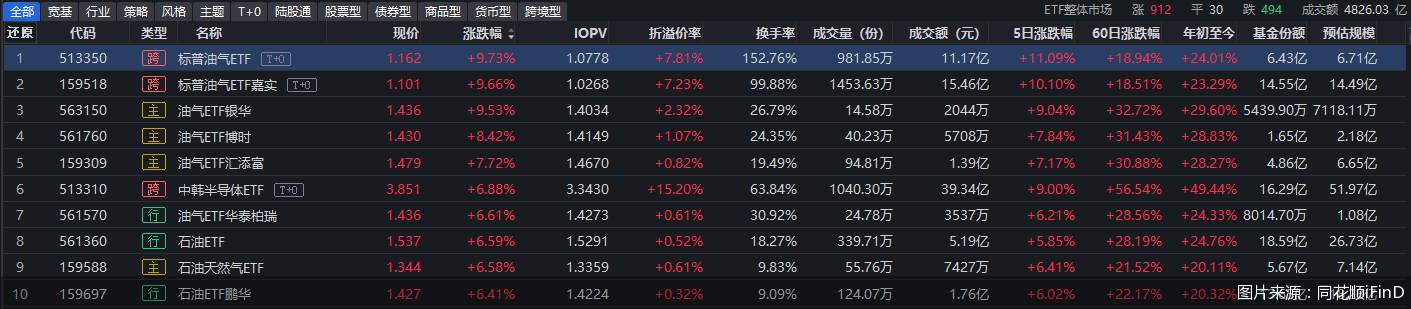
Core Viewpoint - The recent increase in international crude oil prices has positively impacted domestic oil and gas ETFs, with several funds showing significant gains since the beginning of the year [1][2]. Oil Price Trends - Brent crude oil prices have fluctuated, reaching $72 per barrel on February 23, the highest since July 2025, before slightly retreating [1]. - As of February 24, Brent crude was trading around $71.73 per barrel, marking an increase of over 5.5% since February 15 [1][2]. ETF Performance - Multiple oil and gas ETFs surged on February 24, with three products rising over 9%: the Invesco S&P Oil & Gas ETF (QDII) at 9.73%, the Harvest S&P Oil & Gas ETF (QDII) at 9.66%, and the Yinhua CSI Oil & Gas Resources ETF at 9.53% [2]. - Year-to-date, oil and gas themed funds have achieved positive returns, with the highest exceeding 18% [1][3]. Market Analysis - Analysts attribute the rise in oil prices to geopolitical tensions, particularly the escalating conflict between the U.S. and Iran, which has created a tighter supply atmosphere [2][4]. - The EIA reported a decrease in crude oil inventories due to increased winter demand, contributing to the recent price uptick [2]. Long-term Outlook - Experts suggest that while short-term returns on oil and gas ETFs may be optimistic due to current geopolitical and supply-demand dynamics, the long-term trend remains stable with potential for further gains [4]. - The average return for oil and gas themed funds over the past year is 16.94%, with top performers achieving returns over 40% [3].
国际原油价格拉升!一众油气ETF领涨,多只产品单日涨超9%
Bei Jing Shang Bao· 2026-02-24 12:13
Core Viewpoint - The recent rise in international crude oil prices has positively impacted domestic oil and gas ETFs, with several funds showing significant gains since the beginning of the year [1][3]. Group 1: Oil Price Trends - Brent crude oil prices reached $72 per barrel on February 23, marking the first time since July 2025 that prices surpassed this level, before slightly retreating [1][2]. - As of February 24, Brent crude was fluctuating around $71 per barrel, with a reported increase of over 5.5% since the start of the Chinese New Year holiday on February 15 [2][3]. Group 2: ETF Performance - Multiple oil and gas ETFs surged on February 24, with three products recording gains exceeding 9%, specifically the Fuqua S&P Oil & Gas ETF (QDII), the Jiashi S&P Oil & Gas ETF (QDII), and the Yinhua Oil & Gas Resource ETF [3]. - Year-to-date, oil and gas themed funds have achieved positive returns, with the highest fund showing an increase of over 18% [1][4]. Group 3: Investment Outlook - Short-term investment in oil and gas ETFs is viewed positively due to geopolitical tensions and short-term supply-demand imbalances, with expectations for continued robust returns [5]. - Long-term projections suggest that oil prices may stabilize around $65 per barrel, with potential for further increases in the short term due to geopolitical factors [3][5].
跨境ETF规模重返万亿元;博道基金自购旗下新基金800万元|天赐良基日
Mei Ri Jing Ji Xin Wen· 2026-02-13 08:22
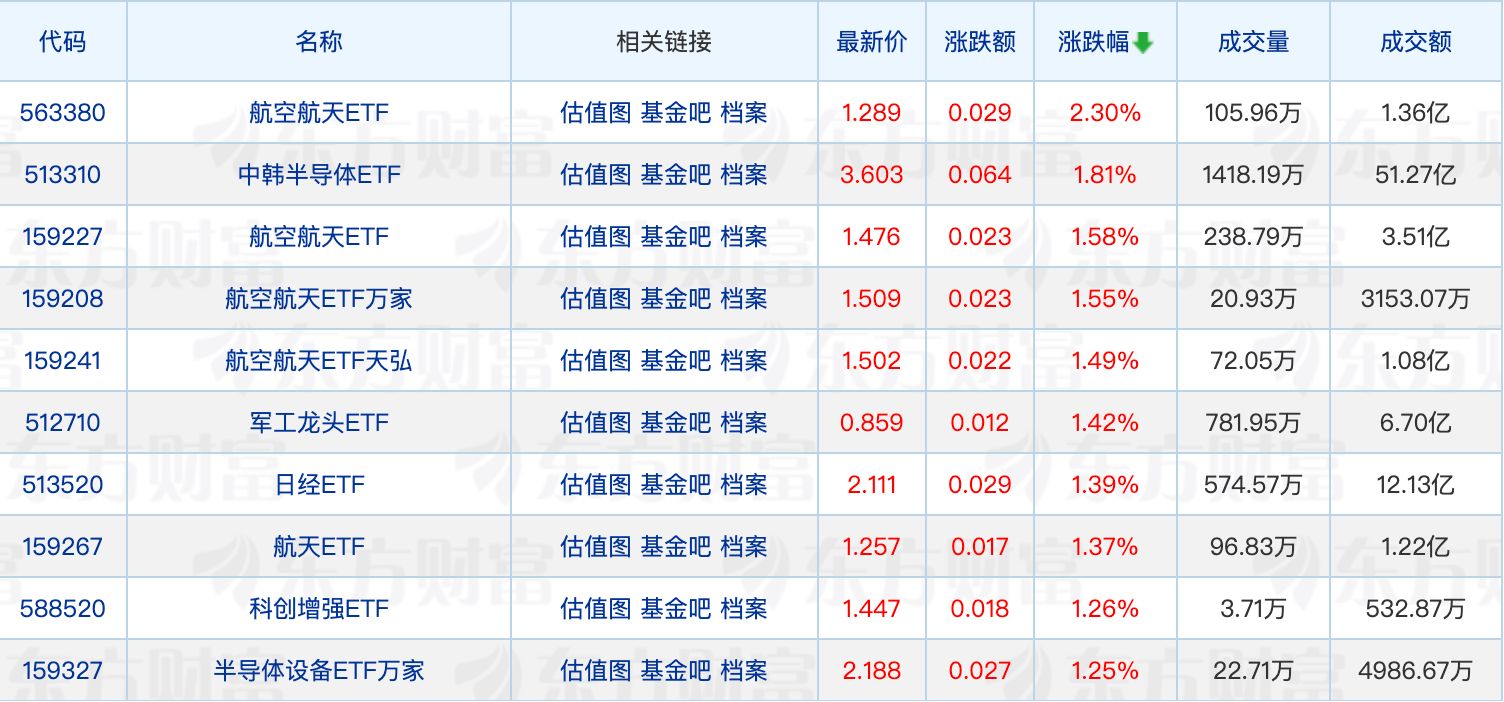
Group 1 - The scale of cross-border ETFs has returned to 1 trillion yuan, reaching 1 trillion yuan again as of February 11, with Hong Kong stock-themed ETFs totaling 822.45 billion yuan [1] - Baodao Fund announced the establishment of the Baodao Xinghang Mixed Fund, with the company investing 8 million yuan of its own funds during the fundraising period [2] - A total of 12 commercial real estate REITs have been filed and accepted since the pilot program began on December 31, 2025, with 11 in the Shanghai market and 1 in the Shenzhen market [3] Group 2 - Ren Xiangdong has reduced holdings in Dalian Technology, with the number of shares held by his managed funds decreasing by 119,400 shares and 63,800 shares respectively as of February 6 [4] - Yan Siqian has been appointed as the new fund manager for the Penghua Fengsheng Bond Fund, marking her first management role in a bond fund [5] Group 3 - The ETF market experienced a day of volatility, with all three major indices declining, while the aerospace sector showed strength with the aerospace ETF rising by 2.30% [6] - Oil and gas-related ETFs saw a collective decline, with the largest drop being 4.21% for the Boshi Oil and Gas ETF [7] Group 4 - The global semiconductor materials market is characterized by "long-term growth and cyclical fluctuations," with a restructuring of the regional landscape accelerated by domestic production trends [8] - Recent government policies have provided robust support for the development of the semiconductor materials industry, creating a comprehensive empowerment system [8]
资源、科技类ETF持续受资金关注 行业ETF本周净流入685.54亿元
Sou Hu Cai Jing· 2026-02-01 12:59
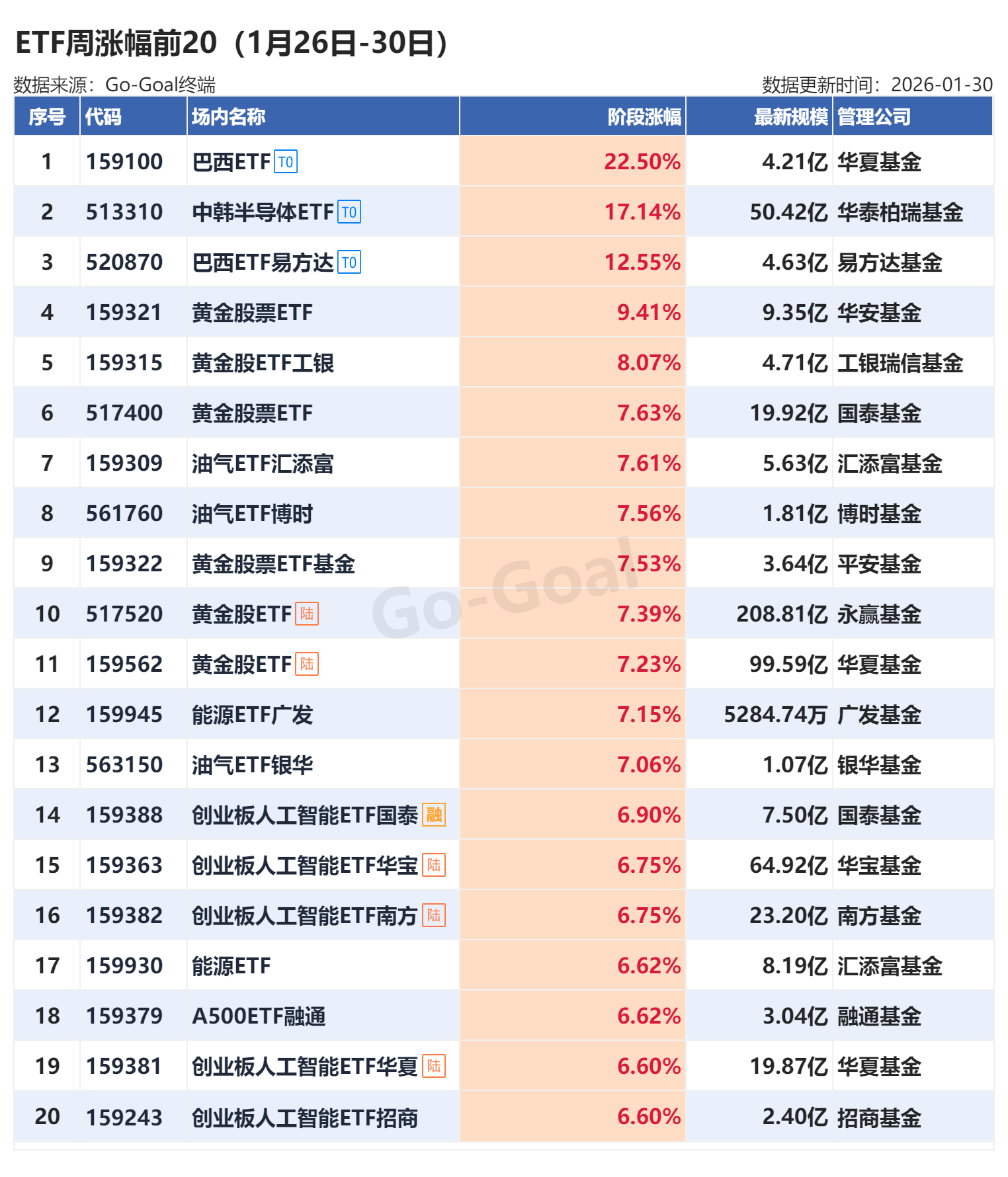
Market Performance - A-share market indices showed mixed performance this week, with the Shanghai Composite Index declining by 0.44%, the Shenzhen Component Index down by 1.62%, while the CSI 300 Index rose by 1.58% and the SSE 50 Index increased by 1.13% [1] ETF Trends - Resource and technology sector ETFs have attracted significant capital recently, with the Brazil ETF leading the weekly gains at 22.5%, driven by the strong performance of the IBOVESPA index and key stocks like Vale and Petrobras benefiting from rising commodity prices [1] - The Brazil ETF currently has a premium rate of 15.04% [1] ETF Performance Rankings - The top-performing ETFs this week include: - Hotel F ETF: 22.50% - South Korea Semiconductor ETF: 17.14% - Brazil ETF: 12.55% - Gold Stocks ETF: 9.41% - Oil and Gas ETFs: around 7% [2][3] Fund Flows - The ETF market experienced a net outflow of 300 billion yuan this week, with broad-based ETFs seeing a net outflow of approximately 390 billion yuan, while industry ETFs recorded a significant net inflow of 68.55 billion yuan and commodity ETFs saw a net inflow of 24.36 billion yuan [3] Upcoming ETF Issuances - Four new ETFs are set to be issued next week, including: - Battery ETF by E Fund - Dividend Quality ETF by E Fund - Industrial Nonferrous ETF by Bosera - Hang Seng Biotechnology ETF by GF Fund [4][5]
图解1月ETF涨跌幅、资金流
Ge Long Hui· 2026-02-01 09:04
Group 1 - In January 2026, the A-share ETF market showed a clear divergence, with over 200 billion yuan flowing into industry-themed ETFs such as non-ferrous metals, gold, chemicals, and satellite, while core broad-based ETFs like CSI 300 and CSI 1000 experienced a net outflow exceeding 1 trillion yuan [1][6] - The Shanghai Composite Index rose by 3.76% in January, reaching above the 4100-point mark, while the Sci-Tech 50 Index saw an increase of over 12% [2] - Significant gains were observed in various ETFs, with semiconductor and gold stock ETFs rising over 40%, and mining and non-ferrous metal ETFs increasing by over 20% [2][3] Group 2 - In January, the banking ETF fell by over 6%, along with declines in the automotive and battery ETFs [4] - On January 28, a notable increase in ETF trading volume was recorded, with the Huatai-PineBridge CSI 300 ETF exceeding 40 billion yuan in trading volume, marking the highest since 2015 for the SSE 50 ETF [5] - Over 1 trillion yuan was withdrawn from broad-based ETFs in January, with significant outflows from the CSI 300, CSI 1000, and SSE 50 ETFs, while industry-themed ETFs saw net inflows exceeding 10 billion yuan [6] Group 3 - In January, there was a substantial inflow of overseas funds into Chinese stock assets, with a net inflow of 16.659 billion USD into mainland Chinese stock funds, according to Goldman Sachs [7]