美国天然气期货

Search documents
What smart people are saying about oil's latest spike to nearly $120 a barrel
Business Insider· 2026-03-19 15:29
Core Viewpoint - The recent surge in oil and gas prices, driven by geopolitical tensions, could lead to significant market volatility and economic repercussions for consumers and growth [1][2][3]. Group 1: Price Movements - Brent crude oil prices increased by over 11% to exceed $119 per barrel, marking the highest levels in nearly four years [1]. - European natural gas futures rose by 35% to above 70 euros per megawatt-hour at their peak [1]. - West Texas Intermediate crude and US natural gas futures also experienced significant increases following attacks on energy infrastructure [2]. Group 2: Geopolitical Context - The escalation of conflict between Iran and the US and Israel has contributed to rising oil and gas prices, particularly due to Iran's actions in the Strait of Hormuz, a critical shipping route for global LNG supplies [3][8]. - The ongoing blockade of the Strait of Hormuz could lead to a supply shock worse than historical events in 1973 or 1979 [8][9]. Group 3: Economic Implications - The combination of rising energy prices and stagnating growth raises concerns about stagflation, reminiscent of the 1970s [4][14]. - Higher energy costs are expected to dampen consumer spending and business investment, exacerbating economic uncertainty [14]. - Disruptions in fertilizer exports from the Middle East could lead to increased food prices, impacting agricultural markets [13][15]. Group 4: Market Reactions - European markets are particularly vulnerable due to their reliance on energy imports, with potential for a shift from 'worried' to 'panic' in global equities [6]. - The volatility in oil and gas markets is likely to persist until stability is restored in the region [18]. - A potential agreement between the US and China could ease geopolitical tensions and lower energy prices, leading to a relief rally in global equities [18].

恐慌性出逃,全球股债双杀,日韩又崩了
凤凰网财经· 2026-03-09 01:24
Core Viewpoint - The ongoing geopolitical tensions in the Middle East have led to significant volatility in global financial markets, with oil prices surging past $110 per barrel, raising concerns about global economic "stagflation" [1]. Group 1: Oil Price Surge - WTI crude oil futures rose by 22%, surpassing $110 per barrel, marking the highest level since 2022; Brent crude oil futures also increased by over 20%, reaching $111.04 per barrel [2]. - The spread between Brent crude spot prices exceeded $8.50 per barrel, the highest since 2013, indicating strong spot premiums [3]. Group 2: Stock Market Reaction - The sharp rise in energy prices severely impacted market risk appetite, leading to significant declines in the Asia-Pacific markets, with the Nikkei 225 index dropping over 5% and the KOSPI index falling by 7% [4]. - U.S. stock futures also faced declines, with the Dow Jones Industrial Average futures dropping over 1,000 points, a decline of more than 2% [4]. Group 3: Commodity and Bond Market Impact - Despite the oil price surge, traditional safe-haven assets like gold and silver experienced significant sell-offs, with gold dropping over 2% to below $1,050 per ounce and silver falling by 4% to below $81 per ounce [5]. - The bond market faced pressure as rising oil prices increased inflation expectations, leading to a significant drop in U.S. Treasury futures and a rise in Australian three-year government bond yields to the highest level since 2011 [5]. Group 4: Market Analysis - Analysts noted that the oil price exceeding $100 per barrel represents not just a rebound in commodities but also acts as a tax on the global economy, raising concerns among central bank officials about "stagflation" risks [6]. - While the Middle East conflict is seen as a short-term volatility factor for U.S. markets, there are warnings that market risks are accumulating, necessitating a de-escalation of regional tensions for stability [6]. Group 5: Government Response - In response to the energy shock, South Korea is considering reinstating price caps on crude oil for the first time in nearly three decades to address the latest round of energy price increases [7].

中东停产潮冲击!油价暴涨20%突破110美元,全球股债双杀、韩股跌7%,金银大跌
华尔街见闻· 2026-03-09 00:49
Group 1: Geopolitical Impact on Oil Prices - The latest developments in the Middle East geopolitical situation are significantly reshaping global asset pricing logic, with oil prices strongly breaking the $100 mark, triggering deep concerns among investors about inflation rebound and economic slowdown [1][2] - On March 9, WTI crude oil surged by 22% to over $110, marking the highest level since 2022, influenced by shipping disruptions in the Strait of Hormuz and production cuts by major oil-producing countries in the Middle East [1][2] - The sharp rise in energy prices has led to discussions among central bank officials about the feared term "stagflation," indicating a potential economic tax imposed by rising oil prices [2][5] Group 2: Stock Market Reactions - U.S. stock index futures experienced significant declines, with the Dow Jones futures dropping over 1000 points, and the S&P 500 and Nasdaq 100 futures falling approximately 1.7% [1][2][10] - European and Asian stock indices also faced sharp declines, with the Euro Stoxx 50 futures down 2.2% and Japan's Nikkei 225 index dropping over 4% [2][10] - Analysts from Wedbush indicated that while the current conflict represents short-term volatility for the U.S. stock market, risks are accumulating, and a de-escalation in the Middle East is necessary for market stabilization [10] Group 3: Bond Market and Inflation Concerns - The global bond market saw widespread declines, with U.S. Treasury yields rising due to inflation concerns, and German 10-year bond futures hitting their lowest level since July 2011 [3][12] - The rise in oil prices is expected to stimulate global inflation pressures, complicating the Federal Reserve's position as it prepares for upcoming inflation data releases [10][12] Group 4: Energy Market Dynamics - The spot premium in the oil market is rapidly expanding, indicating extreme short-term supply tightness, with Brent crude's spot price spread exceeding $8.50 per barrel, the highest level since 2013 [5] - Governments are beginning to take measures in response to soaring energy prices, with South Korea considering reinstating oil price caps for the first time in nearly three decades [5]

道琼斯,大跌近800点
财联社· 2026-03-06 00:11
Market Overview - The U.S. stock market experienced significant volatility due to escalating conflicts in Iran, impacting global markets and causing oil prices to surge to their highest levels since mid-2024 [1] - The Dow Jones index saw a drop of over 1100 points during trading, ultimately closing down 784.67 points, or 1.61%, at 47954.74 points [2][3] - Oil prices increased sharply, with U.S. crude rising by 8.5% to over $81 per barrel, marking the largest single-day increase since May 2020 [2] Oil Market Dynamics - U.S. crude and Brent crude prices have risen over 20% and 17% respectively this week, driven by concerns over potential disruptions in oil transportation through the Strait of Hormuz [3] - The escalation of conflict has reportedly halted oil tanker navigation through the Strait, although Iran's UN representative denied claims of a blockade [3] Sector Performance - In the S&P 500 index, sectors such as industrials, materials, and healthcare saw the largest declines, with the passenger airline sub-industry experiencing significant losses [4] - Energy sector ETFs showed resilience, with oil and gas ETFs rising by 1.88% and energy select ETFs increasing by 0.53% [5] Company Performance - Major tech stocks exhibited mixed results, with Microsoft up 1.35% and Amazon up 0.98%, while Tesla and Google saw declines of 0.10% and 0.74% respectively [6] - Broadcom's strong earnings outlook, predicting AI chip revenue to exceed $100 billion next year, helped limit broader market declines, with its stock rising by 4.8% [6] - Financial stocks dragged down the Dow, with JPMorgan, Goldman Sachs, and Morgan Stanley experiencing declines of 1.95%, 3.67%, and 3% respectively, amid reports of significant layoffs [6] Chinese Stocks - The Nasdaq Golden Dragon China Index fell by 1.4%, with notable declines in stocks such as Bilibili and Hesai, while Trip.com saw an increase of over 2% [7]

突然暴跌超1100点!伊朗传来大消息!
天天基金网· 2026-03-05 23:51
Group 1 - The ongoing conflict in the Middle East is causing significant volatility in financial markets, with the Dow Jones Industrial Average experiencing a drop of over 1100 points during trading on March 5, ultimately closing down 1.61% [3][4] - International oil prices surged, with WTI crude oil futures for April rising over 8.5% to above $81 per barrel, marking the largest single-day increase since May 2020 [4] - Concerns about disruptions to oil transportation through the Strait of Hormuz have intensified, with WTI and Brent crude prices increasing by over 20% and 17% respectively since the beginning of the week [4] Group 2 - The uncertainty surrounding the conflict remains high, with market analysts unable to predict the duration of the conflict or the extent of its impact on global energy supplies [5] - Key issues for the market include whether shipping through the Strait of Hormuz can resume and the potential duration of the war, with fears that prolonged conflict could negatively affect risk assets [6] - Reports indicate that Iranian military actions have escalated, including attacks on U.S. naval vessels and Israeli targets, further complicating the regional security landscape [7][8]

突发!伊朗:击中美国航母!原油飙涨,道指暴跌超1100点!
券商中国· 2026-03-05 23:32
Market Impact - The ongoing conflict in the Middle East, particularly around Iran, has caused significant volatility in financial markets, with the Dow Jones Industrial Average experiencing a drop of over 1100 points at one point [2][3] - International oil prices surged, with WTI crude oil futures for April rising by over 8.5%, reaching above $81 per barrel, marking the largest single-day increase since May 2020 [6][7] Oil Price Dynamics - Since the beginning of the week, WTI and Brent crude oil prices have increased by over 20% and 17% respectively, driven by concerns over potential disruptions to oil transport through the Strait of Hormuz [7] - The Iranian government has denied claims of blocking the Strait, asserting its commitment to international law and freedom of navigation [7] Energy Market Reactions - Natural gas futures in the U.S. rose by nearly 3%, while diesel futures increased by approximately 7%, indicating a broader rise in energy prices that could complicate inflation dynamics and impact Federal Reserve policy [8] - Analysts express high uncertainty regarding the duration of the conflict and its potential impact on global energy supply [8] Regional Tensions - The conflict has led to heightened tensions in the region, with reports of missile threats in the UAE and attacks on Azerbaijani territory by Iranian drones [10][11] - Incidents of missile strikes in Bahrain and Qatar have also been reported, further escalating regional security concerns [11]

美国天然气期货价格下跌2.0%
Mei Ri Jing Ji Xin Wen· 2026-02-26 16:29
Group 1 - The core point of the article is that U.S. natural gas futures prices have decreased by 2.0% on February 26 [1]
美国天然气期货跌3%
Jin Rong Jie· 2026-02-26 12:24
Group 1 - The core point of the article is that U.S. natural gas futures have experienced a decline of 3% within the trading day, currently priced at $2.781 per million British thermal units [1]
美国天然气期货涨3%
Jin Rong Jie· 2026-02-25 16:49
Group 1 - The core point of the article is that U.S. natural gas futures have increased by 3.00% within the trading day, currently priced at $2.916 per million British thermal units [1]
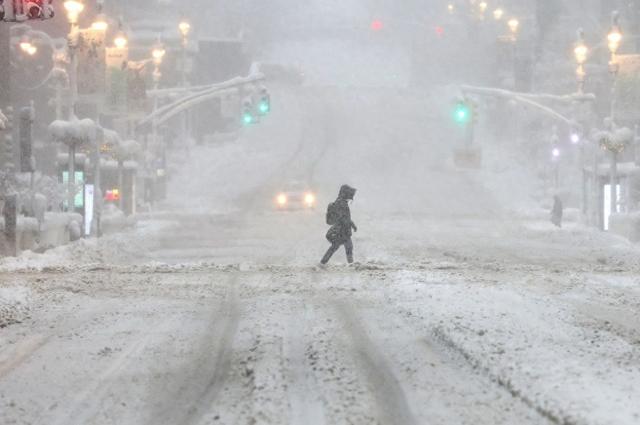
第1现场|暴雪肆虐美国,7个州进入紧急状态,纽约成“孤城”
Xin Lang Cai Jing· 2026-02-25 00:30
Core Points - A severe snowstorm has impacted the northeastern United States since February 22, leading to significant disruptions in public transportation and travel [1][6] - Over 5,670 flights have been canceled, with major airports in New York experiencing cancellation rates of 98% at LaGuardia and 90% at JFK [3][20] - Seven states, including New York and New Jersey, have declared a state of emergency due to the extreme weather conditions [6][9] Group 1 - The storm has caused New York City to implement a travel ban, effectively isolating the city [9][15] - Snow accumulation in Central Park exceeded 19.7 inches (approximately 50 cm), with some areas reporting up to 24 inches (approximately 61 cm) [20][25] - The National Weather Service has classified this storm among the top ten snowstorms in New York City history [25] Group 2 - The storm has resulted in widespread power outages, affecting over 500,000 users in the northeastern region, with nearly 290,000 outages reported in Massachusetts alone [39] - The extreme cold weather is expected to significantly increase heating demand, leading to a spike in natural gas futures prices, which rose by 6.8% on the evening of February 22 [45]