波音767飞机

Search documents
达美航空(DAL.US)盘前跳水!Q4业绩超预期 但2026年EPS指引令人失望
Zhi Tong Cai Jing· 2026-01-13 12:45
Core Viewpoint - Delta Air Lines reported its Q4 2025 earnings, showing revenue of $16.003 billion, a 2.8% year-over-year increase, exceeding market expectations by $130 million. However, adjusted net income fell by 15.6% to $1.015 billion compared to the previous year, and the adjusted earnings per share of $1.55 met market expectations. The company's guidance for 2026 earnings per share was below expectations, leading to a pre-market stock drop of over 5% [1][2]. Group 1 - Delta Air Lines expects 2026 free cash flow to be between $3 billion and $4 billion, down from $4.6 billion in 2025, due to increased reinvestment in the business [2]. - The company emphasizes high-end products both in and out of the cabin to differentiate itself from low-cost carriers and attract high-net-worth travelers [2]. - Delta's focus on the high-end market has helped maintain its profitability goals for 2025, despite economic uncertainties affecting price-sensitive travelers [2]. Group 2 - Delta announced an order for 30 Boeing 787 Dreamliners, marking the first purchase of this model in its history, with deliveries expected to start in 2031 [3]. - This aircraft order reflects Delta's optimistic outlook on international travel demand, as airlines globally seek to update their long-haul fleets [3]. - Delta operates a diverse fleet, including nearly 60 older Boeing 767s and over 90 Boeing 757s, with an average age of 27 years [3].

汽车、船舶之后,美国考虑开征“飞机税”
Hu Xiu· 2025-05-13 06:09
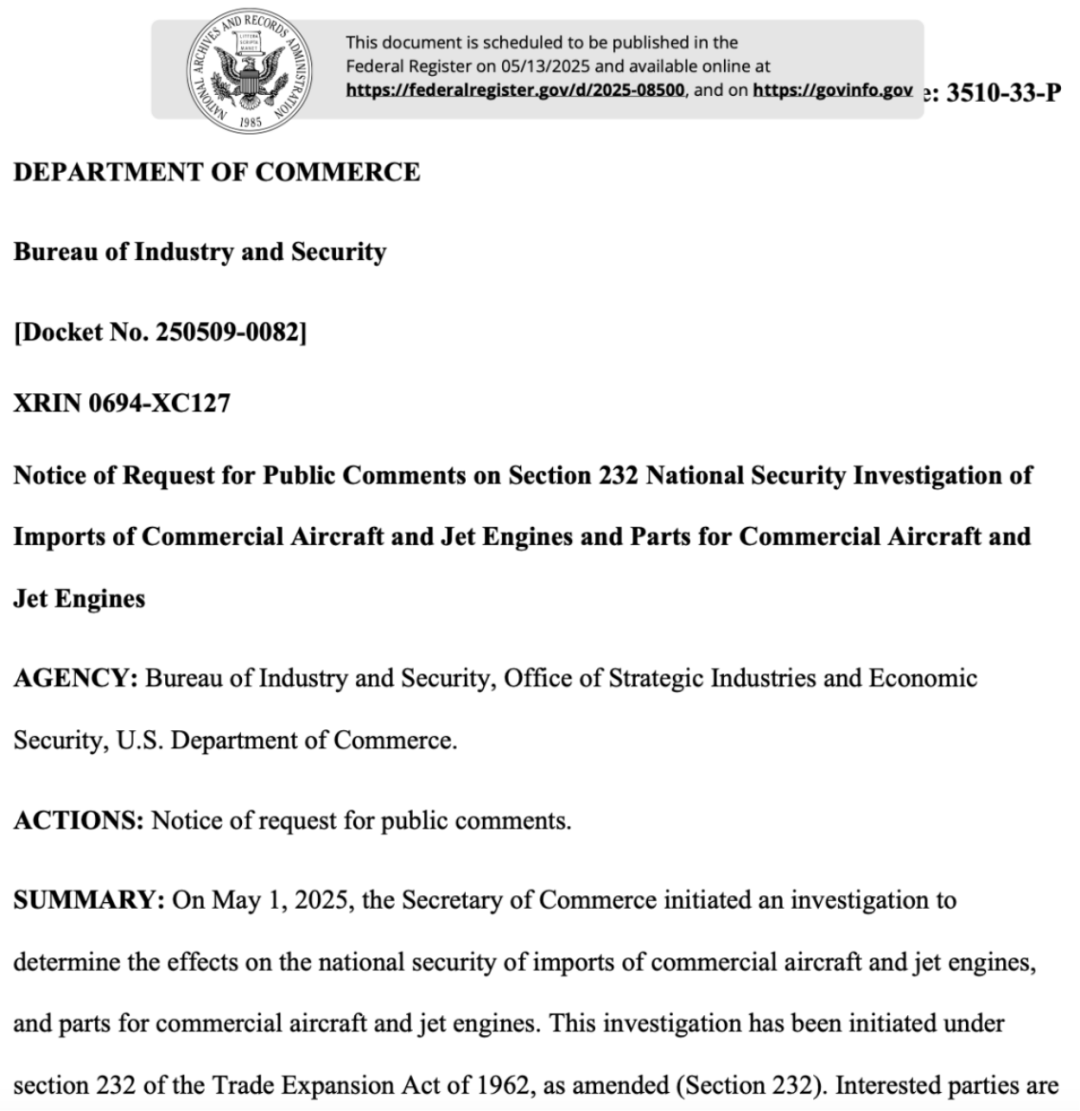
Core Viewpoint - The U.S. Department of Commerce is considering imposing additional tariffs on imported aircraft and parts, following similar measures on automobiles and ships, which could significantly impact the aviation supply chain and related industries [1][2][14]. Group 1: Import and Export Data - In 2024, the U.S. is projected to import aircraft worth $62.1 billion and export aircraft worth $123.6 billion, indicating a substantial trade balance in favor of exports [4]. - Boeing primarily exports aircraft globally but relies on imported parts and materials, highlighting the interconnectedness of the supply chain [4][10]. Group 2: Impact on Aircraft Manufacturers - The potential tariffs could affect two main categories: aircraft imported from Europe and parts supplied globally to Boeing [5]. - Airbus, despite being a competitor, has a significant market presence in the U.S., with models like the A320 and A321 series being popular due to their operational efficiency [6][7]. Group 3: Supply Chain Implications - A single aircraft consists of approximately 3 million parts, and imposing a "plane tax" could disrupt Boeing's global supply chain, particularly affecting Japanese suppliers [8]. - Japanese manufacturers play a crucial role in Boeing's production, with significant contributions to models like the 787, where Japanese firms account for 35% of the production [9]. Group 4: Broader Economic Impact - The automotive industry in Japan, already affected by U.S. tariffs on cars, could face further challenges if tariffs extend to aircraft, potentially harming both Japanese and U.S. industries [15]. - The U.S. has also announced additional fees for ships, indicating a broader trend of increasing tariffs across various sectors, which could further strain international trade relationships [16].