
活体抵押贷

Search documents
金融甘霖润泽河州 倾力服务促发展 中国人民银行临夏州分行支持地方经济高质量发展
Jin Rong Shi Bao· 2026-02-12 02:03
Core Viewpoint - The financial sector in Linxia Prefecture is deeply integrated into the economic and social development, with the People's Bank of China Linxia Branch playing a crucial role in promoting high-quality development through innovative financial services [1][8]. Group 1: Monetary Policy Implementation - The core task of the People's Bank of China Linxia Branch since 2025 has been to ensure that monetary policy benefits reach the real economy, addressing obstacles in policy implementation and enhancing financial services [2]. - A cross-departmental financial coordination mechanism has been established, involving over ten departments to jointly assess economic and financial conditions and optimize the implementation plan for financial support [2]. - The "11453" work promotion system has been innovatively constructed to transform policy transmission from a "one-way push" to a "multi-party interaction and full tracking" model [2]. Group 2: Credit Growth and Structure - As of the end of 2025, the total loan balance in Linxia reached 842.72 billion, with a high average annual growth rate over the past three years, particularly in medium and long-term manufacturing loans, inclusive small loans, and green loans [3]. Group 3: Rural Economic Development - The People's Bank of China Linxia Branch has implemented a "one county, one industry, one product" financial assistance initiative to support rural revitalization, focusing on local resources and industries [4]. - Innovative financial products, such as "live asset mortgage loans," have been introduced to support livestock farming, resulting in over 2.4 billion in loans for the livestock industry [4]. - A total of 126 billion in small loans for poverty alleviation has been issued, benefiting tens of thousands of farmers and helping to prevent large-scale poverty [4]. Group 4: Emergency Financial Services - Following the earthquake in Jishi County, the People's Bank of China Linxia Branch quickly activated an emergency financial service mechanism, providing over 200 million in disaster recovery loans to support affected households [5]. Group 5: Financial Service System Development - The People's Bank of China Linxia Branch has made significant progress in enhancing financial services, focusing on five key areas: technology finance, green finance, inclusive finance, pension finance, and digital finance [6]. - A total of 46.8 billion in loans has been issued to over 52,000 small and micro businesses, ensuring close financial service connections [6]. Group 6: Community Engagement and Financial Education - The People's Bank of China Linxia Branch has actively promoted financial literacy among local communities, particularly among ethnic minorities, through localized educational initiatives [7]. - The "Golden润河州" volunteer service brand has been established, focusing on financial knowledge dissemination and community support [7]. Group 7: Future Outlook - The People's Bank of China Linxia Branch aims to continue its commitment to high-quality development and financial services, contributing to the modernization of Linxia through sustained financial support [8].
甘肃田野调研:从温室大棚到绿电基地 农业银行的“下沉”与“上升”
Mei Ri Jing Ji Xin Wen· 2025-12-16 05:17
Core Viewpoint - Agricultural Bank of China has become the world's largest commercial bank by market capitalization, reaching approximately 2.74 trillion RMB (about 386.9 billion USD) as of October 30, 2025, reflecting its strategic positioning in serving rural revitalization and the real economy [2]. Financial Performance - For the first three quarters of 2025, Agricultural Bank reported operating income of 550.8 billion RMB and net profit of 222.3 billion RMB, representing year-on-year growth of 1.97% and 3.28% respectively [2]. - The total asset scale of the bank exceeded 48 trillion RMB by the end of the reporting period [2]. County-Level Business Growth - As of September 2025, the bank's county-level loan balance reached 10.90 trillion RMB, growing by 10.57% since the beginning of the year, maintaining over 40% of the bank's total loan proportion [3][18]. - The bank's non-performing loan ratio improved to 1.27%, a decrease of 3 basis points from the beginning of the year [3]. Rural Financing Initiatives - The "Fumin Loan" program has disbursed 273.29 billion RMB, benefiting 321,600 rural households across 14 cities in Gansu province [5]. - The "Huinong e-loan" program has provided 930.92 billion RMB in loans, serving 1,168,700 rural households [5]. Innovative Financial Products - The "Electricity Bill e-loan" product allows small enterprises to secure loans based on their electricity usage data, addressing financing challenges for new businesses [11]. - The "Live Asset Mortgage Loan" has evolved into the "Smart Livestock Loan," utilizing AI technology for monitoring livestock, enhancing efficiency in the lending process [13]. Strategic Partnerships and Projects - Agricultural Bank has established a strategic partnership with China Green Development Group, facilitating financing for multiple renewable energy projects, with a total approval amount of 25.84 billion RMB since 2021 [18]. - The bank's rapid loan approval process has been highlighted in projects like the 300 MW compressed air energy storage project, where it completed a 9 billion RMB loan approval swiftly [14][16]. Conclusion - Agricultural Bank's focus on county-level business and innovative financial products positions it as a leader in rural finance, contributing to its competitive advantage and potential for revenue growth in the future [18].


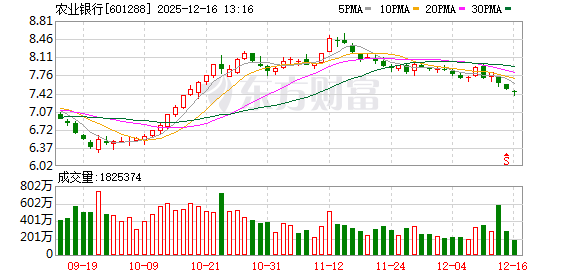
甘肃田野调研:从温室大棚到绿电基地,农业银行的“下沉”与“上升”
Mei Ri Jing Ji Xin Wen· 2025-12-15 12:06
Core Viewpoint - Agricultural Bank of China has become the world's largest commercial bank by market capitalization, reaching approximately 2.74 trillion RMB (about 386.9 billion USD) as of October 30, 2025, reflecting its strategic positioning in serving rural revitalization and the real economy [1]. Financial Performance - For the first three quarters of 2025, Agricultural Bank reported operating income of 550.8 billion RMB and net profit of 222.3 billion RMB, representing year-on-year growth of 1.97% and 3.28% respectively [1]. - The total asset scale of the bank exceeded 48 trillion RMB by the end of the reporting period [1]. County-Level Business Growth - As of September 2025, the bank's county-level loan balance reached 10.9 trillion RMB, a growth of 10.57% from the beginning of the year, maintaining over 40% of the bank's total loan portfolio [2][21]. - The bank's non-performing loan ratio improved to 1.27%, a decrease of 3 basis points from the start of the year [2]. Rural Financing Initiatives - The "Fumin Loan" program has disbursed 273.29 billion RMB, benefiting 321,600 farmers across 14 cities in Gansu province [4]. - The "Huinong e-loan" program has provided 930.92 billion RMB in loans, serving 1,168,700 farmers [4]. Innovative Financial Products - The bank has introduced innovative products like "Electricity Bill e-loan," which uses actual electricity usage data as a basis for credit assessment, facilitating financing for small and micro enterprises [11]. - The "Live Asset Mortgage Loan" has evolved into the "Smart Animal Husbandry Loan," utilizing AI technology for livestock identification, enhancing efficiency in loan management [16]. Strategic Partnerships and Projects - Agricultural Bank has established a strategic partnership with China Green Development Group, supporting multiple renewable energy projects with a total approval amount of 25.84 billion RMB since 2021 [21]. - The bank's rapid loan approval process has been highlighted in projects like the 300MW compressed air energy storage project, where it completed a 9 billion RMB loan approval swiftly [17][20].
农业银行衢州分行:创新金融服务模式 绘就乡村振兴新图景
Zheng Quan Ri Bao Zhi Sheng· 2025-12-07 15:11
Core Viewpoint - The article emphasizes the importance of financial support in achieving agricultural modernization and rural revitalization in China, highlighting the innovative financial services provided by Agricultural Bank of China (ABC) in Quzhou to empower rural industries and improve livelihoods [1]. Group 1: Empowering Leading Enterprises - Agricultural leading enterprises are crucial for rural industrial revitalization, and ABC Quzhou has introduced innovative financial products like living asset collateral and facility collateral to address the financing challenges faced by agricultural enterprises [2]. - The case of Zhejiang Helu Dairy Farm illustrates how the use of smart ear tags for cattle has enabled the farm to secure a loan of 4 million yuan, enhancing its operational efficiency and expected sales growth [2]. - ABC Quzhou has provided credit support exceeding 1.37 billion yuan to over 80 leading agricultural enterprises this year, enhancing the overall competitiveness of related industries [2]. Group 2: Building Credit Villages - ABC Quzhou is addressing the financing difficulties faced by farmers by establishing a comprehensive service channel that includes credit villages, which has led to significant improvements in local economies [3]. - The transformation of Shangjiang Village, which became a pilot credit village, showcases the positive impact of financial support on local agricultural practices and economic growth, with collective income doubling [3][4]. - The bank's grid-based service model has facilitated the issuance of over 200 million yuan in loans, benefiting more than 370 households in rural areas [4]. Group 3: Strengthening Agricultural Associations - Agricultural associations play a vital role in connecting small farmers with larger markets, and ABC Quzhou has adopted a model that integrates associations with farmers to provide targeted financial services [6]. - The case of the ecological Huju planting base demonstrates how timely financial support from ABC Quzhou helped alleviate short-term funding pressures, enabling efficient harvest and production processes [6][7]. - The collaboration between associations and banks has reduced financial service barriers and costs, enhancing the resilience and competitiveness of small farmers in the market [7].
解锁“活体”金融密码 中国人民银行吴忠市分行力推特色养殖产业发展
Jin Rong Shi Bao· 2025-07-24 02:32
Core Insights - The central government has introduced a policy to promote livestock collateral financing loans, transforming livestock production into recognized collateral for financial institutions, creating new opportunities for local specialty breeding industries [1] - The dairy industry in Wuzhong City, Ningxia, has developed into one of the six key agricultural industries, with a total dairy cattle population of 308,000, accounting for 33% of the region's total, and a comprehensive industrial output exceeding 30 billion yuan, representing about 32% of the local GDP [1] - The People's Bank of China in Wuzhong has been actively exploring ways to broaden the range of rural collateral, facilitating financing for rural specialty industries [2] Group 1: Policy and Financial Mechanisms - A collaborative mechanism involving government departments, commercial banks, and breeding enterprises has been established to support the dairy industry, with several policy documents issued to encourage financial institutions to include livestock as collateral [2] - As of May, the balance of livestock collateral loans in Wuzhong has reached 700 million yuan, supporting 110 breeding entities, with 620 million yuan specifically for dairy cattle [1][2] - The use of agricultural support loans has exceeded 500 million yuan, accounting for 14.8% of the city's total re-loan balance, providing financial support for the dairy industry [2] Group 2: Innovative Financing Models - The People's Bank of China in Wuzhong is promoting a tiered and categorized livestock collateral financing model to meet the diverse funding needs of breeding entities [3] - Various innovative financing models have been introduced, such as "livestock collateral + guarantee," "livestock collateral + credit," and "livestock collateral + syndicate loans," to enhance risk management and meet large financing demands [3] - Several banks have launched specific livestock collateral loan products, effectively converting livestock into financial assets and reducing financing costs for breeding entities [3] Group 3: Risk Management and Supervision - The unique characteristics of livestock collateral, such as regulatory challenges and value volatility, have led to increased risks for financial institutions [4] - A dynamic regulatory system has been implemented to strengthen the supervision of livestock collateral, including unified registration and real-time monitoring mechanisms [4][5] - The introduction of digital identification for livestock and third-party supervision has been established to mitigate risks associated with collateral value depreciation or loss [5]