
海铁联运班列

Search documents
人享其行、通达四海,“十四五”临沂市交通运输领域成绩单发布
Qi Lu Wan Bao· 2025-12-24 13:56
Core Viewpoint - The Linyi City government has made significant advancements in its transportation infrastructure and logistics capabilities during the "14th Five-Year Plan" period, achieving high-quality development and recognition as a national comprehensive transportation hub city [1]. Group 1: Transportation Infrastructure Investment - During the "14th Five-Year" period, Linyi's transportation infrastructure investment is expected to reach 126.17 billion yuan, a year-on-year increase of 22.9%, setting a historical record [2]. - The completion of the Daylan High-speed Railway and the acceleration of the Weishui-Suzhou High-speed Railway construction have enhanced connectivity to major urban agglomerations [2]. - The total length of railways has reached 149.3 kilometers with 17 dedicated railway lines, while the total length of highways has reached 33,300 kilometers, an increase of 2,516 kilometers since the beginning of the "14th Five-Year" [2]. Group 2: Logistics Development - Linyi has transitioned from a single logistics channel to a multi-modal logistics network, achieving the title of "China's Logistics Capital" [3]. - The city has established 9 international road transport routes and operates 1,895 China-Europe freight trains over five years, connecting to 14 countries and 43 cities [3]. - The Linyi Airport has been approved as a national open aviation port, enhancing international air connectivity [3]. Group 3: Economic Support and Industrial Development - The "Jinan-Linyi" urban cluster has been recognized as a national comprehensive freight hub, with investments of 12.232 billion yuan during the implementation period [4]. - The total number of enterprises in the hub economy zone has reached 2,800, generating a GDP of 270 billion yuan, with postal delivery volumes increasing by 296.13% [4]. - Major express delivery companies have established regional distribution centers in Linyi, with delivery prices 50% lower than the national average [4]. Group 4: Transportation Services Enhancement - The city has implemented a free public transport policy during specific time periods, with public transport vehicles and routes reaching 3,097 and 286 respectively, serving 140 million passengers annually [5]. - The government has provided over 5 billion yuan in subsidies and fee reductions to support transportation enterprises [5]. - A transportation logistics dispute resolution center has been established, enhancing service quality and efficiency [5]. Group 5: Innovation and Green Development - Linyi has built three general airports and initiated low-altitude airspace applications, with 44 low-altitude economy-related enterprises [6][7]. - The city has implemented a national logistics data open interconnection pilot, gathering over 2 billion data points to support transportation services [7]. - The number of new energy and clean energy vehicles has increased by 77.7%, with a significant rise in charging infrastructure [7].
长三角铁路物流如何降本增效
Jing Ji Ri Bao· 2025-12-14 22:32
Core Viewpoint - The logistics system in the Yangtze River Delta is undergoing a transformation through railway logistics reform, which aims to optimize transportation modes and reduce logistics costs, thereby accelerating the construction of a unified national market [1]. Group 1: Logistics Cost Reduction - The railway logistics system has significant advantages in reducing overall logistics costs, with cost ratios of railway, water transport, and road transport being approximately 1:0.13:2.6, and energy consumption ratios being 1:0.7:5.2 [1]. - Transitioning medium to long-distance road freight to rail can yield substantial economic and social benefits [1]. Group 2: Infrastructure Development - The Shanghai South Xiang classification yard has optimized its classification plan, resulting in a 18.4% year-on-year increase in container throughput [2]. - The introduction of the sea-rail intermodal service has reduced transportation time by 40% compared to traditional road transport, with logistics costs decreasing by over 15% [2]. - The railway network in the Yangtze River Delta has expanded to over 15,000 kilometers, enhancing freight capacity and efficiency [3]. Group 3: Technological Advancements - The introduction of automated driving at the Suqi container handling station marks a significant advancement in logistics efficiency, with a focus on digital management [3]. - The use of intelligent container management systems has improved operational efficiency by over 30% without increasing the scale of the logistics base [5]. Group 4: Service Innovation - The Yangtze River Delta has developed a logistics product matrix that includes 97 sea-rail intermodal trains and 58 cross-regional trains, enhancing service offerings for key industries [6]. - The establishment of a "total package" logistics service has streamlined the supply chain, reducing costs and improving delivery times for companies [9]. Group 5: Market Adaptation - The railway logistics sector is shifting from a passive to an active marketing approach, with teams engaging directly with businesses to tailor logistics solutions [10]. - The introduction of financial products like "railway freight loans" has provided companies with low-cost financing options to support their operations [11]. Group 6: Efficiency Improvements - The implementation of centralized management for train operations has significantly increased productivity and reduced delays in freight handling [12]. - The integration of logistics services with local manufacturing has created a more efficient supply chain, benefiting regional economic development [13].
畅通“大动脉”为经济发展“添”动能 强劲钢铁“脉动”彰显经济蓬勃活力
Yang Shi Wang· 2025-12-05 12:52
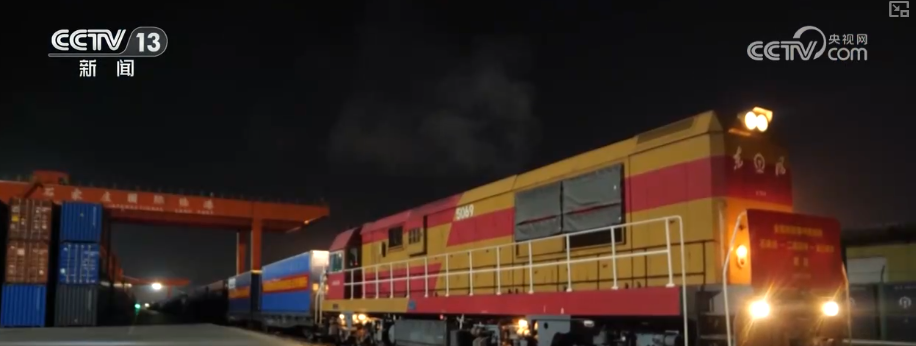
Group 1: China-Europe Railway Express - The first scheduled China-Europe Railway Express train from Shijiazhuang International Land Port departed on December 5, carrying machinery, cashmere, and furniture [1] - This train operates weekly, departing every Friday and reaching Warsaw, Poland in a stable transit time of 14 days and 3 hours [3] - The scheduled service aims to enhance transportation efficiency and stability, helping companies reduce logistics costs through a fixed operation model [5] - Since 2025, Shijiazhuang has launched over 1,100 trains, sending more than 115,000 standard containers, and weighing over 1.4 million tons, establishing itself as a key hub in the Beijing-Tianjin-Hebei region [7] - The Shijiazhuang International Land Port has improved efficiency by over 30% compared to regular trains, enhancing its attractiveness and competitiveness as a new inland open highland [9] Group 2: Shanghai Sea-Rail Intermodal Transport - On December 5, Shanghai's sea-rail intermodal transport business volume surpassed 1 million standard containers for the first time, marking a nearly 20% year-on-year increase [10] - A train carrying solar photovoltaic components and auto parts departed from Shanghai, reflecting the operational efficiency improvements in port and station connections [12] - The annual loading capacity at the Shanghai Railway Container Center has increased from 500,000 to 1.2 million standard containers, with a single container handling time reduced to just 3 minutes [13] - Shanghai's sea-rail intermodal network has expanded to cover 10 provinces and over 40 cities, with a 40% year-on-year increase in daily train operations [13] - Future plans include increasing the frequency of trains to the Yangtze River Delta and central-western regions, as well as launching customized trains to help companies lower logistics costs [15] Group 3: Nanning-Pingxiang High-Speed Railway - The Nanning-Pingxiang high-speed railway officially opened on December 5, providing a rapid passenger transport corridor to the China-Vietnam border [17] - The initial operation includes 4 pairs of trains daily, with a travel time of 1 hour and 33 minutes, significantly faster than conventional trains [17] - This railway not only serves as a quick transport line but also connects various tourist attractions, enhancing cross-border tourism opportunities [21] - The completion of the Nanning-Pingxiang high-speed railway improves the railway network structure in Guangxi and supports high-quality development in border ethnic areas [24]

1—7月乌兰察布中欧班列开行量达85列
Nei Meng Gu Ri Bao· 2025-08-21 01:06
Core Insights - The Ulaanqab city has seen a significant increase in the operation of China-Europe freight trains, with a total of 85 trains launched by the end of July, marking a 46% year-on-year growth [1][2] Group 1: Freight Train Operations - The outbound trains accounted for 57, while the return trains totaled 28 [1] - Ulaanqab city has actively expanded the "Ulaanqab+" model, launching 24 agricultural product trains to Russia, achieving a local trade volume of $4.4382 million [1] - Collaboration with the China-Shanghai Local Economic and Trade Cooperation Demonstration Zone (Qingdao) has led to 16 trains being launched, transporting goods worth $2.73937 million [1] Group 2: Integration with Local Industries - Ulaanqab city is focusing on integrating the China-Europe freight trains with local industries, promoting "integrated transport and trade" return trains to provide comprehensive services for local production and processing enterprises [1] - The city has imported 11,000 tons of raw materials such as flaxseed and oats from Russia, achieving a trade volume of 35 million yuan [1] Group 3: Diversification of Freight Products - Ulaanqab city is actively promoting the diversification of freight products, including the development of sea-rail intermodal products, with 9 intermodal trains launched on the Chelyabinsk-Vladivostok-Tianjin route, valued at $2.1975 million [2] - A partnership with Xiamen Jianfa Paper Industry has led to the establishment of a Russian pulp distribution center, with 13 trains importing Russian pulp [2] - The opening of the China-Mongolia freight train has successfully dispatched 1 train with 19 boxes of daily necessities to Ulaanbaatar, Mongolia, further expanding cross-border transport networks [2] Group 4: Efficiency Improvements - Ulaanqab city has utilized the "Railway Fast Pass" model to export 18 trains of agricultural products, reducing customs clearance time to 24 hours [2] - The introduction of the BX70B container flatcar with a "one car, double box" loading mode has increased capacity by 100%, enhancing operational flexibility [2] - Since the launch of the China-Europe freight trains, Ulaanqab city has cumulatively operated 920 trains, with a total weight of 58.6 million tons and a total value of $1.688 billion [2]