枢纽经济

Search documents
中国春运有个“含广量”,广州发展有个“含番量”
3 6 Ke· 2026-02-26 02:33
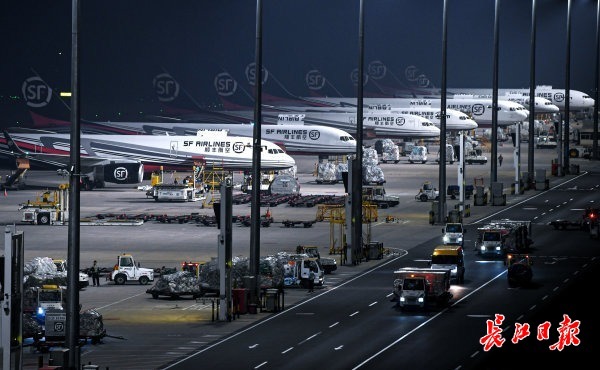
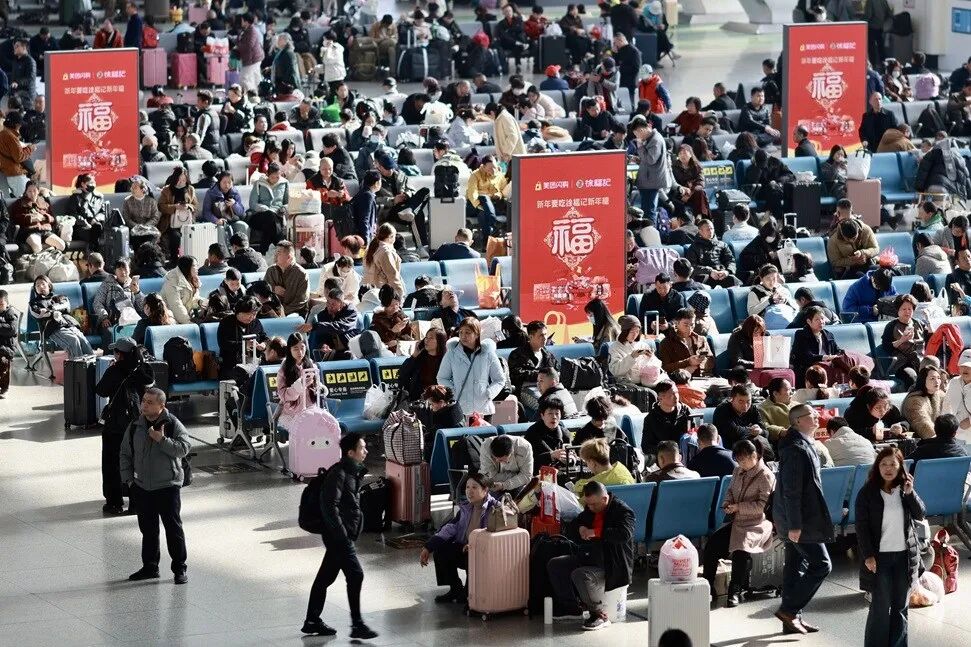
Core Viewpoint - The article emphasizes the strategic development of Panyu District in Guangzhou, highlighting its transformation from a transportation hub to a comprehensive center for talent, commerce, industry, innovation, and lifestyle, driven by the significant passenger flow at Guangzhou South Station and the presence of educational institutions and high-tech industries [1][4][15]. Group 1: Transportation Hub - Guangzhou South Station is projected to handle 175 million passengers in 2025, with an average of 480,000 daily departures, significantly outpacing Shanghai Hongqiao Station by 124,000 passengers [1]. - During the Spring Festival, Guangzhou South Station is expected to see over 20 million passengers, with daily departures exceeding 530,000 and train frequencies comparable to metro services [1][2]. Group 2: Talent Hub - Panyu is evolving into a talent hub, supported by Guangzhou University Town, which houses 12 universities and nearly 200,000 students, contributing to a strong talent base in the Greater Bay Area [5]. - By 2025, Panyu aims to implement the "Million Talents Gather in South Guangdong" initiative, increasing high-level talent to nearly 12,000 and supporting around 1,500 innovation and entrepreneurship teams [5]. Group 3: Cultural and Tourism Development - Panyu's tourism industry is thriving, with 4.553 million visitors and a total tourism revenue of 2 billion yuan during the Spring Festival, marking year-on-year increases of 5.9% and 19.2% respectively [8]. - Key attractions such as Chimelong Resort and other cultural sites are driving tourism growth, contributing to the region's economic vitality [8]. Group 4: High-Tech Industry Growth - By 2025, Panyu's high-tech industrial output is expected to reach 8.961 billion yuan, with a year-on-year growth rate of 17.6%, ranking first in the city [9]. - The automotive sector is performing well, with GAC Group reporting a January sales increase of 18.47%, including a remarkable 87.58% rise in sales of its self-owned brands [9]. Group 5: Innovation and New Economy - Panyu is transitioning to an innovation hub, with R&D intensity rising from 2.85% to 3.56% of GDP over five years, ranking third in the city [11]. - The district has nurtured 50 national-level specialized and innovative enterprises and 1,830 high-tech companies, with four unicorns valued at a total of 465.5 billion yuan [11][12]. Group 6: Commercial Development - Panyu is becoming a commercial hub, with the Chimelong Wanbo Business District attracting over 40 million daily visitors and achieving a total annual foot traffic of 100 million [14]. - The area has seen a surge in new retail stores, ranking 11th nationally for the growth of first-store economies, appealing to younger and diverse consumer demographics [14]. Group 7: Future Outlook - Panyu is positioned as a key flow entry point for the Greater Bay Area, integrating human, logistical, and informational flows, while also enhancing its value beyond mere transportation [15]. - The district's development strategy focuses on leveraging passenger flow, talent, industry, and commerce to create a sustainable and vibrant economic ecosystem [15].


济南“东强”加速兑现:东部六区GDP占全市近2/3
Feng Huang Wang Cai Jing· 2026-02-12 00:03
Core Insights - The GDP performance of Jinan's eastern districts has shown significant growth, with a total GDP of 919.39 billion yuan, accounting for 64.7% of the city's total GDP [1] - The main urban districts (Lixia, High-tech, Licheng, and Zhangqiu) collectively achieved a GDP of 777.72 billion yuan, with growth rates surpassing the city average of 5.4% [1] Group 1: Economic Performance - The eastern region's GDP growth is driven by the "East Strong" strategy, with the main urban districts showing robust performance: High-tech at 7.61%, Zhangqiu at 5.9%, Lixia at 5.6%, and Licheng at 5.1% [1] - The growth rate of the starting districts is 10.4%, but the larger economic base of the main urban districts makes their growth more challenging [1] Group 2: Factors Contributing to Growth - The Qilu Innovation Corridor has created a significant axis effect, linking major research platforms and facilitating the transition from research to industrialization [2] - The advantages of national-level development zones, such as the Jinan High-tech Zone and Zhangqiu Ming Shui Economic and Technological Development Zone, have fostered a collaborative environment for high-end industries [2] - The integration of transportation hubs, including the expansion of Yaoqian International Airport and the development of logistics projects, enhances the eastern region's economic capabilities [2] Group 3: Manufacturing and Industrial Base - The manufacturing sector is a strong foundation for economic growth, with significant increases in industrial output: High-tech at 15.6% and Zhangqiu at 9.5% [3] - The solid manufacturing base in Zhangqiu, characterized by a complete industrial chain and active private economy, supports the region's economic resilience [3] Group 4: Future Growth Potential - The eastern region has vast growth potential, with ongoing projects in high-tech zones and specialized industrial parks [5] - Infrastructure developments, such as the second phase of Yaoqian Airport and the opening of Metro Line 8, will enhance connectivity and integration with the main city [5] - The influx of talent from local universities will strengthen the innovation capabilities of the Qilu Innovation Corridor [6]
“超级枢纽”旁,“产业高地”起
Xin Hua Ri Bao· 2026-02-09 06:44
Core Viewpoint - The construction of the Lian Dong U Valley Smart Industry Park near Nanjing North Station is progressing rapidly, with nearly full occupancy achieved in its leasing efforts, indicating strong demand for innovation-driven enterprises in the region [1][4]. Group 1: Project Development - The Lian Dong U Valley project commenced construction in December last year and is strategically located in a prime area, allowing quick access for entrepreneurs and scientists [1]. - The Nanjing North Station has transitioned to above-ground construction, marking significant progress in the development of a "super hub" [2]. - The project has been recognized for its exceptional efficiency, with the ability to obtain five permits and start construction the next day, showcasing the effective collaboration among local government departments [2][3]. Group 2: Investment and Occupancy - The project has nearly completed its leasing process, with several high-growth technology companies already committed to moving in, including leaders in medical imaging and big data [4]. - The focus on attracting top scientists, technology companies, and investors has led to a surge in interest and occupancy in the park [4]. Group 3: Future Vision and Innovation - The "Industry Technology Innovation Hub Port" is planned to focus on key industries such as new materials, new energy, high-end equipment, and artificial intelligence, with future-oriented sectors like quantum technology and brain-machine interfaces also in the pipeline [5][6]. - The Nanjing North Station is set to enhance the city's connectivity and innovation capacity, with a comprehensive urban design plan that integrates transportation, industry, and ecological elements [7][8]. - The ongoing efforts have resulted in 90 signed investment agreements, with over 200 projects in discussion, indicating a robust pipeline for future development [8].
2025年GDP30强城市洗牌,成都远超杭州,郑州突破1.5万亿,泉州逆袭佛山,徐州入围!
Sou Hu Cai Jing· 2026-02-05 17:11
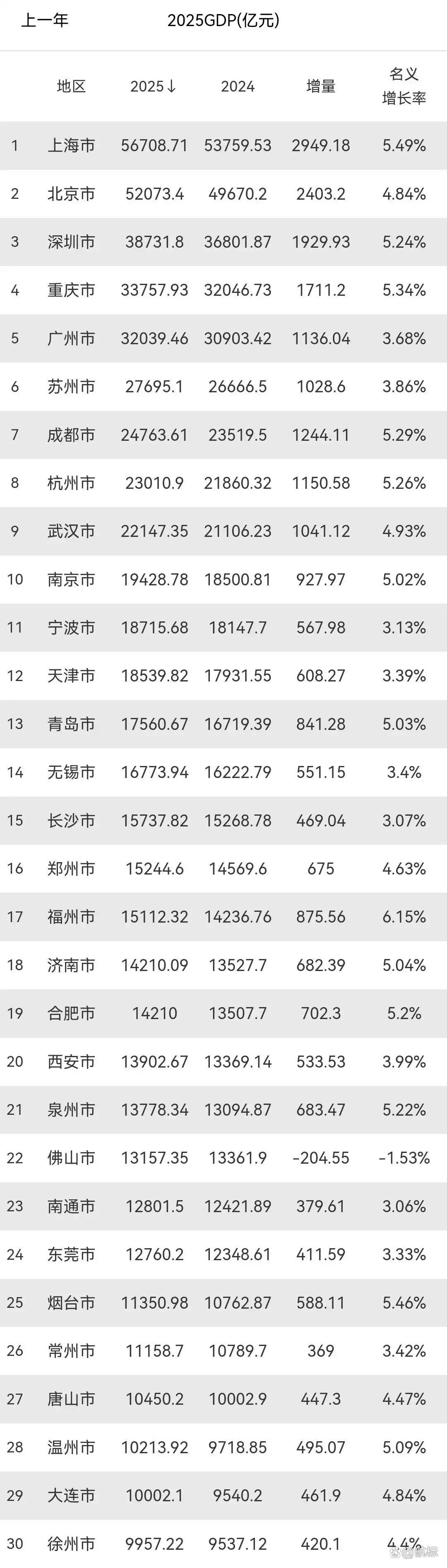
Core Insights - The annual city GDP rankings reflect a competitive landscape, showcasing both expected leaders and surprising "dark horses" in 2025, illustrating the distribution of economic vitality across different cities in China [1] Group 1: GDP Rankings and Growth Rates - Shanghai leads with a GDP of 56,708.71 billion yuan, showing a growth rate of 5.49% from the previous year [2] - Beijing follows with a GDP of 52,073.4 billion yuan and a growth rate of 4.84% [2] - Shenzhen ranks third with a GDP of 38,731.8 billion yuan, growing by 5.24% [2] - Chongqing and Guangzhou round out the top five, with GDPs of 33,757.93 billion yuan (5.34% growth) and 32,039.46 billion yuan (3.68% growth) respectively [2][3] Group 2: Economic Drivers and Trends - Shanghai's economic leadership is attributed to its strong focus on technology innovation, particularly in integrated circuits, biomedicine, and artificial intelligence, which together exceed 20 trillion yuan and account for nearly half of the city's industrial output [5] - Chengdu's GDP surpasses 24.7 trillion yuan, driven by a dual focus on consumption and industry, with retail sales exceeding 1.14 trillion yuan, contributing over half to its economic growth [7][8] - The transformation of traditional cities like Xuzhou into modern economic hubs, exemplified by its solar energy production, highlights successful industrial transitions [5] Group 3: Competitive Dynamics - The competition between Chengdu and Hangzhou illustrates different growth strategies, with Chengdu focusing on comprehensive development and Hangzhou emphasizing service industries, which constitute 73.8% of its GDP [7][8] - Zhengzhou's GDP surpassing 1.5 trillion yuan showcases its strategic advantage as a national central city, leveraging its transportation network to boost manufacturing and electronic information sectors [8] - The notable shift in rankings between Quanzhou and Foshan, with Quanzhou's diverse industrial base leading to a GDP of 13,778.34 billion yuan, emphasizes the importance of economic resilience and adaptability [8]
在“强富美高”新江苏现代化建设中更好展示“象征意义”
Xin Hua Ri Bao· 2026-02-04 21:36
Core Viewpoint - The article emphasizes the commitment to achieving significant progress in modernization and the construction of a northern center city in the Yangtze River Delta, guided by the principles of "leading, demonstrating, shouldering responsibilities, and contributing" during the provincial two sessions [1] Group 1: Economic Development Strategies - The focus is on advancing a dual-driven approach to enhance quality and efficiency, particularly through project attraction and technological innovation, targeting the "353" strategic emerging industry integration cluster [1] - The aim is to develop a hub economy that supports regional development, with a strategic layout for new industrial belts and precise recruitment of hub-preferred and related industries [1] Group 2: Key Initiatives for Progress - Continuous emphasis on four major tasks to drive overall breakthroughs, including revitalizing idle land, reforming development zones, and promoting ecological agriculture [2] - The integration of reforms in state-owned enterprises and the business environment is highlighted as essential for overall progress in modernization [2] Group 3: Focus on Livelihood and Well-being - The article stresses the importance of prioritizing people's livelihoods, enhancing high-quality employment through industrial cultivation and project initiatives, and addressing housing, healthcare, and elderly and child care needs [2] - The goal is to create a safer and more law-abiding environment while improving overall happiness and security in Huai'an [2]
交汇枢纽 通达四方
Sou Hu Cai Jing· 2026-02-02 23:14
Core Insights - The article highlights the significant growth and achievements of the Huai'an Transportation Investment Development Group during the 14th Five-Year Plan period, emphasizing its focus on high-quality development and integration of party leadership with corporate governance [3][4][11] Group 1: Financial Performance and Growth - The asset scale of the Huai'an Transportation Investment Development Group increased from approximately 51 billion to over 60 billion, reflecting an 18% growth rate, with an average annual revenue growth rate exceeding 10% [3] - The group has invested 5.592 billion in 75 projects during the 14th Five-Year Plan, leading to substantial increases in key economic indicators [8] - The public transportation group achieved over 88 million in revenue last year, with a year-on-year increase of approximately 11.23% in market-oriented income [10] Group 2: Operational Achievements - Huai'an Port has been recognized as a major inland port, with container throughput capacity projected to reach 1 million TEUs and cargo volume of 50 million tons upon completion of ongoing projects [6][7] - The public transportation group operates 1,089 buses and 26 trams, with an annual passenger volume exceeding 93 million, marking a nearly 10% year-on-year increase [7] - The data group has successfully launched over 20 data products, including the Huai'an Bus Data Set, marking a significant step in transforming public data into assets [9] Group 3: Strategic Initiatives and Reforms - The group has implemented various reform initiatives, including the "1030" and "1+7+N" actions, aimed at enhancing operational efficiency and governance structures [11] - A comprehensive risk management framework has been established, focusing on debt, operations, safety, and integrity, with over 95% of identified issues rectified [12] - The group has achieved a significant reduction in financing costs, with new financing rates dropping from 4.38% in 2022 to 3.41% currently [12]
成都市青白江区:聚力发展枢纽经济 加快打造世界级陆港枢纽
Xin Lang Cai Jing· 2026-02-02 23:09
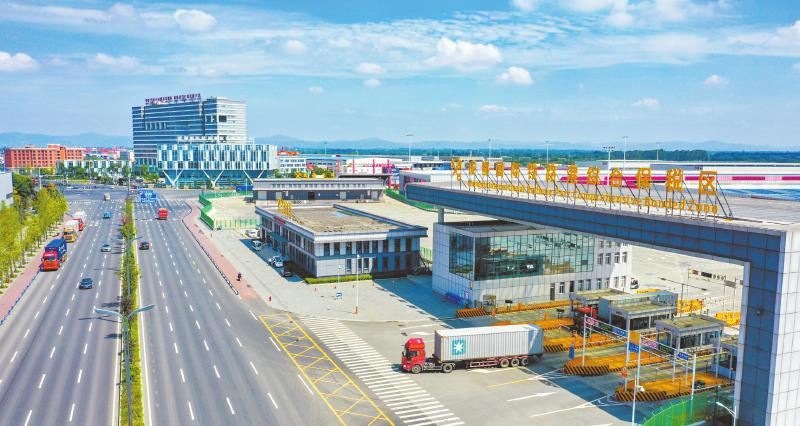
Core Viewpoint - The China-Europe Railway Express (Chengdu-Chongqing) is set to exceed 5,000 trips by 2025, marking it as a significant achievement in the high-quality development of the Belt and Road Initiative and a key vehicle for deepening collaboration between Chengdu and Chongqing [2] Group 1: Development of the Chengdu-Chongqing Railway - The Chengdu-Chongqing Railway Express has maintained the highest number of trips in the country for five consecutive years, becoming a benchmark for high-quality Belt and Road construction [2] - The Qingbaijiang District aims to enhance its development capabilities by focusing on becoming a world-class land port hub and modern emerging urban area, promoting international trade and integrated reforms [2] Group 2: Transportation and Logistics - Qingbaijiang has transformed from an inland port to an international hub, with the cumulative number of international trains exceeding 36,000, connecting 163 cities domestically and internationally [3] - The district has established new transportation routes, including the Chengdu-Qinzhou-Ocean Port rail-sea intermodal service, enhancing trade capabilities [3][6] - The district's logistics competitiveness is highlighted by the rapid delivery times for goods, such as 11 days to Poland and 3 days to Laos [6] Group 3: Trade and Economic Performance - By 2025, Qingbaijiang is expected to add 85 new foreign trade enterprises, achieving an import-export total of 53.17 billion yuan, a 5.2% increase year-on-year [6] - The district's cold chain logistics center has become a key project, facilitating the rapid import and export of high-quality agricultural products [6][7] - The comprehensive bonded zone has achieved a "double A" performance rating, ranking 18th nationally and 2nd in the western and northeastern regions, supporting foreign trade development [7] Group 4: Integration of Trade and Industry - Qingbaijiang is exploring the "transport-trade-industry" integration model, aiming to create a one-stop international supply chain service platform [8] - The district's state-owned enterprises are expanding their roles in trade, with a significant increase in import-export trade volume, reaching 6.162 billion yuan by 2025 [9] - The focus on integrating logistics, trade, and industry is expected to enhance the overall economic development of the region [9]
从“过境”到“落地” 政协提案解锁哈尔滨枢纽经济发展密码
Zhong Guo Xin Wen Wang· 2026-02-01 06:09
Core Viewpoint - The proposals submitted at the Heilongjiang Provincial Political Consultative Conference emphasize the transformation of Heilongjiang's economy through the development of a logistics hub, aiming to shift from a channel economy to a hub economy, thereby enhancing economic growth and addressing existing economic shortcomings [1][2]. Group 1: Logistics Hub Development - Heilongjiang is set to become the core support for hub economy construction, with approval for the establishment of the only air-port type national logistics hub in Northeast China by 2025, complemented by existing land-port logistics hubs to create a comprehensive "air-rail-road" logistics network [1] - The hub economy is seen as a key to converting "transit flow" into "economic increment," addressing the shortcomings of the channel economy [1] Group 2: Unique Advantages and Challenges - Heilongjiang possesses unique advantages, including its strategic location in the China-Mongolia-Russia Economic Corridor, 27 first-class national ports, a well-developed multimodal transport system, and over 100 million acres of green organic food production bases [1] - However, challenges such as poor connectivity of hub facilities, weak industrial transformation capabilities, and a shortage of professional talent need urgent attention [1] Group 3: Specific Recommendations - The proposals suggest deepening the integration of logistics and industry, creating specialized business formats such as "air + culture + cold chain," and optimizing routes like "Harbin-Moscow" [1] - Five major recommendations include building a modern comprehensive hub system, fostering hub-oriented industrial clusters, promoting a "single document" customs clearance system, establishing a cross-border industrial development fund, and enhancing Sino-Russian cooperation through "two countries, dual parks" [1]
宁夏从“通道经济”迈向“枢纽经济” 算力基础设施实现“量质齐升”
Zheng Quan Ri Bao Wang· 2026-01-31 04:28
Core Insights - The "2026 Ningxia Blue Book" series reveals significant economic growth and development strategies for Ningxia during the 14th Five-Year Plan period, with an average annual growth rate of 5.7% and a notable improvement in development quality [1][2]. Economic Development - The "Economic Blue Book" indicates that Ningxia's GDP reached 569.649 billion yuan in 2025, with a year-on-year growth of 5.3%. The primary industry added value was 46.986 billion yuan, the secondary industry 236.038 billion yuan, and the tertiary industry 286.625 billion yuan [2]. - Since 2025, Ningxia's transportation system has completed fixed asset investments of 4.71 billion yuan, exceeding the annual target by 1.79 billion yuan, with a total highway mileage of 2,409 kilometers [2]. Transportation Infrastructure - Comprehensive transportation infrastructure is highlighted as a strategic support for Ningxia's integration into the new development pattern. The region is developing a transportation system that connects key functional areas, facilitating efficient interaction among industries such as coal chemical, electronics, and cold chain logistics [3]. Computing Power Industry - Ningxia is positioned as a favorable location for large data centers due to its cool and dry climate. It is the only province in China recognized as both a national new-type internet exchange center and a national integrated computing power network hub [4]. - The computing power infrastructure in Ningxia has seen significant advancements, with the establishment of a dual-city drive between Yinchuan and Zhongwei, enhancing the region's capabilities in artificial intelligence and data center clusters [5]. Policy Support for Computing Power - A high-quality development implementation plan for computing power infrastructure was jointly issued by ten departments in 2025, aiming for a computing power scale of 600,000 PFLOPS by 2026, with 70% of that being intelligent computing power [6]. - The plan also targets a total storage capacity exceeding 30 EB, with advanced storage capacity accounting for over 40%, promoting applications across eight key sectors including industry, finance, and healthcare [6].
产业内外联动,人才近悦远来——省两会代表委员热议“开放高地”
Chang Jiang Ri Bao· 2026-01-31 03:00
Core Viewpoint - Wuhan is positioning itself as a key hub for international trade and logistics, leveraging its unique geographical advantages to enhance its role in both domestic and international supply chains [1][2]. Group 1: Development of Logistics and Trade Hub - The provincial government aims to expand high-level openness and restructure logistics systems to enhance Wuhan's status as an inland open highland [2]. - The logistics efficiency for automobile exports has significantly improved, with customs clearance times reduced from several days to one week, highlighting Wuhan's growing role as a global automobile export base [2][3]. - By 2025, the number of inbound and outbound trains monitored by Hankou Customs is expected to reach 902, with 96,582 standard containers, marking a new high for the China-Europe Railway Express from Wuhan [3]. Group 2: Integration with Regional Development - Wuhan is seen as a leading force in promoting collaborative openness within the Yangtze River Middle Reaches urban agglomeration, enhancing its strategic position in national development [4]. - The city is tasked with strengthening its hub functions to facilitate domestic circulation and deeply integrate into the Belt and Road Initiative, aiming to create a new inland open highland [4][5]. - The development of a comprehensive transportation system, including rail and waterway connections, is crucial for linking the Yangtze River Middle Reaches urban agglomeration and supporting economic growth [5]. Group 3: Enhancing International Engagement - Wuhan is transitioning to a new phase of international engagement, focusing on deepening cooperation and enhancing its global image through cultural and design initiatives [7][8]. - The city aims to establish permanent international forums to address global issues, thereby enhancing its diplomatic presence and international partnerships [8]. - Attracting high-level global talent is essential for Wuhan's development as an open highland, with plans to collaborate with Hong Kong on talent acquisition and improve the international business environment [8].