
液氧液氢

Search documents
商业火箭高频发射下的最刚性需求:推进剂与特种气体
Hua Er Jie Jian Wen· 2026-01-22 08:37
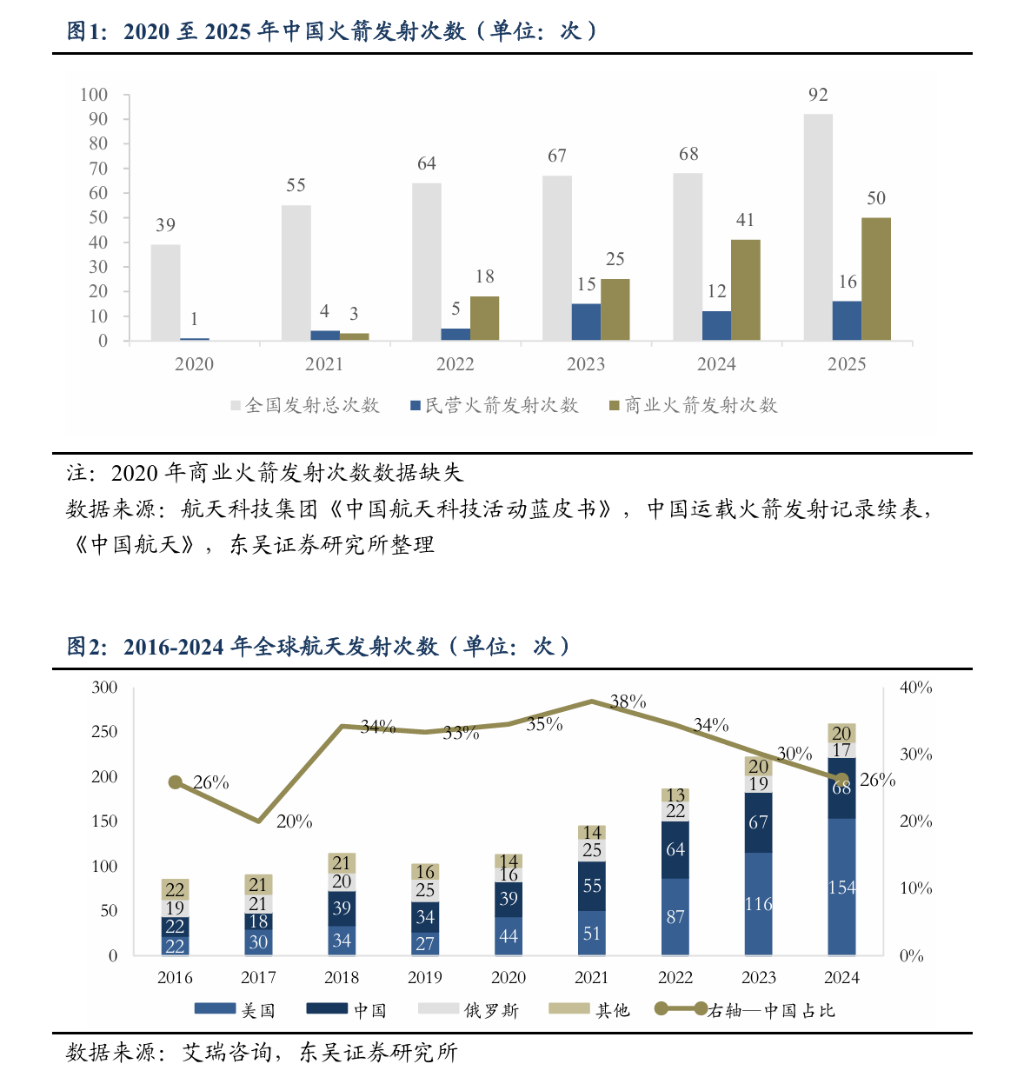
Core Insights - The commercial space industry in China is entering a phase of scaled launches, with a clear path to cost reduction through high payload capacity and reusable technology [1][3] - The demand for propellants and specialty gases is closely tied to launch frequency, making it a stable and predictable value segment in the commercial space sector [2][11] Group 1: Launch Frequency and Infrastructure - China's rocket launch frequency is projected to grow rapidly, reaching 92 launches by 2025, with 50 of those being commercial launches, a significant increase from 39 total launches in 2020 [1][3] - The launch infrastructure is being enhanced, with a total of 21 existing launch sites and 5 more under construction or planned, creating a comprehensive system for inland, coastal, and maritime launches [1][3] Group 2: Cost Structure and Reusability - Reusable technology is significantly altering the cost distribution in rocket launches, with the cost of a Falcon 9 launch's propellant and specialty gas demand estimated at approximately $800,000 [1][11] - The cost of the rocket itself has decreased from $50 million to $15 million due to reusability, while the proportion of launch costs attributed to propellant and specialty gases has increased from 1.6% to 5.3% [1][11] Group 3: Propellant and Specialty Gas Demand - The demand for propellants and specialty gases is expected to grow steadily with increased launch frequency, as they are essential consumables with high safety and reliability requirements [11][12] - The market for propellants and specialty gases is characterized by strong customer loyalty and a converging technology path, providing higher long-term visibility and value stability compared to rocket manufacturing [2][11] Group 4: Fuel Technology Comparison - Liquid oxygen-methane is emerging as a preferred fuel in reusable rocket scenarios due to its low carbon residue and stable combustion properties, which enhance engine performance over multiple flights [13][15] - The comparison of fuel types shows that while liquid oxygen-methane offers advantages in maintenance and operational efficiency, liquid oxygen-kerosene remains prevalent due to its established technology and existing infrastructure [13][15]

公用事业行业深度报告:火箭发射深度1:可回收路径中稀缺耗材:推进剂特气份额&价值量提升
Soochow Securities· 2026-01-22 03:24
Investment Rating - The report maintains a "Buy" rating for Jiufeng Energy, highlighting its potential in the commercial aerospace sector [1]. Core Insights - The commercial aerospace industry is transitioning into a phase of scaled launches, with supply capabilities continuously being released. This shift is characterized by an increase in launch frequency and demand for launch services [9]. - The cost structure of launches is evolving, with a clear path towards cost reduction through high payload capacity and reusability of rockets. The unit launch cost in China is expected to decrease significantly from approximately 115,000 RMB per kilogram in 2020 to around 45,000 RMB per kilogram by 2029 [28]. - The demand for propellants and special gases is becoming increasingly rigid, with their value and share in the overall cost structure expected to rise over time. Liquid oxygen and methane are emerging as preferred propellant choices due to their advantages in reusability and operational efficiency [37][39]. Summary by Sections 1. Industry Trends - The commercial aerospace sector is moving from a capability-building phase to a scaled launch phase, driven by the acceleration of low Earth orbit satellite constellation construction [9]. - China's launch infrastructure has developed a comprehensive system, including multiple inland and coastal launch sites, enhancing overall launch capacity [10]. 2. Cost Structure and Reduction Pathways - The cost structure of launches is being dissected, revealing that consumable elements like propellants are becoming more significant as launch frequencies increase. The rigid nature of these costs is highlighted as a core constraint in the industry [17][19]. - The unit cost of launching satellites is a critical economic indicator, with current costs in China being higher than those of international competitors like SpaceX. The report indicates that the unit launch cost for the Falcon 9 has decreased to approximately 20,000 RMB per kilogram [23][25]. 3. Propellant and Special Gas Demand - The report emphasizes the increasing importance of propellant selection in the context of reusability and operational stability. Liquid oxygen and methane are positioned as the leading choices for future rocket designs due to their cleaner combustion and lower maintenance requirements [39][41]. - Jiufeng Energy is recommended for its strategic positioning in the supply of special gases and propellants, which are expected to see long-term growth in value and market share [1][37].

公用事业行业深度报告:火箭发射深度1:可回收路径中稀缺耗材:推进剂特气份额、价值量提升
Soochow Securities· 2026-01-22 03:15
Investment Rating - The report maintains a "Buy" rating for Jiufeng Energy, highlighting its potential in the commercial aerospace sector [1]. Core Insights - The commercial aerospace industry is transitioning into a phase of scaled launches, with supply capabilities being continuously released. This shift is characterized by an increase in launch frequency and demand for launch services [9]. - The cost structure of launch services is evolving, with a clear path towards cost reduction through high payload capacity and reusable technology. The unit cost of launching is expected to decrease significantly by 2029 [29]. - The demand for propellants and special gases is becoming increasingly rigid, with their value and share in the overall cost structure expected to rise over time [38]. Summary by Sections 1. Industry Trends - The commercial aerospace sector is moving from a capability-building phase to a scaled launch phase, driven by the acceleration of low Earth orbit satellite constellation construction [9]. - China's launch infrastructure has developed a comprehensive system, including multiple launch sites that enhance operational efficiency and specialization [10][11]. 2. Cost Constraints and Reduction Pathways - The cost structure of launch services is divided into fixed, semi-fixed, and variable costs, with propellants and special gases representing the most rigid costs [19][22]. - The unit cost of launching is currently high, but it is projected to decrease from approximately 115,000 RMB per kilogram in 2020 to around 45,000 RMB per kilogram by 2029 [29][24]. - High payload capacity and reusable technology are recognized as key methods for reducing costs in the industry [29]. 3. Propellant and Special Gas Demand - The choice of rocket fuel is evolving, with liquid oxygen and methane emerging as a prominent option due to their cleaner combustion and lower carbon buildup, which is advantageous for high-frequency reuse [39][40]. - The report outlines the comparative advantages of different rocket fuel technologies, emphasizing the long-term coexistence of liquid oxygen and kerosene alongside liquid oxygen and methane [41][42]. 4. Investment Recommendations - Jiufeng Energy is recommended for its strategic positioning in the supply of special fuels and gases for commercial aerospace, with expected net profits of 1.56 billion, 1.8 billion, and 2.13 billion RMB from 2025 to 2027 [1].