液氧甲烷

Search documents
中小盘行业点评:液氧甲烷-定义商业航天的“未来燃料”
GOLDEN SUN SECURITIES· 2026-03-29 08:24
Investment Rating - The report maintains an "Accumulate" rating for the industry [5] Core Insights - Liquid oxygen methane is emerging as the "future fuel" for commercial space travel due to its cost-effectiveness, environmental benefits, and reusability, positioning it as a key driver for the next generation of reusable rockets [2][4] - The successful launch of the world's first liquid oxygen methane rocket in 2023 marks a significant milestone, indicating the technology's transition from concept to practical application [2] - The commercial space industry's primary goal is to drastically reduce the cost per kilogram of payload, with liquid oxygen methane being a crucial pathway to achieve this [4] Summary by Sections Technical Necessity - Liquid oxygen methane offers a superior balance of performance and cost compared to traditional propellants, addressing issues like carbon buildup associated with kerosene and the high costs of liquid hydrogen [2][3] - It provides an optimal solution with excellent cooling properties, a wide range of thrust adjustment capabilities, and outstanding multiple start characteristics, making it ideal for reusable rocket engines [3] Commercial Logic - The widespread availability and low cost of methane (a primary component of natural gas) facilitate quick turnaround times for rocket engines, significantly reducing refurbishment time and labor costs [4] - The potential for in-situ production of liquid oxygen methane on extraterrestrial bodies like Mars and the Moon supports future deep space exploration and base construction [4] Technical Challenges - The performance limits and development complexity of liquid oxygen methane engines are determined by the "power cycle" method used, with a clear global competitive landscape emerging [6] - Different cycles, such as gas generator cycles and full-flow staged combustion cycles, present varying levels of complexity and performance, with SpaceX's Raptor engine representing the highest performance level achieved [6] Industry Chain Opportunities - The report identifies key segments within the industry chain that are poised for growth, including: 1. Leading manufacturers and engine developers that have successfully validated liquid oxygen methane technology [7] 2. Special metal materials that meet the extreme requirements of high-temperature environments [7] 3. Additive manufacturing (3D printing) technologies that enable the production of complex engine components [7] 4. Fuel preparation and launch suppliers that ensure a stable and low-cost supply of liquid oxygen methane [7]
液氧甲烷:定义商业航天的“未来燃料”
GOLDEN SUN SECURITIES· 2026-03-29 08:05
Investment Rating - The report maintains an "Increase" rating for the industry [5] Core Insights - Liquid oxygen methane is emerging as the "future fuel" for commercial space travel due to its cost-effectiveness, environmental benefits, and reusability, positioning it as a key driver for the next generation of reusable rockets [2][4] - The successful launch of the world's first liquid oxygen methane rocket in 2023 marks a significant milestone, indicating the technology's transition from concept to practical application [2] - The commercial space industry's primary goal is to drastically reduce the cost per kilogram of payload, with liquid oxygen methane being a crucial pathway to achieve this [4] Summary by Sections Technical Necessity - Liquid oxygen methane offers a superior balance of performance and cost compared to traditional propellants, addressing issues like carbon buildup associated with kerosene and the high costs of liquid hydrogen [3][4] - It provides optimal performance characteristics, including excellent cooling properties and thrust modulation capabilities, making it ideal for reusable rocket engines [3] Commercial Logic - The widespread availability and low cost of methane contribute to reduced refurbishment times and labor costs, facilitating high-frequency reuse and lowering launch costs [4] - The potential for in-situ resource utilization of methane on extraterrestrial bodies supports future deep space exploration and base construction [4] Technical Challenges - The global competitive landscape for liquid oxygen methane engines is defined by varying levels of technical complexity, with different cycles (gas generator, staged combustion, full flow) presenting distinct challenges and performance levels [6] - China has achieved a "first launch" advantage in engineering efficiency, but still lags in cutting-edge technologies compared to international leaders [6] Industry Chain Opportunities - The report identifies key segments for investment, including: 1. Leading manufacturers and engine developers that have successfully validated liquid oxygen methane technology [7] 2. Specialized materials for high-temperature environments [7] 3. Additive manufacturing technologies that enable the production of complex engine components [7] 4. Suppliers of liquid oxygen methane fuel, emphasizing the importance of stable and low-cost fuel supply for industry operations [7]
商业火箭高频发射下的最刚性需求:推进剂与特种气体
Hua Er Jie Jian Wen· 2026-01-22 08:37
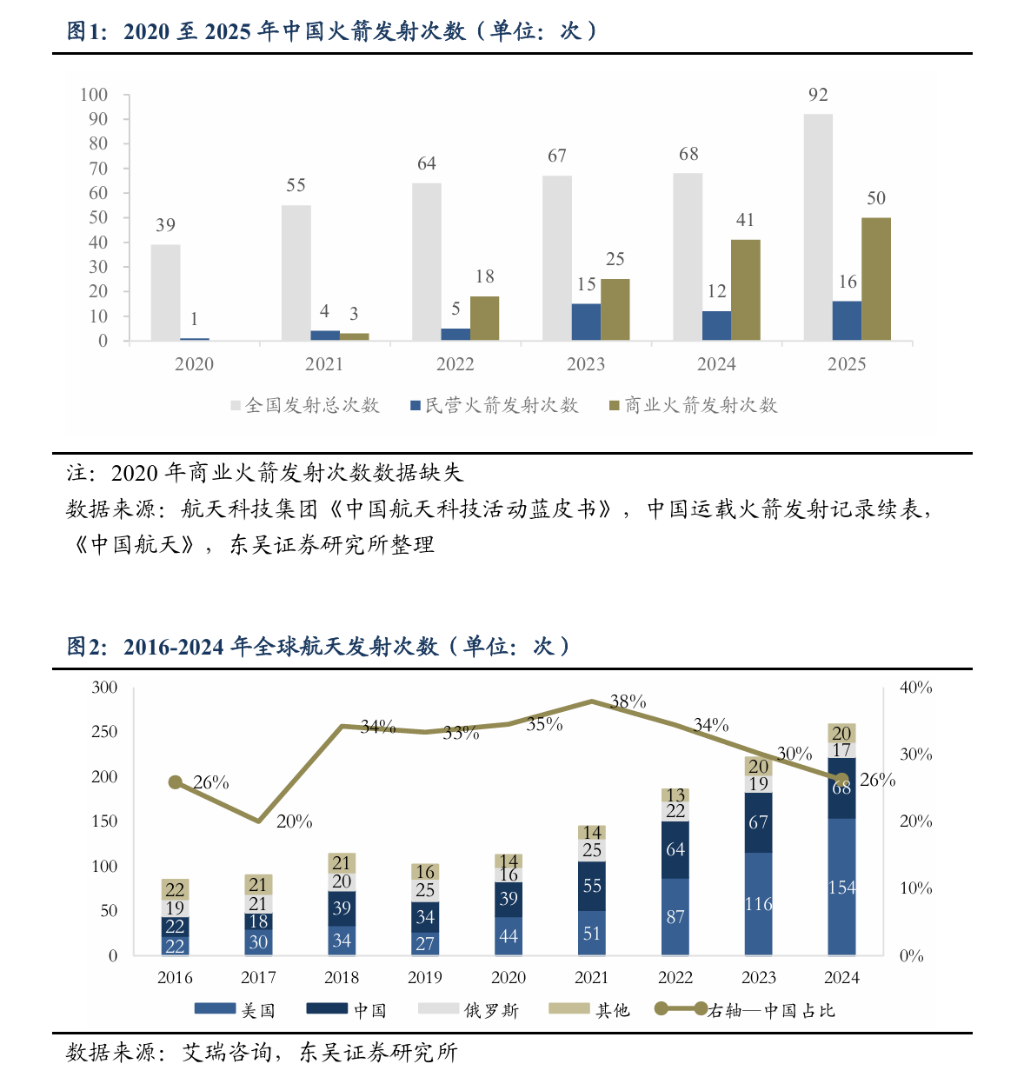
Core Insights - The commercial space industry in China is entering a phase of scaled launches, with a clear path to cost reduction through high payload capacity and reusable technology [1][3] - The demand for propellants and specialty gases is closely tied to launch frequency, making it a stable and predictable value segment in the commercial space sector [2][11] Group 1: Launch Frequency and Infrastructure - China's rocket launch frequency is projected to grow rapidly, reaching 92 launches by 2025, with 50 of those being commercial launches, a significant increase from 39 total launches in 2020 [1][3] - The launch infrastructure is being enhanced, with a total of 21 existing launch sites and 5 more under construction or planned, creating a comprehensive system for inland, coastal, and maritime launches [1][3] Group 2: Cost Structure and Reusability - Reusable technology is significantly altering the cost distribution in rocket launches, with the cost of a Falcon 9 launch's propellant and specialty gas demand estimated at approximately $800,000 [1][11] - The cost of the rocket itself has decreased from $50 million to $15 million due to reusability, while the proportion of launch costs attributed to propellant and specialty gases has increased from 1.6% to 5.3% [1][11] Group 3: Propellant and Specialty Gas Demand - The demand for propellants and specialty gases is expected to grow steadily with increased launch frequency, as they are essential consumables with high safety and reliability requirements [11][12] - The market for propellants and specialty gases is characterized by strong customer loyalty and a converging technology path, providing higher long-term visibility and value stability compared to rocket manufacturing [2][11] Group 4: Fuel Technology Comparison - Liquid oxygen-methane is emerging as a preferred fuel in reusable rocket scenarios due to its low carbon residue and stable combustion properties, which enhance engine performance over multiple flights [13][15] - The comparison of fuel types shows that while liquid oxygen-methane offers advantages in maintenance and operational efficiency, liquid oxygen-kerosene remains prevalent due to its established technology and existing infrastructure [13][15]

东吴证券:商业航天可回收路径中稀缺耗材 推进剂特气份额&价值量提升
智通财经网· 2026-01-22 03:56
Group 1 - The core viewpoint is that commercial aerospace is entering a high-density and standardized launch phase driven by high payload capacity and reusable technology, leading to a continuous decrease in launch costs [1] - The demand for propellants and special gases is rigid, with their cost share increasing due to the overall reduction in rocket costs, highlighting the importance of liquid oxygen and methane as a key development direction for new reusable rockets [1][4] - The economic viability of rocket launches is becoming a crucial factor for the transition to high-density and standardized launches, with the cost of propellants and special gases becoming a more stable and predictable value segment [1][3] Group 2 - China's launch infrastructure has been significantly enhanced, with a total of 21 existing launch sites and 5 more under construction or planned, leading to an increase in rocket launch frequency from 39 times in 2020 to an expected 92 times by 2025 [2] - The cost of rocket launches in China is projected to decrease from approximately 115,000 yuan per kilogram in 2020 to around 45,000 yuan per kilogram by 2029, driven by advancements in new generation launch vehicles and reusable technology [3] - The industry is witnessing a parallel development of liquid oxygen and kerosene alongside liquid oxygen and methane, with the latter gaining prominence due to its cleaner combustion and lower maintenance requirements [4] Group 3 - The investment recommendation emphasizes focusing on Jiufeng Energy, which is positioned to supply special fuels and gases for commercial aerospace, with capabilities in liquid hydrogen, liquid methane, and helium [5] - Jiufeng Energy's strategic partnerships with rocket companies and expansion plans align with the increasing demand for high-density launch operations, particularly with the completion of the first phase of the Hainan commercial launch project [5]


公用事业行业深度报告:火箭发射深度1:可回收路径中稀缺耗材:推进剂特气份额&价值量提升
Soochow Securities· 2026-01-22 03:24
Investment Rating - The report maintains a "Buy" rating for Jiufeng Energy, highlighting its potential in the commercial aerospace sector [1]. Core Insights - The commercial aerospace industry is transitioning into a phase of scaled launches, with supply capabilities continuously being released. This shift is characterized by an increase in launch frequency and demand for launch services [9]. - The cost structure of launches is evolving, with a clear path towards cost reduction through high payload capacity and reusability of rockets. The unit launch cost in China is expected to decrease significantly from approximately 115,000 RMB per kilogram in 2020 to around 45,000 RMB per kilogram by 2029 [28]. - The demand for propellants and special gases is becoming increasingly rigid, with their value and share in the overall cost structure expected to rise over time. Liquid oxygen and methane are emerging as preferred propellant choices due to their advantages in reusability and operational efficiency [37][39]. Summary by Sections 1. Industry Trends - The commercial aerospace sector is moving from a capability-building phase to a scaled launch phase, driven by the acceleration of low Earth orbit satellite constellation construction [9]. - China's launch infrastructure has developed a comprehensive system, including multiple inland and coastal launch sites, enhancing overall launch capacity [10]. 2. Cost Structure and Reduction Pathways - The cost structure of launches is being dissected, revealing that consumable elements like propellants are becoming more significant as launch frequencies increase. The rigid nature of these costs is highlighted as a core constraint in the industry [17][19]. - The unit cost of launching satellites is a critical economic indicator, with current costs in China being higher than those of international competitors like SpaceX. The report indicates that the unit launch cost for the Falcon 9 has decreased to approximately 20,000 RMB per kilogram [23][25]. 3. Propellant and Special Gas Demand - The report emphasizes the increasing importance of propellant selection in the context of reusability and operational stability. Liquid oxygen and methane are positioned as the leading choices for future rocket designs due to their cleaner combustion and lower maintenance requirements [39][41]. - Jiufeng Energy is recommended for its strategic positioning in the supply of special gases and propellants, which are expected to see long-term growth in value and market share [1][37].
公用事业行业深度报告:火箭发射深度1:可回收路径中稀缺耗材:推进剂特气份额、价值量提升
Soochow Securities· 2026-01-22 03:15
Investment Rating - The report maintains a "Buy" rating for Jiufeng Energy, highlighting its potential in the commercial aerospace sector [1]. Core Insights - The commercial aerospace industry is transitioning into a phase of scaled launches, with supply capabilities being continuously released. This shift is characterized by an increase in launch frequency and demand for launch services [9]. - The cost structure of launch services is evolving, with a clear path towards cost reduction through high payload capacity and reusable technology. The unit cost of launching is expected to decrease significantly by 2029 [29]. - The demand for propellants and special gases is becoming increasingly rigid, with their value and share in the overall cost structure expected to rise over time [38]. Summary by Sections 1. Industry Trends - The commercial aerospace sector is moving from a capability-building phase to a scaled launch phase, driven by the acceleration of low Earth orbit satellite constellation construction [9]. - China's launch infrastructure has developed a comprehensive system, including multiple launch sites that enhance operational efficiency and specialization [10][11]. 2. Cost Constraints and Reduction Pathways - The cost structure of launch services is divided into fixed, semi-fixed, and variable costs, with propellants and special gases representing the most rigid costs [19][22]. - The unit cost of launching is currently high, but it is projected to decrease from approximately 115,000 RMB per kilogram in 2020 to around 45,000 RMB per kilogram by 2029 [29][24]. - High payload capacity and reusable technology are recognized as key methods for reducing costs in the industry [29]. 3. Propellant and Special Gas Demand - The choice of rocket fuel is evolving, with liquid oxygen and methane emerging as a prominent option due to their cleaner combustion and lower carbon buildup, which is advantageous for high-frequency reuse [39][40]. - The report outlines the comparative advantages of different rocket fuel technologies, emphasizing the long-term coexistence of liquid oxygen and kerosene alongside liquid oxygen and methane [41][42]. 4. Investment Recommendations - Jiufeng Energy is recommended for its strategic positioning in the supply of special fuels and gases for commercial aerospace, with expected net profits of 1.56 billion, 1.8 billion, and 2.13 billion RMB from 2025 to 2027 [1].
中科环保:星际荣耀双曲线三号火箭发射所使用的液氧甲烷不是由本公司供应的
Mei Ri Jing Ji Xin Wen· 2025-12-29 04:37
Core Viewpoint - The company, Zhongke Environmental Protection, clarified that the liquid oxygen methane used in the launch of the Star Glory Hyperbola-3 rocket is not supplied by them, but they have established a cooperation intention with Star Glory for providing clean energy solutions [2]. Group 1 - Zhongke Environmental Protection confirmed that the liquid oxygen methane for the Star Glory Hyperbola-3 rocket is not sourced from their production [2]. - The company has signed a cooperation framework agreement with Sichuan Star Glory Aerospace Power Co., Ltd. to provide green methane, green electricity, green thermal energy, reclaimed water, and desalinated water [2]. - This collaboration opens up commercial aerospace applications for the company's green energy utilization, supporting their "dual carbon" strategy and expanding the demonstration application of green energy in high-end manufacturing [2].
等着!这事没完!
债券笔记· 2025-12-24 11:31
Group 1: Commercial Aerospace - The Long March 12甲 rocket successfully completed its maiden flight on December 23, achieving its second-stage orbit insertion goal, although the first-stage recovery did not meet expectations. This event highlights the importance of commercial aerospace development [3][5]. - The successful verification of the liquid oxygen-methane technology route is significant, as this fuel is considered a "clean gasoline" for rockets, allowing for carbon-free and reusable applications, which could facilitate future missions to Mars [5]. - The collaboration between state-owned enterprises and private companies is enhancing the aerospace industry, with the Aerospace Eight Institute providing a framework and private firms supplying core engines, thus activating the entire industry chain [5]. Group 2: Market Indices - Despite over 3,800 stocks declining in the market, the indices managed to close slightly positive, indicating a divergence where the index appears strong while individual stocks are underperforming [6]. - The market is currently fluctuating around the 5-day moving average, with increasing short-term divergence, suggesting a cautious approach is warranted as investors await clearer direction [7]. Group 3: Macro and Fixed Income - The 30-year government bond futures surged by 0.89%, reaching nearly 113, driven by a favorable liquidity environment despite the central bank's net withdrawal of funds. This has attracted institutional investors, leading to a drop in the yield of ultra-long bonds to 2.2% [7][8]. - The U.S. GDP for the third quarter grew at an annualized rate of 4.3%, significantly exceeding expectations, primarily due to strong consumer spending, although core PCE inflation rose to 2.9%, dampening interest rate cut expectations [8]. - The Chinese yuan strengthened, breaking the 7.05 mark against the dollar, reaching a 14-month high, with a year-to-date appreciation of 3%, making Chinese assets attractive to foreign investors amid global market pressures [8].