激光雷达模组

Search documents
立景创新闯关港股 “果链”龙头能否撑起225亿估值?
Zhi Tong Cai Jing· 2026-01-12 09:43
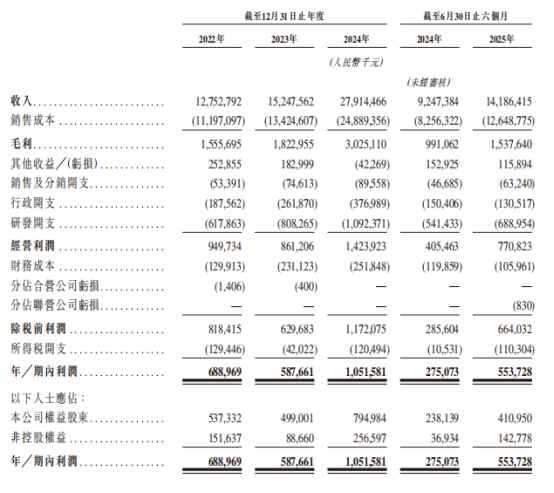
Core Viewpoint - The global consumer electronics market is entering a new recovery cycle driven by AI, presenting structural growth opportunities in the optical lens sector, highlighted by the IPO application of Lijing Innovation Technology Co., Ltd. [1] Company Overview - Lijing Innovation, founded in 2018, has become the largest supplier of camera modules for consumer electronics in China, successfully entering the supply chains of major global smartphone brands like Apple and Huawei [1] - The company has raised over 5.24 billion RMB before its IPO, with notable investors including Hillhouse, Sequoia, IDG, and CICC [1] - By June 2025, Lijing is valued at 22.5 billion RMB and is listed in the Hurun Global Unicorn List [1] Financial Performance - Revenue is projected to grow from 12.75 billion RMB in 2022 to 27.91 billion RMB in 2024, doubling in this period, while net profit is expected to increase from 689 million RMB to 1.05 billion RMB, a 53% growth [2] - In the first half of 2025, revenue increased by 53.4% year-on-year to 14.19 billion RMB, and net profit surged by 101.5% to 554 million RMB [2] Market Position - Lijing is ranked second globally in the camera module sector for consumer electronics, and first among Chinese manufacturers, with significant market share in high-end smartphone camera modules [8][9] - The company supplies over 320 clients across various sectors, including consumer electronics, automotive electronics, and XR devices [9] Customer and Supplier Concentration - The company has a high customer concentration, with the top five clients accounting for 89% of revenue in the first half of 2025, and the largest client representing 67.6% of total revenue [4] - Supplier concentration is also notable, with the top five suppliers accounting for 45.9% of procurement in the first half of 2025 [5] R&D and Acquisitions - R&D expenditures have increased from 618 million RMB in 2022 to 1.09 billion RMB in 2024, with 689 million RMB spent in the first half of 2025 [4] - The company has made several acquisitions to expand its business, including entering Apple's supply chain and enhancing production capabilities for high-end optical lenses [4] Industry Trends - The consumer electronics market is experiencing a recovery driven by AI, with a projected market size of approximately 79 billion USD for precision optical solutions by 2024, growing at a CAGR of 2.9% from 2020 to 2024 [6] - The market for AI-related consumer electronics is expected to exceed 76.4 billion USD by 2029, with a CAGR of 32.4% from 2025 to 2029 [6] Product Structure and Growth - The company remains heavily reliant on consumer electronics, which accounted for 88% of revenue in the first half of 2025, although high-value products are increasing their share [10] - The automotive electronics segment has shown a 158.5% CAGR from 2022 to 2024, but revenue declined in the first half of 2025 due to product mix adjustments [10]

立景创新闯关港股,“果链”龙头能否撑起225亿估值?
Zhi Tong Cai Jing· 2026-01-12 08:47
Core Viewpoint - The global consumer electronics market is entering a new recovery cycle driven by AI, presenting structural growth opportunities in the optical lens sector, highlighted by the IPO application of Lijing Innovation Technology Co., Ltd. [1] Group 1: Company Overview - Lijing Innovation, founded in 2018, has become the largest supplier of camera modules for consumer electronics in China and has entered the supply chains of major global smartphone brands like Apple and Huawei [1] - The company has raised over 5.24 billion RMB prior to its IPO, with notable investors including Hillhouse, Sequoia, IDG, and CICC [1] - By June 2025, Lijing is valued at 22.5 billion RMB and is listed in the Hurun Global Unicorn List [1] Group 2: Financial Performance - From 2022 to 2024, Lijing's revenue is projected to grow from 12.75 billion RMB to 27.91 billion RMB, doubling in size, while net profit is expected to increase from 689 million RMB to 1.05 billion RMB, a 53% growth [2] - In the first half of 2025, the company reported a 53.4% year-on-year revenue growth to 14.19 billion RMB and a net profit increase of 101.5% to 554 million RMB [2] Group 3: Market Position and Competition - Lijing is ranked second globally in the camera module sector for consumer electronics, and first among Chinese manufacturers, with significant market share in high-end smartphone camera modules [8][9] - The company has established a strong position in emerging fields such as automotive electronics and smart office applications, with over 320 global clients [9] Group 4: Customer and Supplier Concentration - The company has a high customer concentration, with the top five clients accounting for 90.7% of revenue in 2022, decreasing to 89.0% in the first half of 2025, while the largest client contributes 67.6% of revenue [4] - Supplier concentration is also notable, with the top five suppliers accounting for 56.5% of procurement in 2024, increasing to 45.9% in the first half of 2025 [5] Group 5: R&D and Growth Strategy - Lijing has significantly increased its R&D spending from 618 million RMB in 2022 to 1.09 billion RMB in 2024, with 689 million RMB spent in the first half of 2025 [4] - The company has pursued a series of acquisitions to expand its business, including entering Apple's supply chain and enhancing production capabilities for high-end optical lenses [4] Group 6: Industry Trends - The consumer electronics market is experiencing a recovery driven by AI, with a projected market size of approximately 79 billion USD for precision optical solutions by 2024, growing at a CAGR of 2.9% from 2020 to 2024 [6] - The market for AI-related consumer electronics is expected to exceed 76.4 billion USD by 2029, with a projected CAGR of 32.4% from 2025 to 2029 [6]
宇瞳光学:目前已获得主流激光雷达模组客户多个定点,多个项目已开始批量交付
Mei Ri Jing Ji Xin Wen· 2025-08-04 04:16
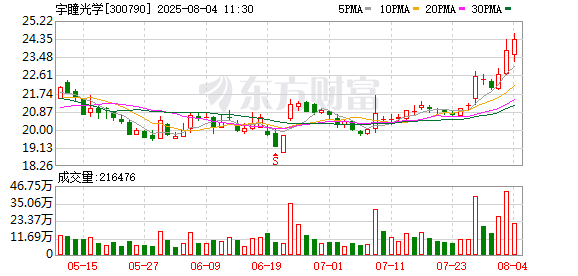
Group 1 - The company has received multiple orders from mainstream lidar module customers and several projects have begun mass delivery [2] - The delivery progress of the projects is currently not meeting expectations, as indicated by investor inquiries [2] - The company is actively collaborating with major lidar module manufacturers in the domestic market [2]

乐动机器人冲刺H股:机器人激光雷达开启“三国杀”
2 1 Shi Ji Jing Ji Bao Dao· 2025-06-09 13:24
Core Viewpoint - The company, Ledong Robotics, is experiencing rapid revenue growth driven by the increasing demand for machine vision technology in consumer-grade robots, despite facing significant competition in the laser radar market [1][2]. Group 1: Company Overview - Ledong Robotics has submitted its listing application to the Hong Kong Stock Exchange, with plans to list on the main board, supported by Haitong International and Guotai Junan International as joint sponsors [1]. - The company focuses on laser radar module sales, primarily targeting home, commercial, and industrial robot applications, distinguishing itself from competitors like Hesai and Suteng, which are more known for automotive laser radar [1][3]. - In 2024, Ledong Robotics empowered 6 million intelligent robots, with a DTOF laser radar shipment of 720,000 units, making it the global leader in this segment [3]. Group 2: Financial Performance - The company's total revenue grew from 233 million RMB in 2022 to 467.3 million RMB in 2024, achieving a compound annual growth rate of 41.4% [5]. - Revenue from visual perception products increased from 228.7 million RMB in 2022 to 439.3 million RMB in 2024, while the revenue from lawnmowers surged to 23.27 million RMB in 2024 from just 63,000 RMB in 2023 [5]. - Despite revenue growth, the company reported losses of 73.13 million RMB, 68.49 million RMB, and 56.48 million RMB over the past three reporting periods [5]. Group 3: Cost Management - The company has managed to reduce its losses by controlling expenses, with administrative expenses decreasing from 45.66 million RMB in 2022 to 36.93 million RMB in 2024, and R&D expenses also showing a slight decline [6][7]. - Marketing expenses increased significantly, from 13.91 million RMB in 2022 to 31.43 million RMB in 2024, indicating a strategic focus on promoting its products [7]. Group 4: Market Competition - Ledong Robotics faces intense competition from major players like Hesai and Suteng, who are expanding their presence in the robotics sector [10]. - Hesai reported a 649.1% year-on-year growth in robot deliveries, with expectations to reach 200,000 units in 2025, while Suteng also achieved significant growth in its robot business [10][11]. - The competitive landscape is expected to impact Ledong Robotics' market share, as the overall robot lidar market is projected to reach 28 billion RMB by 2030, with a compound annual growth rate of 67.9% [11].

【招商电子】高伟电子:24H2业绩超预期,后摄放量驱动新一轮高成长
招商电子· 2025-03-21 01:25
Core Viewpoint - The company reported a significant increase in revenue and net profit for 2024, driven by the growth of its rear camera business and rising demand for laser radar in the smart driving sector [2]. Group 1: Financial Performance - For the full year 2024, the company achieved revenue of 2.494 billion yuan, representing a year-on-year increase of 169%, and a net profit attributable to shareholders of 119 million yuan, up 156% year-on-year [2]. - In the second half of 2024, the company’s revenue reached 1.896 billion yuan, showing a year-on-year growth of 242% and a quarter-on-quarter increase of 218%. The net profit for this period was 103 million yuan, reflecting a year-on-year increase of 261% and a quarter-on-quarter increase of 544% [2]. - The net profit margin for the full year 2024 is projected to be 4.8%, with the second half showing a margin of 5.4%, indicating an improvement in profitability as the rear camera business scales up [2]. Group 2: Business Growth Drivers - The rear camera business is entering a growth phase, with successful penetration into the iPhone's new ultra-wide and periscope camera segments, contributing to substantial revenue growth [2]. - The demand for laser radar is rapidly increasing, benefiting from the widespread adoption of smart driving technologies [2]. - The company is expected to continue strong performance in the first half of 2025, supported by the new iPhone 17 models featuring optical innovations [3]. Group 3: Strategic Initiatives - The company is actively expanding into new business areas such as AR/VR, smart driving, and robotics, which are expected to provide long-term growth opportunities [3]. - In AR/VR, the company is involved in Apple's innovations, focusing on core optical components like MicroLED display technology [3]. - In the smart driving sector, the company has established a deep partnership with a leading player, providing laser radar module services [3].