
焙烤食品

Search documents
我国轻工制造业不断显现内生动力
Xiao Fei Ri Bao Wang· 2026-01-06 00:42
Core Insights - The light industry in China has achieved notable structural adjustments in 2025, with growth driven more by internal upgrades than external stimuli [1] - The overall economic performance of the light industry remains stable, with revenue and profit growth of 1.9% and 1.6% respectively in the first ten months of 2025 [1] - The focus of competition in light industry products is shifting from quantity to consumer experience and value [1] Demand Side Changes - The changes in demand are reflected more in the consumption structure rather than total consumption [1] - Specific sectors such as baked goods, daily chemical products, and home goods have shown more stable performance, indicating a shift towards emotional and daily consumption [1] Export Dynamics - The export growth of light industry products has shown significant differentiation, with traditional markets like Europe and the US slowing down while emerging markets such as ASEAN, the Middle East, and Latin America maintain rapid growth [2] - The reliance on low-price orders is decreasing, with an increase in brand-oriented, customized, and small-batch export models [2] Digital Transformation - The digital transformation of the light manufacturing industry has entered a practical phase, with a focus on specific sectors such as home appliances and furniture [2] - Policies aim for a 75% CNC rate in key processes of major light industry enterprises by 2027 [2] Green Transition - The green transition is becoming a prerequisite rather than an added benefit, with environmental standards increasingly included in procurement and cooperation agreements [3] - Companies are experiencing short-term cost increases but are gaining competitiveness in mid-to-high-end markets [3] Regional Policies - New regional policies and institutional environments are providing support for the light manufacturing industry, with free trade zones and cross-border e-commerce platforms enhancing attractiveness [4] - The light manufacturing industry is focusing on structural optimization rather than high-speed expansion, emphasizing long-term returns and comprehensive capabilities [4] Industry Outlook - The light industry is gradually moving away from the "low added value" label towards a more resilient and sustainable direction [4] - The key takeaway for the light industry in 2025 is that stability, quality, and patience are becoming new industry consensus as speed is no longer the sole objective [4]
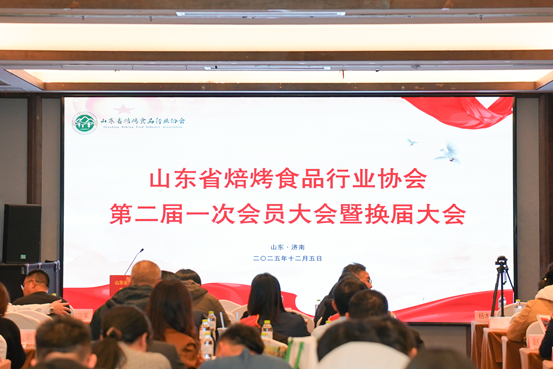
山东省焙烤食品行业协会第二届一次会员大会暨换届大会圆满结束
Qi Lu Wan Bao· 2025-12-08 03:27
Core Viewpoint - The Shandong Province Baking Food Industry Association held its second member congress, marking a new phase of standardized and professional development for the industry, with a focus on high-quality growth and innovation in the baking sector [1][15]. Group 1: Industry Achievements and Future Directions - The baking food and sugar products industry is recognized as an important livelihood industry, with past achievements in steady growth acknowledged by the association's leadership [4]. - The association aims to enhance its role as a bridge, creating a more influential "Shandong Baking" brand and promoting high-quality development in China's baking industry [4]. - Future recommendations include focusing on digital and green transformation, fostering new growth points such as healthy and pre-prepared baking, and integrating regional culinary culture [6]. Group 2: Organizational Developments - The first secretary and supervisory board representative reported significant achievements in organizational construction, party leadership, industry services, and social responsibility during the previous term, laying a solid foundation for healthy industry development [9]. - A new leadership team was elected, with He Huajun as the new president and other key positions filled, alongside the approval of 14 internal regulations related to membership and party work [11]. - The newly elected president outlined a four-year work plan emphasizing party leadership, skills competitions, industry-education integration, and food safety, aiming for higher quality and sustainability in the baking industry [13].

临沂打造“中国食品之都”新名片
Da Zhong Ri Bao· 2025-08-29 03:08
Core Viewpoint - Linyi is establishing itself as "China's Food Capital" through a modern industrial chain that integrates raw material cultivation and deep processing, achieving significant growth in the grain and oil industry [1] Industry Overview - By 2024, Linyi will have 161 large-scale enterprises in the premium grain and oil processing industry, with a production value exceeding 30 billion yuan [1] - From January to July this year, the number of large-scale enterprises increased to 177, achieving a production value of 19.69 billion yuan, representing a year-on-year growth of 25.2% [1] Raw Material Base - Linyi is a major grain and oil production base in China, with 9 national grain-producing counties and 6 top peanut counties [1] - The peanut planting area is 2.303 million acres, with a total output of 713,000 tons, ranking first in the province; wheat planting area is 4.388 million acres with a total output of 1.881 million tons; soybean planting area is 294,000 acres with processing capacity exceeding 1 million tons [1] Processing Industry - The processing sector is described as the "heart" of the industrial chain, with a focus on cluster development and intelligent transformation [1] - Three major processing clusters have emerged: - Peanut and vegetable oil processing cluster, centered in Ju County, with 222 peanut processing enterprises, including 21 large-scale ones, producing about 1/6 of the country's refined peanut oil [1] - Baked goods processing cluster, with over 670 enterprises producing more than 6 million tons of processed foods annually, covering over 1,000 varieties [1] - Grain processing industry chain, featuring the world's largest single flour mill and innovative products like zero-additive natural tofu [1] Technological and Collaborative Efforts - Linyi has 26 provincial-level specialized and innovative enterprises and 18 provincial-level R&D centers, collaborating with universities to tackle key processes [1] - The establishment of a 60-member "expert think tank" and various initiatives to support enterprise development have been implemented to enhance the industrial ecosystem [1] Future Outlook - The continuous efforts in "supplementing, strengthening, and extending" the industrial chain are expected to enhance Linyi's status as "China's Food Capital" [1]
临沂|临沂打造“中国食品之都”新名片
Da Zhong Ri Bao· 2025-08-29 01:17
Core Insights - The core viewpoint of the article highlights the significant growth of the premium grain and oil deep processing industry chain in Linyi, which has surpassed a production value of 30 billion yuan, positioning the city as a new emblem of "China's Food Capital" [2][4]. Industry Overview - In 2024, Linyi has 161 large-scale enterprises in the premium grain and oil deep processing industry chain, achieving a production value exceeding 30 billion yuan. From January to July of this year, the number of large-scale enterprises increased to 177, with a production value of 19.69 billion yuan, reflecting a year-on-year growth of 25.2% [2]. - Linyi is a crucial grain and oil production base in China, featuring 9 national grain-producing counties and 6 top peanut-producing counties. The peanut planting area is 2.303 million acres, with a total output of 713,000 tons, ranking first in the province [2]. Processing Segment - The processing segment is described as the "heart" of the industry chain, with Linyi focusing on cluster development and intelligent transformation to convert raw material advantages into product advantages. Three distinct processing clusters have emerged: 1. Peanut and vegetable oil processing cluster, centered in Ju County, with 222 peanut processing enterprises, including 21 large-scale ones. Four companies rank among the top ten peanut oil processors in the country, producing about 1/6 of the national refined peanut oil [3]. 2. Baked goods processing cluster, with over 670 enterprises producing more than 6 million tons of processed foods annually, covering over 1,000 varieties [3]. 3. Grain processing chain, featuring the world's largest single flour mill and innovative products like zero-additive natural dried tofu [3]. Ecosystem Development - The smooth operation of the industry chain relies on a robust industrial ecosystem. Linyi has established a 60-member "expert think tank" for top-level design and implemented various initiatives to address project land use and raw material import challenges. This has led to a collaborative model for industry chain development known as the "Linyi Model" [4]. - The premium grain and oil deep processing industry chain in Linyi is set to continue its high-quality development through ongoing efforts to "supplement, strengthen, and extend" the chain [4].
聚势创新促消费 优品提质惠民生
Xiao Fei Ri Bao Wang· 2025-05-06 02:55
Core Viewpoint - The meeting focused on "Boosting Consumption and Serving People's Good Life," aiming to transform work styles, conduct in-depth research, and promote high-quality development in the light industry sector. Group 1: Light Industry Development - The China Light Industry Federation emphasizes the need for in-depth industry research to understand new market demands and trends, aiming to innovate and cultivate consumption growth points [1][2] - The China Sewing Machinery Association plans to implement seven major initiatives in 2024 to promote high-quality development, including policy advocacy, skill training, and international market expansion [1] - The China Household Electrical Appliances Association is actively promoting the "old for new" appliance replacement program, leveraging the AWE exhibition to stimulate consumer demand [3] Group 2: Challenges and Solutions - The China Toy and Juvenile Products Association is addressing industry challenges such as tariffs and standards, advocating for the inclusion of certain products in the "old for new" policy [5][6] - The China Sugar Association is focusing on technological empowerment and sustainable practices, with a projected sugar production increase to 11 million tons in the 2024/25 period [7][8] - The China Food Additives and Ingredients Association reported a stable growth in the food additives sector, with a production increase of 3.5% and sales growth of 2.0% in 2024 [9][10] Group 3: Consumer Trends and Innovations - The China Beverage Association reported a record beverage production of 188 million tons in 2024, with a focus on enhancing consumer experience and expanding market reach [15][16] - The China Biochemical Fermentation Industry Association is implementing six practical measures to support industry growth, emphasizing technology and safety [17][18] - The China Industrial Design Association is promoting design innovation to enhance product value and stimulate consumer demand [22][23] Group 4: Sector-Specific Insights - The China Musical Instruments Association identified trends such as the rise of electronic instruments and a growing interest in music among middle-class consumers [28][29] - The China Bicycle Association noted a stable production environment with a significant increase in electric bicycle sales due to the "old for new" policy [30][31]