燃气涡轮机

Search documents
通用电气取得燃气涡轮机模型及构造方法专利
Jin Rong Jie· 2026-01-20 03:00
Core Viewpoint - General Electric Technology Co., Ltd. has obtained a patent for a gas turbine model and a method for constructing a gas turbine system using the model, indicating ongoing innovation in the energy sector [1] Group 1: Patent Details - The patent is titled "Gas Turbine Model and Method for Constructing Gas Turbine System Using the Model" [1] - The patent was granted with the announcement number CN109252964B [1] - The application date for the patent was July 2018 [1]

招商证券国际:AIDC行业成机械行业核心引擎 关注燃气涡轮机领域
Zhi Tong Cai Jing· 2025-12-24 06:36
Core Viewpoint - The Artificial Intelligence Data Center (AIDC) industry is becoming a core growth engine for the machinery sector, benefiting from the strong momentum of global AI development and computing power expansion [1] Group 1: Industry Insights - The gas turbine sector is experiencing significant growth due to increased orders and energy bottlenecks in North America, with both quantity and prices showing a clear upward trend [1] - Market confidence in diesel engines, liquid cooling, and gas turbines has strengthened since the beginning of the year [1] Group 2: Investment Recommendations - The company maintains an "overweight" rating for the industry, suggesting a focus on gas turbines, diesel generators, and cooling equipment sectors amid simultaneous growth in sales and prices [1]

“AI新宠”卡特彼勒(CAT.US)股价遭遇至暗5日的背后:AI叙事迈向剧烈波动期
Zhi Tong Cai Jing· 2025-12-20 03:43
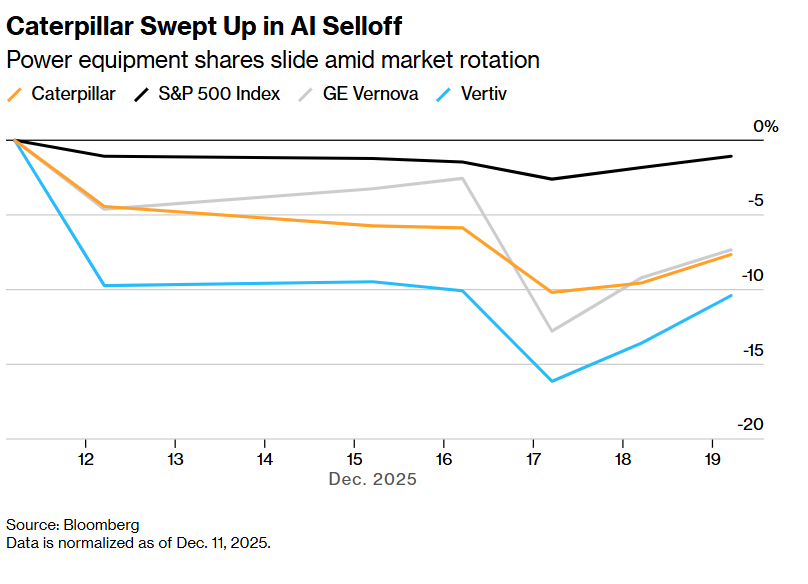
Core Viewpoint - Caterpillar Inc. (CAT.US), once dubbed the "AI darling" of the U.S. stock market, has recently faced significant setbacks, highlighting investor skepticism regarding the sustainability of the AI investment frenzy and the potential returns from massive investments in AI data centers [1][4]. Group 1: Company Performance - Caterpillar's stock price has experienced a notable decline, dropping 9.6% over the worst five-day period since April, making it the weakest component of the S&P 500 Machinery Index [1][6]. - Despite the recent downturn, Caterpillar's stock had risen approximately 60% year-to-date, driven by its involvement in the AI power supply chain, particularly through its gas turbine business [6][8]. - The company remains a key player in the construction and mining equipment sector, often viewed as a barometer for global economic health [6]. Group 2: Market Trends and Investor Sentiment - The broader market has seen a rotation away from AI-related stocks, with significant declines in companies like GE Vernova and Vertiv, which are also tied to AI data center infrastructure [7]. - Analysts express concerns that the current AI investment narrative may be nearing its peak, with skepticism growing about the long-term viability of returns from AI investments [5][8]. - High-profile investment firms are increasingly questioning the sustainability of the AI boom, likening it to the internet bubble, and are focusing on identifying the true beneficiaries of AI advancements [5][6].


美国电荒发酵:除了储能,无牌可打
3 6 Ke· 2025-11-11 11:53
Core Insights - The U.S. is facing a significant electricity shortage, exacerbated by aging infrastructure and increasing demand from data centers and AI technologies [7][9][31] - Microsoft CEO Satya Nadella highlighted that GPU purchases are being wasted due to insufficient power supply for data centers [3][5] - The combination of solar power and energy storage is emerging as the most viable solution to address the electricity crisis in the U.S. [6][27] Group 1: Current Electricity Shortage - The U.S. is confirmed to be experiencing a real electricity shortage, which is not merely a supply-demand imbalance but a competition for electricity between AI and human needs [7][8] - Electricity costs in North Virginia have risen by 13% over the past year, putting pressure on consumers [8] - The aging U.S. power grid, with 70% of transmission lines over 25 years old, is a critical issue contributing to the shortage [8][9] Group 2: Infrastructure and Supply Challenges - The average outage duration for U.S. electricity users reached 662.6 minutes last year, nearly doubling over the past decade [9] - Electricity prices have increased by 25% over the last three years, while the power generation side is not solely to blame; the grid's inefficiencies play a significant role [11] - The integration of new power sources into the grid is a lengthy process, with projects waiting for three years or more to connect [11][14] Group 3: Demand from Data Centers - The demand for electricity from data centers is expected to require an additional 50-80 GW over the next five years, equivalent to the capacity of four Three Gorges Dams [14] - The current electricity supply strategies are inadequate, with traditional energy sources either too slow or politically constrained [27][31] Group 4: Renewable Energy Solutions - Solar power combined with energy storage systems is identified as a cost-effective and rapidly deployable solution, with production costs around $0.30 per watt [27][31] - The market demand for energy storage driven by AI data centers and grid improvements could exceed 200 GWh [28] - However, tariffs and policies like the Inflation Reduction Act are creating barriers for Chinese solar and storage equipment entering the U.S. market, complicating the situation for domestic companies [29][30]