玛奇朵

Search documents
为什么奶茶店只有中杯、大杯,小杯被谁“偷”走了?
东京烘焙职业人· 2026-01-23 08:33
Core Viewpoint - The evolution of cup sizes in the milk tea industry reflects various issues, including production capabilities, consumer demand changes, and operational management costs. The absence of small cups is attributed to historical trends and the influence of brands like Starbucks [5][6][17]. Group 1: Historical Context and Influences - The initial presence of small cups at Starbucks was primarily for espresso-based drinks, but as these products were phased out, the perception shifted to only medium, large, and extra-large options [6]. - The milk tea industry's early days saw smaller cup sizes due to the high cost of ice machines, leading to larger standard sizes as production capabilities improved [9]. - Starbucks has served as a model for many brands in the milk tea sector, influencing product offerings and service styles, which contributed to the trend of omitting small cup sizes [6][9]. Group 2: Current Trends and Consumer Preferences - Brands like Baozhugong and 1DianDian still offer small cup options, labeled as "children's cup" and "mini cup," respectively, indicating a niche market for smaller sizes [13]. - Major brands such as Heytea and Chayan Yuesheng have eliminated cup size options, focusing instead on customizing temperature, packaging, and sweetness levels, reflecting a shift in consumer preferences towards quality over quantity [15]. - The changes in cup sizes encapsulate the evolution of consumer economics, highlighting a transition in focus from volume to the quality and standardization of beverages [17].


魏牌九年九帅,长城高端化之困待破局
Guan Cha Zhe Wang· 2025-12-22 10:37
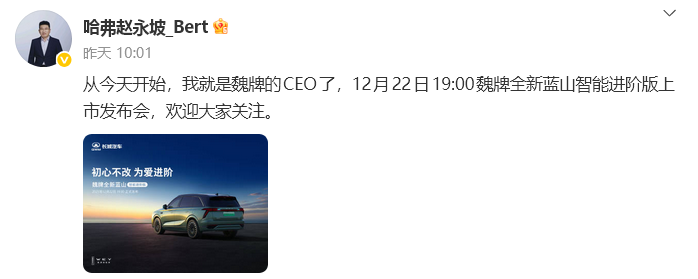
Core Viewpoint - The appointment of Zhao Yongpo as CEO of WEY marks the ninth leadership change since the brand's establishment in 2016, reflecting ongoing strategic instability and challenges in positioning within the high-end automotive market [1][2][6]. Leadership Changes - WEY has experienced frequent CEO changes, with eight different leaders in nine years, indicating a lack of stability in its management [2][4]. - The longest-serving CEO, Yan Si, held the position for two years, while the shortest tenure lasted only two months [2][4]. - Recent CEOs, including Feng Fuzhi, have left due to various reasons, including failure to meet strategic goals such as establishing a direct sales channel [5][10]. Strategic Challenges - WEY's strategic direction has been inconsistent, with shifts in focus that have not solidified its market position [7][9]. - The brand initially aimed for a luxury market presence with models like VV7 and VV5 but struggled with innovation and market differentiation, leading to a decline in sales after 2019 [7][9]. - The decision to pivot to a "coffee series" of electric vehicles did not resonate with consumers, resulting in confusion and a loss of brand identity [9][10]. Market Performance - Despite a 93% year-on-year sales increase in the first eleven months of the year, WEY's total sales were only 89,000 units, representing just 4.4% of Great Wall's total sales [13]. - The brand's performance is significantly lower compared to competitors like Geely and Dongfeng, which have established stronger sales figures in the high-end market [13]. Broader Industry Context - Great Wall Motors faces challenges in high-end market penetration, electric vehicle transition, and global expansion, with its overseas revenue contributing nearly 40% of total income [11][13]. - The company is perceived as a follower in the competitive landscape, particularly in the smart vehicle sector, where it lags behind rivals like BYD and Chery [11][13].