
现金类理财产品

Search documents
投顾周刊:开年吸金超百亿元,混合理财产品热销
Wind万得· 2026-03-07 22:30
Economic Growth and Policy Focus - The government aims for an economic growth target of 4.5%-5% for the year, with a focus on maintaining medium to high-speed growth while nurturing new productive forces and transforming the economic structure [3] - The report emphasizes strengthening housing security for newly married and childbearing families, and encourages multiple channels to revitalize existing housing stock [3] Artificial Intelligence Industry - By 2025, China's core artificial intelligence industry is projected to exceed 1.2 trillion yuan, with over 6,200 companies, indicating strong growth in embodied intelligence and computing infrastructure [4] - The rapid development of AI is seen as a core engine for the transformation and upgrading of China's real economy [4] Financial Products and Market Trends - In early 2026, mixed financial products have seen significant popularity, with over 60 new products issued, totaling nearly 15 billion yuan, reflecting a shift in investor preference towards stable and enhanced returns [4] - Public fund institutions have initiated a self-purchase trend, accumulating over 910 million yuan, primarily in equity funds, signaling confidence in long-term investment value [6] Global Market Insights - IDC predicts that the global intelligent robotics hardware market will approach 30 billion USD by 2026, with China leading the market, expected to surpass 11 billion USD [7] - Recent geopolitical tensions, particularly involving Iran, have heightened risk perceptions in international energy markets, impacting oil prices [7] Stock Market Performance - Major global stock markets have experienced declines, with the Shanghai Composite Index down 0.93% and the Hang Seng Index down 3.28% [8][9] - The recent week saw a general downturn across various indices, indicating a cautious market sentiment [8][9] Bond Market Trends - Recent bond yield movements show a mixed performance, with 1-year Chinese government bond yields decreasing by 3.10 basis points to 1.29% [12] - The 10-year U.S. Treasury yield increased by 18 basis points to 4.15%, reflecting differing market conditions [12] Fund Performance and Market Dynamics - The overall fund index has shown a downward trend, with the total index down 1.35% in the recent week [14] - Fixed income and pure bond funds dominate the market, accounting for nearly 70% of the total number of products and over 90% of the total scale [17] Commodity Market Movements - Precious metals have seen a pullback, with COMEX gold down 1.27% and silver down 9.21%, while international oil prices surged by 28.06% [15][16] - The dollar index has risen by 1.34%, indicating a stronger dollar against other currencies [15][16]


多家银行推出年终奖理财攻略,主打稳健低波一站式配置
Sou Hu Cai Jing· 2026-01-04 13:35
Core Insights - The article discusses how various banks are launching year-end bonus investment plans to help investors manage their funds effectively in the current market environment, focusing on safety and yield enhancement [1][2]. Group 1: Investment Strategies - Multiple banks, including Postal Savings Bank, Guangfa Bank, and Everbright Wealth, are promoting "one-stop" investment solutions for year-end bonuses, emphasizing a stable and low-volatility approach [1][2]. - Guangfa Bank offers a tiered asset allocation strategy categorized as conservative, stable, and aggressive, aligning with different risk appetites and return expectations of investors [1]. - Everbright Wealth suggests dividing the year-end bonus into three segments based on usage: short-term living expenses, medium-term expenditures, and long-term growth, each linked to specific low-risk fixed-income products [2]. Group 2: Product Offerings - Postal Savings Bank and Bank of Communications are also actively participating in the year-end bonus investment market, with Postal Savings Bank providing tailored low-risk products based on different usage scenarios [2]. - Bank of Communications has enhanced its offerings by including insurance and precious metals alongside its stable mid-term investment products, broadening the "one-stop" investment matrix [2]. - The main focus of the products is on PR1 to PR2 risk levels, with only a few higher-risk options appearing in fund recommendations, indicating a conservative investment climate [2]. Group 3: Expert Recommendations - Analysts recommend a combined approach of "designated funds for specific uses" and "diversified allocation" to meet various financial needs, ensuring liquidity and safety for short-term needs while considering long-term growth through appropriate insurance products [3]. - Investors are advised to analyze their financial situations, risk tolerance, and funding needs before customizing their year-end bonus investment plans, taking into account income stability and market trends [2][3].


年终奖理财怎么投?银行力推“一站式”稳健配置
Huan Qiu Wang· 2026-01-04 03:41
Core Insights - The focus of investors is on how to effectively plan their year-end bonuses in the current market environment, aiming for safety while upgrading returns [1] - Financial institutions like Postal Savings Bank, Guangfa Bank, and Everbright Wealth Management are launching targeted "one-stop" year-end bonus investment plans [1][2] - The core theme for year-end bonus investments this year is "steady and low volatility," with institutions providing diversified asset allocation solutions for different risk preferences [1][4] Group 1: Investment Strategies - Guangfa Bank offers a tiered asset allocation strategy categorized as "Conservative - Steady - Aggressive," matching different investors' risk tolerance and return expectations [1] - The conservative allocation focuses on pure bond funds to create a "safety cushion" for asset growth, while the steady allocation suggests "fixed income+" products to enhance yield [1] - The aggressive allocation recommends broad-based index funds for higher returns through long-term holding [1] Group 2: Product Offerings - Everbright Wealth Management suggests splitting the year-end bonus into three segments: short-term living expenses, medium-term expenditures, and long-term compounding growth, each corresponding to different types of fixed-income products [1] - Postal Savings Bank and Bank of Communications are also actively participating in the year-end bonus investment market, offering low-risk or medium-low-risk products tailored to various scenarios [2] - Bank of Communications has enhanced its offerings by adding insurance and precious metals to its "one-stop" investment product matrix [2] Group 3: Risk and Financial Planning - The main risk levels of products are concentrated in PR1 to PR2 categories, with few products rated PR3 or higher appearing in fund recommendations [4] - Analysts recommend that investors analyze their financial situation, risk tolerance, and funding needs before customizing their year-end bonus investment plans [4] - A combined approach of "earmarked funds" and "diversified allocation" is suggested, with cash or daily-opening investment products for short-term needs and insurance products for long-term planning [4][5]

年终奖如何理财?银行主打“一站式配置”
Zhong Guo Zheng Quan Bao· 2026-01-03 13:43
Core Insights - The article emphasizes the importance of optimizing personal asset allocation during the year-end bonus season, highlighting various financial products that ensure safety while aiming for yield enhancement [1] Group 1: One-Stop Solutions - Multiple financial institutions, including Postal Savings Bank, Guangfa Bank, and Everbright Wealth, have launched targeted "one-stop" year-end bonus investment plans, focusing on stable and low-volatility options [1][2] - Guangfa Bank offers a tiered asset allocation strategy categorized as conservative, stable, and aggressive, aligning with different risk tolerances and return expectations [2] - Everbright Wealth suggests a fund allocation based on the purpose of the funds, dividing year-end bonuses into short-term, medium-term, and long-term categories, each corresponding to different types of fixed-income products [2] Group 2: Market Trends and Recommendations - The core trend for year-end bonus investments is a focus on stable and low-volatility products, with most recommended products falling within risk levels PR1 to PR2 [3] - Financial experts advise investors to analyze their financial situations, risk tolerance, and funding needs to create tailored year-end bonus investment plans [3] - Specific investment strategies are recommended based on different financial goals, such as cash or daily liquidity products for short-term needs and insurance products for long-term family security [3]
独家!14家理财公司8月规模增超2800亿元!现金理财规模占比创年内新低
Zheng Quan Shi Bao Wang· 2025-09-11 02:13
Core Insights - In August, the top 14 wealth management companies experienced a net inflow of approximately 285.7 billion yuan, bringing their total management scale to 25.02 trillion yuan [1] - Among these companies, 12 achieved a net growth in their existing balance, indicating a positive trend in the wealth management sector [1] - The growth in management scale for August was significantly lower compared to July, where the increase was about 1.8 trillion yuan [1] Group 1 - The total balance of cash management products across the 14 companies reached approximately 5.95 trillion yuan, a decrease of over 296.5 billion yuan since the beginning of the year [1] - The proportion of cash management products within the total management scale fell to about 23.78%, marking a decline of over 3 percentage points from the end of January [1] - This proportion represents the lowest level recorded in the current year [1]
14家理财公司8月规模增超2800亿,现金类占比创年内新低
Zheng Quan Shi Bao Wang· 2025-09-11 02:08
Core Insights - In August, the top 14 wealth management companies in China achieved a net inflow of approximately 285.7 billion yuan, bringing the total management scale to 25.02 trillion yuan [1][2] Group 1: Management Scale Growth - 12 out of the 14 wealth management companies reported a net increase in their management scale in August, following a significant growth in July [1] - The growth in management scale in August (approximately 285.7 billion yuan) is notably lower than the growth in July (approximately 1.8 trillion yuan) [2] Group 2: Market Trends and Product Shifts - The overall scale of the banking wealth management industry is estimated to have surpassed 33 trillion yuan, driven by a shift towards new product avenues due to weak bond market performance [2] - Retail "fixed income +" and corporate wealth management demand are identified as key drivers for recent scale expansion, with banks increasing the development of R3 risk-level products [2] Group 3: Cash Product Trends - The balance of cash management products among the 14 companies is approximately 5.95 trillion yuan, which has decreased by over 296.5 billion yuan since the beginning of the year [3] - The proportion of cash management products in the total management scale has dropped to about 23.78%, down from 27% at the end of January, marking a new low for the year [3]
货币市场日报:7月11日
Xin Hua Cai Jing· 2025-07-11 13:54
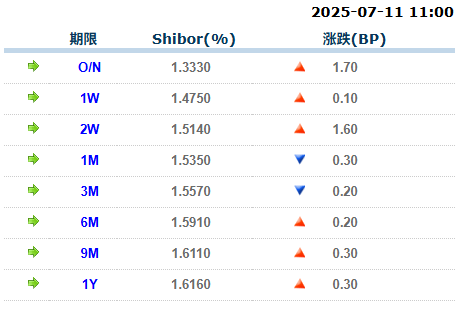
Monetary Policy Operations - The People's Bank of China conducted a 847 billion yuan reverse repurchase operation with a rate of 1.40%, maintaining the previous level; with 340 billion yuan of reverse repos maturing, the net injection was 507 billion yuan [1] - This week, the central bank performed a total of 4,257 billion yuan in reverse repos, with 6,522 billion yuan maturing, resulting in a net withdrawal of 2,265 billion yuan [1] Interbank Rates - The Shanghai Interbank Offered Rate (Shibor) showed low volatility; overnight Shibor rose by 1.70 basis points to 1.3330%, while the 7-day Shibor increased by 0.10 basis points to 1.4750%, and the 14-day Shibor went up by 1.60 basis points to 1.5140% [1][2] - The short-term funding rates in the interbank pledged repo market exhibited mixed movements; DR001 and R001 weighted average rates increased by 2.0 basis points and 1.7 basis points, respectively, while DR007 and R007 rates decreased by 2.3 basis points and 1.2 basis points [5] Market Conditions - The overall funding situation on July 11 was balanced, with non-bank entities being relatively loose while banks were tighter; overnight pledged rate certificates traded around 1.48%-1.50% [10] - A total of 120 interbank certificates were issued on July 11, with an actual issuance volume of 1,635.9 billion yuan; the primary market saw active trading with issuers raising prices [11] Financial Products and Regulations - The National Financial Regulatory Administration released the "Management Measures for the Appropriateness of Financial Institution Products," emphasizing the need for financial institutions to collect customer information responsibly and protect customer data [13] - As of the end of May, the balance of Shanghai's foreign and domestic currency loans was 12.73 trillion yuan, reflecting a year-on-year growth of 8.6%, while deposits reached 22.33 trillion yuan, up 5.7% year-on-year [14]
理财年中时点规模回吐:14家公司6月环比减少9500亿元,上半年增量回落至5300亿元
news flash· 2025-07-11 08:48
Group 1 - The total wealth management scale of the top 14 banks reached 22.96 trillion yuan by the end of June, a decrease of approximately 950 billion yuan compared to the end of May [1] - The growth of these institutions in the first half of the year narrowed to 530 billion yuan due to scale fluctuations in June [1] - The decline in scale in June was primarily due to a rapid loss of cash products, which decreased by over 550 billion yuan compared to the end of May and approximately 800 billion yuan since the beginning of the year [1] Group 2 - Looking ahead, the wealth management market is expected to see a rapid rebound in July, with an estimated recovery of over one trillion yuan [1]

银行理财首季减少8100亿 4月强势回升 存款搬家带来增量资金
Zheng Quan Shi Bao· 2025-04-24 22:33
Core Viewpoint - The banking wealth management market experienced a significant decline in scale at the end of Q1 2025, primarily due to various factors including adjustments in the bond market and seasonal financial management practices, but showed signs of recovery in April 2025 [1][2][4]. Group 1: Market Scale and Performance - As of the end of Q1 2025, the total scale of banking wealth management products was 29.14 trillion yuan, a decrease of approximately 810 billion yuan from the beginning of the year [1][2]. - The number of existing products in the market reached 40,600, an increase of 0.67% year-on-year, while the scale increased by 9.41% year-on-year [2]. - The decline in scale was primarily observed in March 2025, influenced by factors such as delayed expectations for interest rate cuts, the "seesaw" effect between stocks and bonds, and seasonal deposit assessments [2][3]. Group 2: Product Types and Trends - Fixed income products accounted for 97.22% of the total wealth management product scale, with a decline of approximately 820 billion yuan since the beginning of the year [3]. - Cash management products and non-cash pure bond products experienced the most significant reductions, with cash products decreasing by nearly 400 billion yuan in March alone [3]. - Conversely, equity products showed growth, with an increase of about 200 billion yuan, reaching a scale of approximately 80 billion yuan by the end of March [3]. Group 3: Recovery and Future Outlook - In April 2025, the wealth management scale rebounded, with an increase of approximately 320 billion yuan in the third week of April [4][5]. - The reduction in deposit rates by various banks is expected to drive more funds into wealth management products, as the average annualized yield for these products rose to 2.56% in March 2025 [5]. - The asset allocation in wealth management products showed a decline in cash and bank deposits, indicating a shift in investment strategies [5]. Group 4: Market Sentiment and Investment Strategies - The banking wealth management sector is currently benefiting from heightened risk aversion in the market, generating a total return of 206 billion yuan for investors in Q1 2025 [6]. - There is a growing concern regarding the short-term nature of funding sources for wealth management products, with a trend towards shorter product durations and a preference for low-risk products [6]. - Investment strategies are being adjusted to focus on risk management, with recommendations to prioritize deposits and short to medium-term credit bonds [7].